-
Articles/Ads
Article THE GRAND LODGE OF LIBERIA. ← Page 2 of 2 Article BRO. HUGHAN'S NEW WORK. Page 1 of 1 Article BRO. HUGHAN'S NEW WORK. Page 1 of 1 Article WATSON'S MS. OF THE "OLD CHARGES." Page 1 of 2 →
Note: This text has been automatically extracted via Optical Character Recognition (OCR) software.
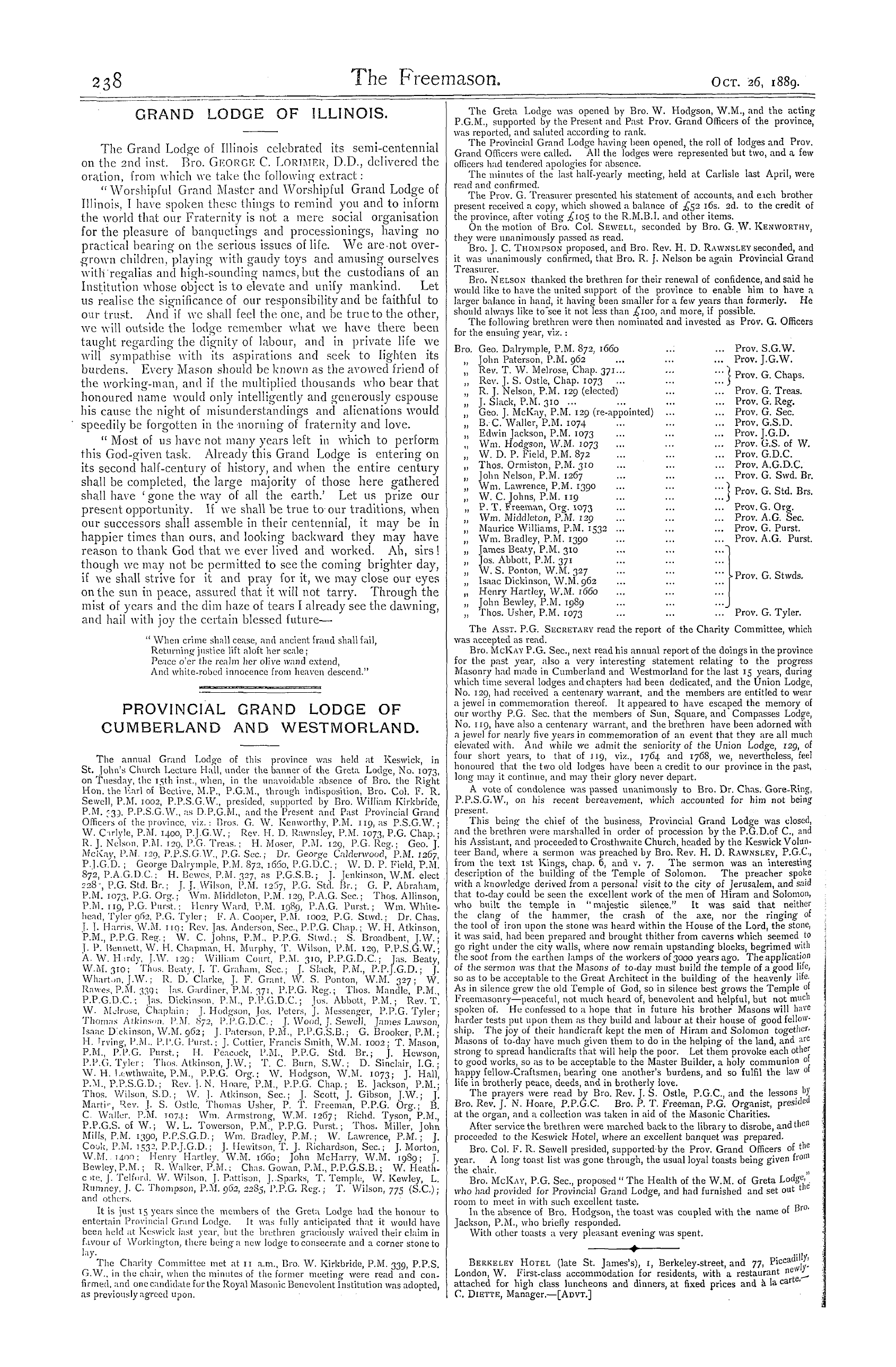
The Grand Lodge Of Liberia.
address , from which we gather that , in his opinion , though " all tilings have not worked together for our good , and some of our lodges have not been able to work out all the plans laid down on their trestleboard at the commencement of the year , our Order is still on the increase in this Republic , ancl the condition of the
lodges generally is flourishing . " On St . John the Evangelist ' s Day ( 27 th December ) there was a procession of Grand Lodge to Trinity Church , where a mixed Divine ancl Masonic service was held , the singing and prayers of the former being interspersed with a " Charge to Grand Officers , " the " Grand Honours , " the
"Grand Master ' s Address , " ancl an "Oration by Prof . A . B . KlNG " in somewhat high-flown language . Thus , Liberian Freemasonry appears to have about it most of the outward and visible signs of the Craft , while some of its observances are , to say the least , unusual among the earlier and more important branches of the
Society . To judge , however , from some of the business set down for transaction at this Annual Communication , our Liberian brethren ' s notions would seem to be crude , nor does there appear to be any great amount of energy or anxiety to determine the questions submitted for decision . Indeed , some of these questions
strike us as being somewhat peculiar to say the least of it . For instance , let us imagine the Grand Lodge of England , New York , or Pennsylvania being called upon to consider such a " business item" as "That Grand Secretary be assisted by the two Secretaries
of Oriental and St . John ' s Lodge of Monrovia , " and if we can bring ourselves to believe such a contingency possible , let us endeavour to picture to ourselves one of those Grand Lodges votino * that the item "be laid over until time indefinite . " The
following questions also were submitted , namely . ( 1 ) " Are Entered Apprentices and Fellow Craft Masons regarded as members of a lodge ? " and ( 2 ) " Can a lodge compell Entered Apprentices or
Fellow Craft Masons to pay monthly dues and Grand Lodge tax fees ? " ; and both of them were " voted to lie on the table for further consideration . " Still some amends were made for these crudities when a recommendation " That there be established a
Widow and Orphans' Fund in each and every of the subordinate lodges throughout the Republic , and that the annual amount contributed thereto by each member of the Craft be no less than one dollar , the said fund so accumulating in each lodge to be applied to the relief of the widows and orphans of its deceased
members , " was carried . Such a plan is not quite in accordance with our ideas in relation to this class of Fund or Institution , though it must be admitted that the payments to our Fund of Benevolence are compulsory ; but it is possible to excuse what is
crude and eccentric when we find the widows and orphans are well cared for . Later on , perhaps , we shall hear that the Craft in this African Republic has advanced still further on the road to prosperity .
Bro. Hughan's New Work.
BRO . HUGHAN'S NEW WORK .
FIRST NOTICE . We know as a matter of tact that whenever Bro . Hughan brings out a new book it means enough orders being placed in a few weeks to absorb the edition . It has been so with all the works that well-known writer has produced , for our experience extends back to his first issue in i 860 , the whole of which was
subscribed for prior to publication . A set of books of no other Masonic author of modern times fetches in the open market what Bro . Hughan ' s readily obtains , and there are always a number of collectors waiting for certain of the important series which are exceptionally scarce and valuable .
Of course , we would not presume to dictate to Bro . Hughan , but the time is surely come for second editions of such volumes as his "Constitutions of the Freemasons ( 1869 ); " " Old Charges of British Freemasons" ( 1872 ); and particularly the "Memorials
of the Masonic Union of 1813 " ( 18 74 ) . The present issue , which is now ready , will be gladly welcomed by the large circle of ordinary readers who desire to possess a succinct account of "York Masonry , " especially in relation to the Apollo Lodge , which had such an eventful career .
Its full title is as follows : " History of the Apollo Lodge , York , in relation to Craft and Royal Arch Masonry ; with brief sketches of its local predecessors and contemporaries ; the ' Grand Lodge of all England' ( York Masons ); The Provincial
Grand Lodge , and various lodges from 1705 to 1805 , by William James Hughan , author of " Origin of the English Rite of Freemasonry , " and numerous other works ; with valuable appendices . London : George Kenning , 16 , Great Queen-street , W . C ., 188 9 . " It will be seen that the author has undertaken a considerable
task , and , certainly , one few would like either to attempt or could possibly accomplish . We need hardly , say that Bro . Hughan has succeeded most admirably , and has written a history which may be fairly accepted as a model of its kind . It is not a narration of a number of uninteresting details , undigested and unexplained , but a careful reproduction of all
Bro. Hughan's New Work.
needful and desirable minutes and particulars concerning the wide subjectembracedbythe title , accompanied by accurate and invaluable information , tersely expressed and interestingly described with supplemental matter of considerable utility and significance . Wherever York Masonry is known and respected—and
where is it not ?—this work ought to travel , and have the opportunity of telling its deeply interesting tale , and prove the means of removing the widespread ignorance that still exists in many parts with respect to the doings of the " Grand Lodge of all England " held at York , its subordinates , and also its local rivals .
The handsome volume is divided into five chapters , the first of which deals with Masonry in what Bro . Hughan aptly terms the Masonic city of England from 1705 , not only as to the extinct Grand Lodge , but also in relation to an old lodge meeting at the Punch Bowl from 1761 , about which he furnishes not a few details which are quite new to most if not all of us .
Chapters 2 and 3 concern the "Apollo' Lodge , 1773 to 1805 , the revival of the Provincial Grand Lodge of N . and E . Yorkshire in 1771-4 , and lodges in that county under three Grand Lodges . An ancient hostelrie makes a curious recital , the interest being added to by the frontispiece , which reproduces
one of Cave's choicest pictures of that establishment—the noted " George Inn . " The fruitful topics of Masters' lodges , appointment of Deacons and other officers are duly examined ancl dealt with . " A Family of Organists , " " Numerous Presentations , " "Divulging Masonic Secrets / ' " The Antiquity Manifesto , "
" Early Initiation of a Lewis , " " Funeral of a Masonic Veteran , " " The Tyler ' s Obligation , " " Lodge Benevolence and Hospitality , " " Storm in a Tea-cup , " " Sermons and Festivals , " " Indiscreet Solicitations , " and " The Origin of the now Famous York Lodge " may be enumerated as a few of the many subjects alluded to in these two parts of the work .
To many students of our history , and assuredly all who are interested in the origin of Royal Arch Masonry , chapter iv will prove an especial boon and most welcome light on that subject . Bro . Hughan evidently leans to the view that this Degree was arranged about 20 years after the "Revival of 1717 , " and
considers existing evidence clearly points to its being worked so early as 1740 . He does not clear up the question , howeverdoubtless because he cannot—of its exact origin , and can only quote three p laces as the earliest known where the ceremony was practised , viz ., York , London , and Dublin .
So far the full solution of the problem appears to have been too much for Bro . Hughan , so we are quite content to leave it where he has , and we anticipate most of our readers will not only approve of our discretion but act in like manner . The author's reference to the noted " Ancients " tends to
suggest that they were not ancients , and beyond question he demonstrates the fact that they cannot be credited with the fabrication of the Royal Arch . Singular to state , the first minutes of a chapter ( or lodge ) yet traced of Royal Arch Masonry are to be found at York , and hence they are briefly described in the work ,
the period of the ceremony being absorbed by the then powerful Grand Lodge of all England being also noted . The " Five Degrees , " recognised at York by that body in 1779-80 , illustrate the fact that caution is necessary in fixing the date of orig in for
both the R . A . ancl K . T . Degrees . The Moderns ( started about 1765 ) chartered a subordinate at York , 1779 , and again in 1799 , about which Bro . Hughan relates many particulars , which are not only new , but also true , although hitherto terra incognita .
The last chapter refers mainly to the Phcenix Lodge at Hull , which was supposed to have continued the warrant on the collapse of the Apollo . We are bound to say that although evidence , accessible of late years , pointed in that direction , the fresh lig ht thrown on the subject in this volume has quite disproved such
a notion . Bro . Hughan reproduces several of the old warrants to support his position , and besides which in the appendix has printed much valuable information , adding much to the usefulness of the history , and to the author's labours in the compilation . The volume is dedicated by permission to Bro . the
Right Hon . the Earl of Zetland , Prov . G . M . of North ana East Yorkshire . Copies may be had from the author or publisher ( see advertisement ) , and we would advise English brethren who desire to possess the volume to lose no time in applying for ' '> as the edition is a very small one—much too small in our opinion
Watson's Ms. Of The "Old Charges."
WATSON'S MS . OF THE "OLD CHARGES . "
As announced in the Freemason , of October 5 th , an 0 l Manuscript has been traced , and , out of compliment to its own . ¦ I propose to call it Watson's MS . It came into possession Bro . Thomas Millican Watson , of Sunderland , quite recently , ^
purchase , from a non-Mason , who states that his gran" ^ was a member of the " Mystic Tie . " Its history , therefore , ^ respects its custody prior to this century , is obscure , as vvlt'l . aS of the old MSS ., though it is quite probable that the Scroll







Note: This text has been automatically extracted via Optical Character Recognition (OCR) software.
The Grand Lodge Of Liberia.
address , from which we gather that , in his opinion , though " all tilings have not worked together for our good , and some of our lodges have not been able to work out all the plans laid down on their trestleboard at the commencement of the year , our Order is still on the increase in this Republic , ancl the condition of the
lodges generally is flourishing . " On St . John the Evangelist ' s Day ( 27 th December ) there was a procession of Grand Lodge to Trinity Church , where a mixed Divine ancl Masonic service was held , the singing and prayers of the former being interspersed with a " Charge to Grand Officers , " the " Grand Honours , " the
"Grand Master ' s Address , " ancl an "Oration by Prof . A . B . KlNG " in somewhat high-flown language . Thus , Liberian Freemasonry appears to have about it most of the outward and visible signs of the Craft , while some of its observances are , to say the least , unusual among the earlier and more important branches of the
Society . To judge , however , from some of the business set down for transaction at this Annual Communication , our Liberian brethren ' s notions would seem to be crude , nor does there appear to be any great amount of energy or anxiety to determine the questions submitted for decision . Indeed , some of these questions
strike us as being somewhat peculiar to say the least of it . For instance , let us imagine the Grand Lodge of England , New York , or Pennsylvania being called upon to consider such a " business item" as "That Grand Secretary be assisted by the two Secretaries
of Oriental and St . John ' s Lodge of Monrovia , " and if we can bring ourselves to believe such a contingency possible , let us endeavour to picture to ourselves one of those Grand Lodges votino * that the item "be laid over until time indefinite . " The
following questions also were submitted , namely . ( 1 ) " Are Entered Apprentices and Fellow Craft Masons regarded as members of a lodge ? " and ( 2 ) " Can a lodge compell Entered Apprentices or
Fellow Craft Masons to pay monthly dues and Grand Lodge tax fees ? " ; and both of them were " voted to lie on the table for further consideration . " Still some amends were made for these crudities when a recommendation " That there be established a
Widow and Orphans' Fund in each and every of the subordinate lodges throughout the Republic , and that the annual amount contributed thereto by each member of the Craft be no less than one dollar , the said fund so accumulating in each lodge to be applied to the relief of the widows and orphans of its deceased
members , " was carried . Such a plan is not quite in accordance with our ideas in relation to this class of Fund or Institution , though it must be admitted that the payments to our Fund of Benevolence are compulsory ; but it is possible to excuse what is
crude and eccentric when we find the widows and orphans are well cared for . Later on , perhaps , we shall hear that the Craft in this African Republic has advanced still further on the road to prosperity .
Bro. Hughan's New Work.
BRO . HUGHAN'S NEW WORK .
FIRST NOTICE . We know as a matter of tact that whenever Bro . Hughan brings out a new book it means enough orders being placed in a few weeks to absorb the edition . It has been so with all the works that well-known writer has produced , for our experience extends back to his first issue in i 860 , the whole of which was
subscribed for prior to publication . A set of books of no other Masonic author of modern times fetches in the open market what Bro . Hughan ' s readily obtains , and there are always a number of collectors waiting for certain of the important series which are exceptionally scarce and valuable .
Of course , we would not presume to dictate to Bro . Hughan , but the time is surely come for second editions of such volumes as his "Constitutions of the Freemasons ( 1869 ); " " Old Charges of British Freemasons" ( 1872 ); and particularly the "Memorials
of the Masonic Union of 1813 " ( 18 74 ) . The present issue , which is now ready , will be gladly welcomed by the large circle of ordinary readers who desire to possess a succinct account of "York Masonry , " especially in relation to the Apollo Lodge , which had such an eventful career .
Its full title is as follows : " History of the Apollo Lodge , York , in relation to Craft and Royal Arch Masonry ; with brief sketches of its local predecessors and contemporaries ; the ' Grand Lodge of all England' ( York Masons ); The Provincial
Grand Lodge , and various lodges from 1705 to 1805 , by William James Hughan , author of " Origin of the English Rite of Freemasonry , " and numerous other works ; with valuable appendices . London : George Kenning , 16 , Great Queen-street , W . C ., 188 9 . " It will be seen that the author has undertaken a considerable
task , and , certainly , one few would like either to attempt or could possibly accomplish . We need hardly , say that Bro . Hughan has succeeded most admirably , and has written a history which may be fairly accepted as a model of its kind . It is not a narration of a number of uninteresting details , undigested and unexplained , but a careful reproduction of all
Bro. Hughan's New Work.
needful and desirable minutes and particulars concerning the wide subjectembracedbythe title , accompanied by accurate and invaluable information , tersely expressed and interestingly described with supplemental matter of considerable utility and significance . Wherever York Masonry is known and respected—and
where is it not ?—this work ought to travel , and have the opportunity of telling its deeply interesting tale , and prove the means of removing the widespread ignorance that still exists in many parts with respect to the doings of the " Grand Lodge of all England " held at York , its subordinates , and also its local rivals .
The handsome volume is divided into five chapters , the first of which deals with Masonry in what Bro . Hughan aptly terms the Masonic city of England from 1705 , not only as to the extinct Grand Lodge , but also in relation to an old lodge meeting at the Punch Bowl from 1761 , about which he furnishes not a few details which are quite new to most if not all of us .
Chapters 2 and 3 concern the "Apollo' Lodge , 1773 to 1805 , the revival of the Provincial Grand Lodge of N . and E . Yorkshire in 1771-4 , and lodges in that county under three Grand Lodges . An ancient hostelrie makes a curious recital , the interest being added to by the frontispiece , which reproduces
one of Cave's choicest pictures of that establishment—the noted " George Inn . " The fruitful topics of Masters' lodges , appointment of Deacons and other officers are duly examined ancl dealt with . " A Family of Organists , " " Numerous Presentations , " "Divulging Masonic Secrets / ' " The Antiquity Manifesto , "
" Early Initiation of a Lewis , " " Funeral of a Masonic Veteran , " " The Tyler ' s Obligation , " " Lodge Benevolence and Hospitality , " " Storm in a Tea-cup , " " Sermons and Festivals , " " Indiscreet Solicitations , " and " The Origin of the now Famous York Lodge " may be enumerated as a few of the many subjects alluded to in these two parts of the work .
To many students of our history , and assuredly all who are interested in the origin of Royal Arch Masonry , chapter iv will prove an especial boon and most welcome light on that subject . Bro . Hughan evidently leans to the view that this Degree was arranged about 20 years after the "Revival of 1717 , " and
considers existing evidence clearly points to its being worked so early as 1740 . He does not clear up the question , howeverdoubtless because he cannot—of its exact origin , and can only quote three p laces as the earliest known where the ceremony was practised , viz ., York , London , and Dublin .
So far the full solution of the problem appears to have been too much for Bro . Hughan , so we are quite content to leave it where he has , and we anticipate most of our readers will not only approve of our discretion but act in like manner . The author's reference to the noted " Ancients " tends to
suggest that they were not ancients , and beyond question he demonstrates the fact that they cannot be credited with the fabrication of the Royal Arch . Singular to state , the first minutes of a chapter ( or lodge ) yet traced of Royal Arch Masonry are to be found at York , and hence they are briefly described in the work ,
the period of the ceremony being absorbed by the then powerful Grand Lodge of all England being also noted . The " Five Degrees , " recognised at York by that body in 1779-80 , illustrate the fact that caution is necessary in fixing the date of orig in for
both the R . A . ancl K . T . Degrees . The Moderns ( started about 1765 ) chartered a subordinate at York , 1779 , and again in 1799 , about which Bro . Hughan relates many particulars , which are not only new , but also true , although hitherto terra incognita .
The last chapter refers mainly to the Phcenix Lodge at Hull , which was supposed to have continued the warrant on the collapse of the Apollo . We are bound to say that although evidence , accessible of late years , pointed in that direction , the fresh lig ht thrown on the subject in this volume has quite disproved such
a notion . Bro . Hughan reproduces several of the old warrants to support his position , and besides which in the appendix has printed much valuable information , adding much to the usefulness of the history , and to the author's labours in the compilation . The volume is dedicated by permission to Bro . the
Right Hon . the Earl of Zetland , Prov . G . M . of North ana East Yorkshire . Copies may be had from the author or publisher ( see advertisement ) , and we would advise English brethren who desire to possess the volume to lose no time in applying for ' '> as the edition is a very small one—much too small in our opinion
Watson's Ms. Of The "Old Charges."
WATSON'S MS . OF THE "OLD CHARGES . "
As announced in the Freemason , of October 5 th , an 0 l Manuscript has been traced , and , out of compliment to its own . ¦ I propose to call it Watson's MS . It came into possession Bro . Thomas Millican Watson , of Sunderland , quite recently , ^
purchase , from a non-Mason , who states that his gran" ^ was a member of the " Mystic Tie . " Its history , therefore , ^ respects its custody prior to this century , is obscure , as vvlt'l . aS of the old MSS ., though it is quite probable that the Scroll