-
Articles/Ads
Article Correspondence. Page 1 of 1 Article BOARD OF BENEVOLENCE. Page 1 of 1 Article ORATION ON THE NATURE AND PRINCIPLES OF FREEMASONRY. Page 1 of 1 Article ORATION ON THE NATURE AND PRINCIPLES OF FREEMASONRY. Page 1 of 1
Note: This text has been automatically extracted via Optical Character Recognition (OCR) software.
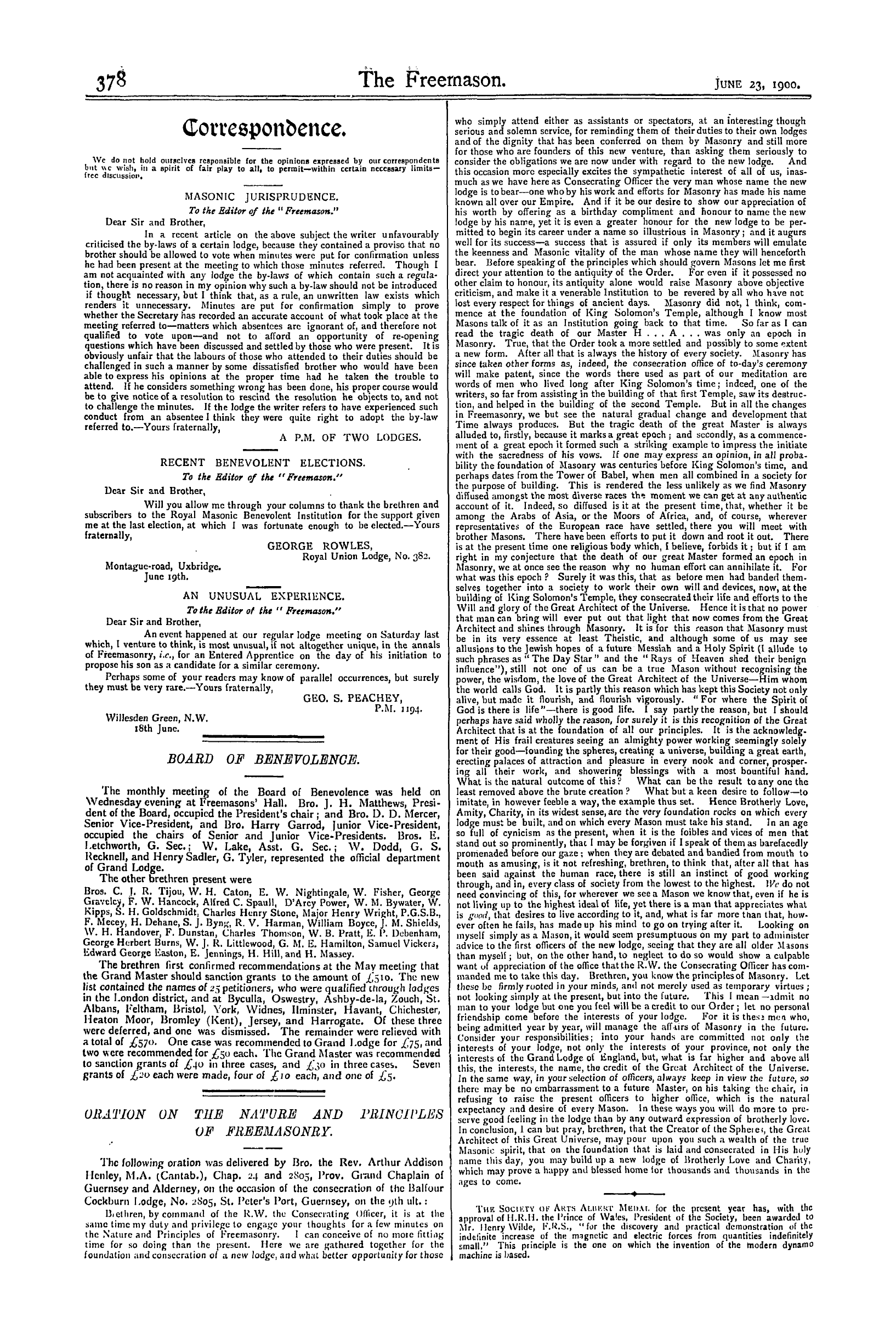
Correspondence.
Correspondence .
We do not hold ourselves responsible for the opinions expressed by our correspondents but wc wish , in a spirit of fair play to all , to permit—within certain necessary limitsfree discussion .
MASONIC JURISPRUDENCE . To the Editor of the " Freemason . " Dear Sir and Brother , In a recent article on the above subject the writer unfavourably criticised the by-laws of a certain lodge , because they contained a proviso that no brother should be allowed to vote when minutes were put for confirmation unless
he had been present at the meeting to which those minutes referred . Though I am not acquainted with any lodge the by-laws of which contain such a regulation , there is no reason in my opinion why such a by-law should not be introduced if thought necessary , but I think that , as a rule , an unwritten law exists which renders it unnecessary . Minutes are put for confirmation simply to prove whether the Secretary has recorded an accurate account of what took place at the
meeting referred to—matters which absentees are ignorant of , and therefore not qualified to vote upon—and not to afford an opportunity of re-opening questions which have been discussed and settled by those who were present . It is obviously unfair that the labours of those who attended to their duties should be challenged in such a manner by some dissatisfied brother who would have been
able to express his opinions at the proper time had he taken the trouble to attend . If he considers something wrong has been done , his proper course would be to give notice of a resolution to rescind the resolution he objects to , and not to challenge the minutes . If the lodge the writer refers to have experienced such conduct from an absentee I think they were quite right to adopt the by-law referred to . —Yours fraternally , A P . M . OF TWO LODGES .
RECENT BENEVOLENT ELECTIONS . To the Editor of the "Freemason . " Dear Sir and Brother , Will you allow me through your columns to thank the brethren and subscribers to the Royal Masonic Benevolent Institution for the support given me at the last election , at which I was fortunate enough to be elected . —Yours fraternally ,
GEORGE ROWLES , Royal Union Lodge , No . 3 8 Montague-road , Uxbridge . June ioth .
AN UNUSUAL EXPERIENCE . Tothe Editor ot the " Freemason . " Dear Sir and Brother , An event happened at our regular lodge meeting on Saturday last which , I venture to think , is most unusual , if not altogether unique , in the annals of Freemasonry , i . e ., ( or an Entered Apprentice on the day of his initiation to propose his son as a candidate for a similar ceremony .
Perhaps some of your readers may know of parallel occurrences , but surely they must be very rare . —Yours fraternally , GEO . S . PEACHEY , P . M . 1194 . Willesden Green , N . W . 18 th June .
Board Of Benevolence.
BOARD OF BENEVOLENCE .
The monthly meeting of the Board of Benevolence was held on Wednesday evening at Freemasons' Hall . Bro . J . H . Matthews , President of the Board , occupied the President ' s chair ; and Bro . D . D . Mercer , Senior Vice-President , and Bro . Harry Garrod , Junior Vice-President , occupied the chairs of Senior and Junior Vice-Presidents . Bros . E . Letchworth , G . Sec ; W . Lake , Asst . G . Sec ; W . Dodd , G . S . Recknell , and Henry Sadler , G . Tyler , represented the official department of Grand Lodge . The other brethren present were
Bros . C . J . R . Tijou , W . H . Caton , E . W . Nightingale , W . Fisher , George Gravck ? , F . W . Hancock , Alfred C . Spaull , D'Arcy Power , W . M . Bywater , W . Kipps , S . H . Goldschmidt , Charles Henry Stone , Major Henry Wright , P . G . S . B ., F . Mecey , H . Dehane , S . J . Byng , R . V . Harman , William Boyce , J . M . Shields , W . H . Handover , F . Dunstan , Charles Thomson , W . B . Pratt , E . P . Debenham , George Herbert Burns , W . J . R . Littlewood , G . M . E . Hamilton , Samuel Vickers , Edward George Easton , E . Jennings , H . Hill , and H . Massey .
The brethren first confirmed recommendations at the May meeting that the Grand Master should sanction grants to the amount of i . 510 . Thc new list contained the names of 25 petitioners , who were qualified through lodges in the London district , and at BycuIIa , Oswestry , Ashby-de-la , Zouch , St . Albans , Feltham , Bristol , York , Widnes , Ilminster , Havant , Chichester ,
Heaton Moor , Bromley ( Kent ) , Jersey , and Harrogate . Of these three were deferred , and one was dismissed . The remainder were relieved with a total of ^ 570 . One case was recommended to Grand Lodge for £ 75 , and two were recommended for £ 50 each . Thc Grand Master was recommended to sanction grants of . £ 40 in three cases , and £ 30 in three cases . Seven grants of £ 20 each were made , four of £ 10 each , and one oi £ 5 .
Oration On The Nature And Principles Of Freemasonry.
ORATION ON THE NATURE AND PRINCIPLES OF FREEMASONRY .
The following oration was delivered by Bro . the Rev . Arthur Addison Henley , M . A . ( Cantab . ) , Chap . 24 and 2805 , Prov . Grand Chaplain of Guernsey and Alderney , 011 the occasion of the consecration of the Balfour Cockburn Lodge , No . - ' 805 , St . Peter ' s Port , Guernsey , on the ijth ult . . *
Biethren , by command of the R . W . the Consecrating Officer , it is at the same time my duty and privilege to engage your thoughts for a few minutes on the Nature and Principles of Freemasonry . 1 can conceive of no moie fitting time for so doing than the present . Mere we are gathered together for the foundation and consecration of a new lodge , and what better opportunity for those
Oration On The Nature And Principles Of Freemasonry.
who simply attend either as assistants or spectators , at an interesting though serious and solemn service , for reminding them of their duties to their own lodges and of the dignity that has been conferred on them by Masonry and still more for those who are founders of this new venture , than asking them seriously to consider the obligations we are now under with regard to the new lodge . And this occasion more especially excites the sympathetic interest of all of us , inasmuch as we have here as Consecrating Officer the very man whose name the new
lodge is to bear—one who by his work and efforts for Masonry has made his name known all over our Empire . And if it be our desire to show our appreciation of his worth by offering as a birthday compliment and honour to name the new lodge by his name , yet it is even a greater honour for the new lodge to be permitted to begin its career under a name so illustrious in Masonry ; and it augurs well for its success—a success that is assured if only its members will emulate the keenness and Masonic vitality of the man whose name they will henceforth
bear . Before speaking of the principles which should govern Masons let me first direct your attention to the antiquity of the Order . For even if it possessed no other claim to honour , its antiquity alone would raise Masonry above objective criticism , and make it a venerable Institution to be revered by all who have not lost every respect for things of ancient days . Masonry did not , I think , commence at the foundation of King Solomon ' s Temple , although I know most Masons talk of it as an Institution going back to that time . So far as I can
read the tragic death of our Master H . . . A . . . was only an epoch in Masonry . True , that the Order took a more settled and possibly to some extent a new form . After all that is always the history of every society . Masonry has since taken other forms as , indeed , the consecration office of to-day's ceremony will make patent , since the words there used as part of our meditation are words of men who lived long after King Solomon's time ; indeed , one of the writers , so far from assisting in the building of that first Temple , saw its
destruction , and helped in the building of the second Temple . But in all the changes in Freemasonry , we but see the natural gradual change and development that Time always produces . But the tragic death of the great Master is always alluded to , firstly , because it marks a great epoch and secondly , as a commencement of a great epoch it formed such a striking example to impress the initiate with the sacredness of his vows . If one may express an opinion , in all probability the foundation of Masonry was centuries before King Solomon ' s time , and
perhaps dates from the Tower of Babel , when men all combined in a society for the purpose of building . This is rendered the less unlikely as we find Masonry diffused amongst the most diverse races th-: moment we can get at any authentic account of it . Indeed , so diffused is it at the present time , that , whether it be among the Arabs of Asia , or the Moors of Africa , and , of course , wherever representatives of the European race have settled , there you will meet with brother Masons . There have been efforts to put it down and root it out . There
is at the present time one religious body which , 1 believe , forbids it ; but if I am right in my conjecture that the death of our great Master formed an epoch in Masonry , we at once see the reason why no human effort can annihilate it . For what was this epoch ? Surely it was this , that as before men had banded themselves together into a society to work their own will and devices , now , at the building of King Solomon ' s Temple , they consecrated their life and efforts to the Will and glory of the Great Architect of the Universe . Hence it is that no power
that man can bring will ever put out that light that now comes from the Great Architect and shines through Masonry . It is for this reason that Masonry must be in its very essence at least Theistic , and although some of us may see allusions to the J ewish hopes of a future Messiah and a Holy Spirit ( I allude to such phrases as " The Day Star " and the " Rays of Heaven shed their benign influence" ) , still not one of us can be a true Mason without recognising the power , the wisdom , the love of the Great Architect of the Universe—Him whom
the world calls God . It is partly this reason which has kept this Society not only alive , but made it flourish , and flourish vigorously . " For where the Spirit of God is there is life" —there is good life . I say partly the reason , but I should perhaps have said wholly the reason , for surely it is this recognition of the Great Architect that is at the foundation of all our principles . It is the acknowledgment of His frail creatures seeing an almighty power working seemingly solely for their good—founding the spheres , creating a universe , building a great earth ,
erecting palaces of attraction and pleasure in every nook and corner , prospering all their work , and showering blessings with a most bountiful hand . What is the natural outcome of this ? What can be the result to any one the least removed above the brute creation ? What but a keen desire to follow—to imitate , in however feeble a way , the example thus set . Hence Brotherly Love , Amity , Charity , in its widest sense , are the very foundation rocks on which every lodge must be built , and on which every Mason must take his stand . In an age
so full of cynicism as the present , when it is the foibles and vices of men that stand out so prominently , that I may be forgiven if I speak of them as barefacedly promenaded before our gaze ; when they are debated and bandied from mouth to mouth as amusing , is it not refreshing , brethren , to think that , after all that has been said against the human race , there is still an instinct of good working through , and in , every class of society from the lowest to the highest . Wc do not need convincing of this , for wherever we see a Mason we know that , even if he is
not living up to the highest ideal of life , yet there is a man that appreciates what is good , that desires to live according to it , and , what is far more than that , however often he fails , has made up his mind to go on trying after it . Looking on myself simply as a Mason , it would seem presumptuous on my part to administer advice to the first officers of the new lodge , seeing that they are all older Masons than myself ; but , on the other hand , to neglect to do so would show a culpable want of appreciation of the office that the R . W . the Consecrating Officer has
commanded me to take this day . Brethren , you know the principles of Masonry . Let these be firmly rooted in your minds , and not merely used as temporary virtues ; not looking simply at the present , but into the future . This I mean —admit no man to your lodge but one you feel will be a credit to our Order ; let no personal friendship come before the interests of your lodge . For it is thes ; men who , being admitted year by year , will manage the affairs of Masonry in the future . Consider your responsibilities ; into your hands are committed not only the
interests of your lodge , not only the interests of your province , not only thc interests of the Grand Lodge of England , but , what is far higher and above all this , the interests , the name , tha credit of the Great Architect of the Universe . In the same way , in your selection of officers , always keep in view the future , so there may be no embarrassment to a future Master , on his taking the chair , in refusing to raise the present ofiicers to higher ofiice , which is the natural
expectancy and desire of every Mason . In these ways you will do more to preserve good feeling in the lodge than by any outward expression of brotherly love . In conclusion , 1 can but pray , brethren , that the Creator of the Spheiei , the Great Architect of this Great Universe , may pour upon you such a wealth of the true Masonic spirit , that on the foundation that is laid and consecrated in His holy name this day , you may build up a new lodge of Brotherly Love and Charity , which may prove a happy and blessed home ( or thousands and thousands in the
ages to come . ? THK SOCIKTV OK AKTS Ai . iii' . ia * Muiui . for thc present year has , with thc approval of H . R . H . the Prince of Wales , President of the Society , been awarded to Mr . Henry Wilde , E . R . S ., "for the discovery and practical demonstration ofthe indefinite increase of the magnetic and electric forces from quantities indefinitely small . " This principle is the one on which the invention of the modern dynamo machine is based .






Note: This text has been automatically extracted via Optical Character Recognition (OCR) software.
Correspondence.
Correspondence .
We do not hold ourselves responsible for the opinions expressed by our correspondents but wc wish , in a spirit of fair play to all , to permit—within certain necessary limitsfree discussion .
MASONIC JURISPRUDENCE . To the Editor of the " Freemason . " Dear Sir and Brother , In a recent article on the above subject the writer unfavourably criticised the by-laws of a certain lodge , because they contained a proviso that no brother should be allowed to vote when minutes were put for confirmation unless
he had been present at the meeting to which those minutes referred . Though I am not acquainted with any lodge the by-laws of which contain such a regulation , there is no reason in my opinion why such a by-law should not be introduced if thought necessary , but I think that , as a rule , an unwritten law exists which renders it unnecessary . Minutes are put for confirmation simply to prove whether the Secretary has recorded an accurate account of what took place at the
meeting referred to—matters which absentees are ignorant of , and therefore not qualified to vote upon—and not to afford an opportunity of re-opening questions which have been discussed and settled by those who were present . It is obviously unfair that the labours of those who attended to their duties should be challenged in such a manner by some dissatisfied brother who would have been
able to express his opinions at the proper time had he taken the trouble to attend . If he considers something wrong has been done , his proper course would be to give notice of a resolution to rescind the resolution he objects to , and not to challenge the minutes . If the lodge the writer refers to have experienced such conduct from an absentee I think they were quite right to adopt the by-law referred to . —Yours fraternally , A P . M . OF TWO LODGES .
RECENT BENEVOLENT ELECTIONS . To the Editor of the "Freemason . " Dear Sir and Brother , Will you allow me through your columns to thank the brethren and subscribers to the Royal Masonic Benevolent Institution for the support given me at the last election , at which I was fortunate enough to be elected . —Yours fraternally ,
GEORGE ROWLES , Royal Union Lodge , No . 3 8 Montague-road , Uxbridge . June ioth .
AN UNUSUAL EXPERIENCE . Tothe Editor ot the " Freemason . " Dear Sir and Brother , An event happened at our regular lodge meeting on Saturday last which , I venture to think , is most unusual , if not altogether unique , in the annals of Freemasonry , i . e ., ( or an Entered Apprentice on the day of his initiation to propose his son as a candidate for a similar ceremony .
Perhaps some of your readers may know of parallel occurrences , but surely they must be very rare . —Yours fraternally , GEO . S . PEACHEY , P . M . 1194 . Willesden Green , N . W . 18 th June .
Board Of Benevolence.
BOARD OF BENEVOLENCE .
The monthly meeting of the Board of Benevolence was held on Wednesday evening at Freemasons' Hall . Bro . J . H . Matthews , President of the Board , occupied the President ' s chair ; and Bro . D . D . Mercer , Senior Vice-President , and Bro . Harry Garrod , Junior Vice-President , occupied the chairs of Senior and Junior Vice-Presidents . Bros . E . Letchworth , G . Sec ; W . Lake , Asst . G . Sec ; W . Dodd , G . S . Recknell , and Henry Sadler , G . Tyler , represented the official department of Grand Lodge . The other brethren present were
Bros . C . J . R . Tijou , W . H . Caton , E . W . Nightingale , W . Fisher , George Gravck ? , F . W . Hancock , Alfred C . Spaull , D'Arcy Power , W . M . Bywater , W . Kipps , S . H . Goldschmidt , Charles Henry Stone , Major Henry Wright , P . G . S . B ., F . Mecey , H . Dehane , S . J . Byng , R . V . Harman , William Boyce , J . M . Shields , W . H . Handover , F . Dunstan , Charles Thomson , W . B . Pratt , E . P . Debenham , George Herbert Burns , W . J . R . Littlewood , G . M . E . Hamilton , Samuel Vickers , Edward George Easton , E . Jennings , H . Hill , and H . Massey .
The brethren first confirmed recommendations at the May meeting that the Grand Master should sanction grants to the amount of i . 510 . Thc new list contained the names of 25 petitioners , who were qualified through lodges in the London district , and at BycuIIa , Oswestry , Ashby-de-la , Zouch , St . Albans , Feltham , Bristol , York , Widnes , Ilminster , Havant , Chichester ,
Heaton Moor , Bromley ( Kent ) , Jersey , and Harrogate . Of these three were deferred , and one was dismissed . The remainder were relieved with a total of ^ 570 . One case was recommended to Grand Lodge for £ 75 , and two were recommended for £ 50 each . Thc Grand Master was recommended to sanction grants of . £ 40 in three cases , and £ 30 in three cases . Seven grants of £ 20 each were made , four of £ 10 each , and one oi £ 5 .
Oration On The Nature And Principles Of Freemasonry.
ORATION ON THE NATURE AND PRINCIPLES OF FREEMASONRY .
The following oration was delivered by Bro . the Rev . Arthur Addison Henley , M . A . ( Cantab . ) , Chap . 24 and 2805 , Prov . Grand Chaplain of Guernsey and Alderney , 011 the occasion of the consecration of the Balfour Cockburn Lodge , No . - ' 805 , St . Peter ' s Port , Guernsey , on the ijth ult . . *
Biethren , by command of the R . W . the Consecrating Officer , it is at the same time my duty and privilege to engage your thoughts for a few minutes on the Nature and Principles of Freemasonry . 1 can conceive of no moie fitting time for so doing than the present . Mere we are gathered together for the foundation and consecration of a new lodge , and what better opportunity for those
Oration On The Nature And Principles Of Freemasonry.
who simply attend either as assistants or spectators , at an interesting though serious and solemn service , for reminding them of their duties to their own lodges and of the dignity that has been conferred on them by Masonry and still more for those who are founders of this new venture , than asking them seriously to consider the obligations we are now under with regard to the new lodge . And this occasion more especially excites the sympathetic interest of all of us , inasmuch as we have here as Consecrating Officer the very man whose name the new
lodge is to bear—one who by his work and efforts for Masonry has made his name known all over our Empire . And if it be our desire to show our appreciation of his worth by offering as a birthday compliment and honour to name the new lodge by his name , yet it is even a greater honour for the new lodge to be permitted to begin its career under a name so illustrious in Masonry ; and it augurs well for its success—a success that is assured if only its members will emulate the keenness and Masonic vitality of the man whose name they will henceforth
bear . Before speaking of the principles which should govern Masons let me first direct your attention to the antiquity of the Order . For even if it possessed no other claim to honour , its antiquity alone would raise Masonry above objective criticism , and make it a venerable Institution to be revered by all who have not lost every respect for things of ancient days . Masonry did not , I think , commence at the foundation of King Solomon ' s Temple , although I know most Masons talk of it as an Institution going back to that time . So far as I can
read the tragic death of our Master H . . . A . . . was only an epoch in Masonry . True , that the Order took a more settled and possibly to some extent a new form . After all that is always the history of every society . Masonry has since taken other forms as , indeed , the consecration office of to-day's ceremony will make patent , since the words there used as part of our meditation are words of men who lived long after King Solomon's time ; indeed , one of the writers , so far from assisting in the building of that first Temple , saw its
destruction , and helped in the building of the second Temple . But in all the changes in Freemasonry , we but see the natural gradual change and development that Time always produces . But the tragic death of the great Master is always alluded to , firstly , because it marks a great epoch and secondly , as a commencement of a great epoch it formed such a striking example to impress the initiate with the sacredness of his vows . If one may express an opinion , in all probability the foundation of Masonry was centuries before King Solomon ' s time , and
perhaps dates from the Tower of Babel , when men all combined in a society for the purpose of building . This is rendered the less unlikely as we find Masonry diffused amongst the most diverse races th-: moment we can get at any authentic account of it . Indeed , so diffused is it at the present time , that , whether it be among the Arabs of Asia , or the Moors of Africa , and , of course , wherever representatives of the European race have settled , there you will meet with brother Masons . There have been efforts to put it down and root it out . There
is at the present time one religious body which , 1 believe , forbids it ; but if I am right in my conjecture that the death of our great Master formed an epoch in Masonry , we at once see the reason why no human effort can annihilate it . For what was this epoch ? Surely it was this , that as before men had banded themselves together into a society to work their own will and devices , now , at the building of King Solomon ' s Temple , they consecrated their life and efforts to the Will and glory of the Great Architect of the Universe . Hence it is that no power
that man can bring will ever put out that light that now comes from the Great Architect and shines through Masonry . It is for this reason that Masonry must be in its very essence at least Theistic , and although some of us may see allusions to the J ewish hopes of a future Messiah and a Holy Spirit ( I allude to such phrases as " The Day Star " and the " Rays of Heaven shed their benign influence" ) , still not one of us can be a true Mason without recognising the power , the wisdom , the love of the Great Architect of the Universe—Him whom
the world calls God . It is partly this reason which has kept this Society not only alive , but made it flourish , and flourish vigorously . " For where the Spirit of God is there is life" —there is good life . I say partly the reason , but I should perhaps have said wholly the reason , for surely it is this recognition of the Great Architect that is at the foundation of all our principles . It is the acknowledgment of His frail creatures seeing an almighty power working seemingly solely for their good—founding the spheres , creating a universe , building a great earth ,
erecting palaces of attraction and pleasure in every nook and corner , prospering all their work , and showering blessings with a most bountiful hand . What is the natural outcome of this ? What can be the result to any one the least removed above the brute creation ? What but a keen desire to follow—to imitate , in however feeble a way , the example thus set . Hence Brotherly Love , Amity , Charity , in its widest sense , are the very foundation rocks on which every lodge must be built , and on which every Mason must take his stand . In an age
so full of cynicism as the present , when it is the foibles and vices of men that stand out so prominently , that I may be forgiven if I speak of them as barefacedly promenaded before our gaze ; when they are debated and bandied from mouth to mouth as amusing , is it not refreshing , brethren , to think that , after all that has been said against the human race , there is still an instinct of good working through , and in , every class of society from the lowest to the highest . Wc do not need convincing of this , for wherever we see a Mason we know that , even if he is
not living up to the highest ideal of life , yet there is a man that appreciates what is good , that desires to live according to it , and , what is far more than that , however often he fails , has made up his mind to go on trying after it . Looking on myself simply as a Mason , it would seem presumptuous on my part to administer advice to the first officers of the new lodge , seeing that they are all older Masons than myself ; but , on the other hand , to neglect to do so would show a culpable want of appreciation of the office that the R . W . the Consecrating Officer has
commanded me to take this day . Brethren , you know the principles of Masonry . Let these be firmly rooted in your minds , and not merely used as temporary virtues ; not looking simply at the present , but into the future . This I mean —admit no man to your lodge but one you feel will be a credit to our Order ; let no personal friendship come before the interests of your lodge . For it is thes ; men who , being admitted year by year , will manage the affairs of Masonry in the future . Consider your responsibilities ; into your hands are committed not only the
interests of your lodge , not only the interests of your province , not only thc interests of the Grand Lodge of England , but , what is far higher and above all this , the interests , the name , tha credit of the Great Architect of the Universe . In the same way , in your selection of officers , always keep in view the future , so there may be no embarrassment to a future Master , on his taking the chair , in refusing to raise the present ofiicers to higher ofiice , which is the natural
expectancy and desire of every Mason . In these ways you will do more to preserve good feeling in the lodge than by any outward expression of brotherly love . In conclusion , 1 can but pray , brethren , that the Creator of the Spheiei , the Great Architect of this Great Universe , may pour upon you such a wealth of the true Masonic spirit , that on the foundation that is laid and consecrated in His holy name this day , you may build up a new lodge of Brotherly Love and Charity , which may prove a happy and blessed home ( or thousands and thousands in the
ages to come . ? THK SOCIKTV OK AKTS Ai . iii' . ia * Muiui . for thc present year has , with thc approval of H . R . H . the Prince of Wales , President of the Society , been awarded to Mr . Henry Wilde , E . R . S ., "for the discovery and practical demonstration ofthe indefinite increase of the magnetic and electric forces from quantities indefinitely small . " This principle is the one on which the invention of the modern dynamo machine is based .