-
Articles/Ads
Article MASONIC JURISPRUDENCE. ← Page 2 of 2 Article MASONIC JURISPRUDENCE. Page 2 of 2 Article MASONIC STATISTICS. Page 1 of 2 →
Note: This text has been automatically extracted via Optical Character Recognition (OCR) software.
Masonic Jurisprudence.
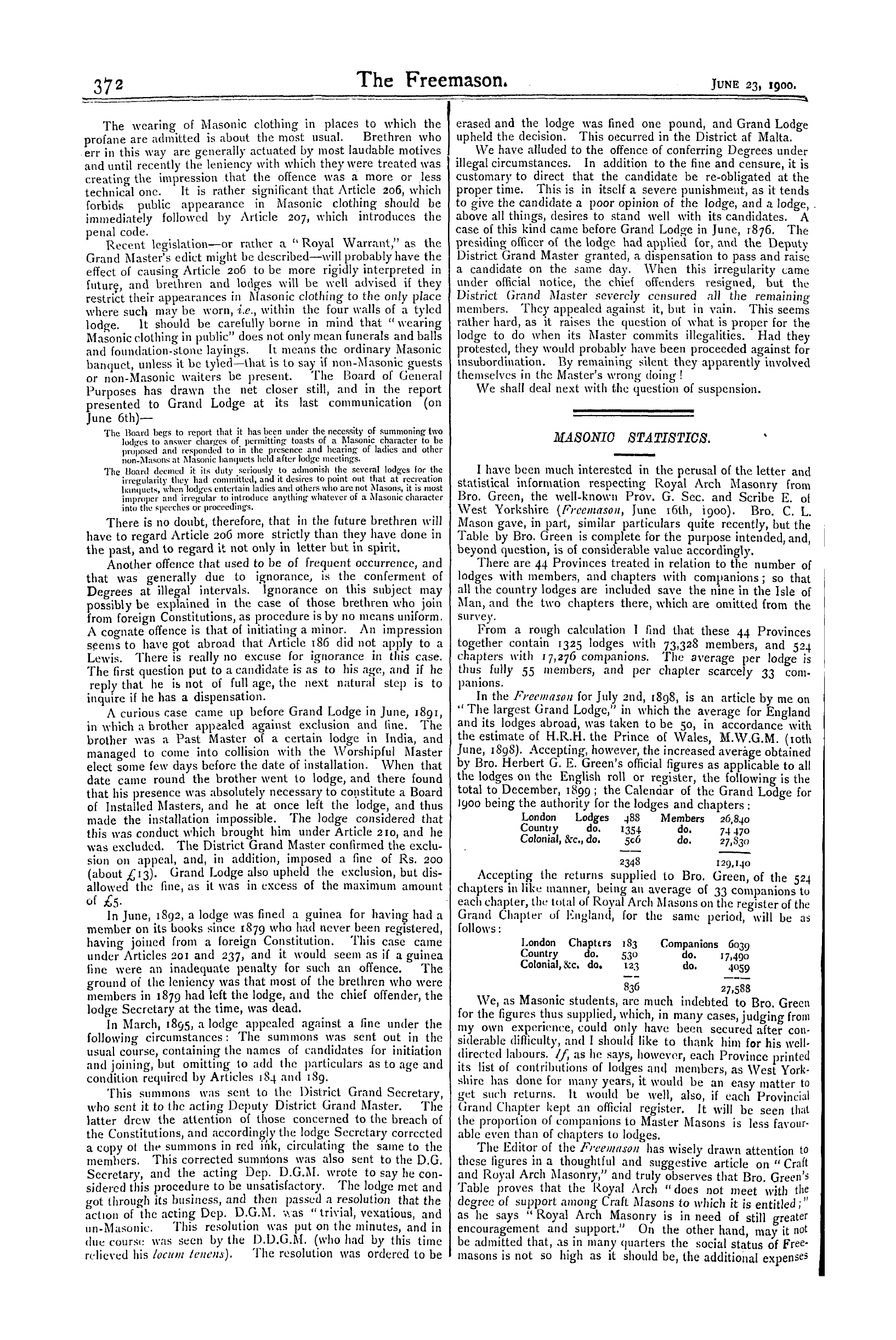
The wearing of Masonic clothing in places to which the profane are admitted is about the most usual . Brethren who err in this way are generally actuated by most laudable motives and until recently the leniency with which they were treated was
creatine the impression that the offence was a more or less technical one . It is rather significant that Article 206 , which forbids public appearance in Masonic clothing should be immediately followed by Article 207 , which introduces the penal code .
Recent legislation—or rather a " Royal Warrant , " as the Grand Master ' s edict mig ht be described—will probably have the effect of causing Article 206 to be more rigidly interpreted in future , and brethren and lodges will be well advised if they restrict their appearances in Masonic clothing to the only place
where such niay be worn , i . e ., within the four walls of a tyled lod ^ e . It should be carefully borne in mind that " wearing Masonic clothing in public" does not only mean funerals and balls and foundation-stone layings . It means the ordinary Masonic
banquet , unless it be tyled—that is to say if non-Masonic guests or non-Masonic waiters be present . The Board of General Purposes has drawn the net closer still , and in the report presented to Grand Lodge at its last communication ( on June 6
th)—The Board begs to report that it has been under thc necessity of summoning two lodges to answer charges of permitting toasts of a Masonic character to be proposed and responded to in the presence and hearing of ladies and other non-Masons at Masonic banquets held after lodge meetings .
The Hoard deemed it its duty seriously to admonish the several lodges for the irregularity they had committed , and it desires to point out that at recreation banquets , when lodges entertain ladies and others who are not Masons , it is most improper and irregular to introduce anything whatever of a Masonic character into the speeches or proceedings .
There is no doubt , therefore , that in the future brethren will have to regard Article 206 more strictly than they have done in the past , and to regard it not only in letter but in spirit . Another offence that used to be of frequent occurrence , and that was generally due to ignorance , is the conferment of
Degrees at illegal intervals . Ignorance on this subject may possibly be explained in the case of those brethren who join from foreign Constitutions , as procedure is by no means uniform . A cognate offence is that of initiating a minor . An impression
seems to have got abroad that Article 186 did not apply to a Lewis . There is really no excuse for ignorance in this case . The first question put to a candidate is as to his age , and if he reply that he is not of full age , thc next natural step is to inquire if he has a dispensation .
A curious case came up before Grand Lodge in June , 1891 , in which a brother appealed against exclusion and fine . The brother was a Past Master of a certain lodge in India , and managed to come into collision with the Worshipful Master elect some few days before the date of installation . When that
date came round the brother went to lodge , and there found that his presence was absolutely necessary to constitute a Board of Installed Masters , and he at once left the lodge , and thus made the installation impossible . The lodge considered that this was conduct which brought him under Article 210 , and he was excluded . The District Grand Master confirmed the
exclusion on appeal , and , in addition , imposed a fine of Rs . 200 ( about £ 13 ) . Grand Lodge also upheld the exclusion , but disallowed the fine , as it was in excess of the maximum amount of £ 5-In June , 1802 , a lodge was fined a guinea for having had a
member on its books since 18 79 who had never been registered , having joined from a foreign Constitution . This case came under Articles 201 and 237 , and it would seem as if a guinea
fine were an inadequate penalty for such an offence . The ground of the leniency was that most of the brethren who were members in 18 79 had left the lodge , and the chief offender , the lodge Secretary at the time , was dead .
In March , 18 95 , a lodge appealed against a fine under the following circumstances : The summons was sent out in the usual course , containing thc names of candidates for initiation and joining , but omitting to add the particulars as to age and condition required by Articles 18 4 and 18 9 .
This summons was sent to the District Grand Secretary , who sent it to thc acting Deputy District Grand Master . The latter drew the attention of those concerned to the breach of the Constitutions , and accordingly the lodge Secretary corrected a copy ot the summons in red ink , circulating the same to the
members . This corrected sumnions was also sent to the D . G , Secretary , and the acting Dep . D . G . M . wrote to say he considered this procedure to be unsatisfactory . The lodge met and wot through its business , and then passed a resolution that the
action of the acting Dep . D . G . M . was " trivial , vexatious , and un-Masonic . This resolution was put on the minutes , and in due course * was seen by the D . D . G . M . ( who had by this time relieved his locum tcnens ) . The resolution was ordered to be
Masonic Jurisprudence.
erased and the lodge was fined one pound , and Grand Lodge upheld the decision . This occurred in the District af Malta . We have alluded to the offence of conferring Degrees under illegal circumstances . In addition to the fine and censure , it is customary to direct that the candidate be re-obligated at the
proper time . This is in itself a severe punishment , as it tends to give the candidate a poor opinion of the lodge , and a lodge , above all things , desires to stand well with its candidates . A case of this kind came before Grand Lodge in June , 18 7 6 . The presiding officer of the lodge had applied for , and the Deputy
District Grand Master granted , a dispensation to pass and raise a candidate on the same day . When this irregularity came under official notice , the chief offenders resigned , but the District Grand Master severely censured all the remaining members . They appealed against it , but in vain . This seems
rather hard , as it raises the question of what is proper for the lodge to do when its Master commits illegalities . Had they protested , they would probably have been proceeded against for insubordination . By remaining silent they apparently involved themselves in the Master ' s wrong doing ! We shall deal next with the question of suspension .
Masonic Statistics.
MASONIC STATISTICS .
I have been much interested in the perusal of the letter and statistical information respecting Royal Arch Masonry from Bro . Green , the well-known Prov . G . Sec . and Scribe E . ol
west Yorkshire ( Freemason , June 16 th , 1900 ) . Bro . C . L . Mason gave , in part , similar particulars quite recently , but the Table by Bro . Green is complete for the purpose intended , and , beyond question , is of considerable value accordingly .
There are 44 Provinces treated in relation to the number of lodges with members , and chapters with companions ; so that all the country lodges are included save the nine in the Isle of Man , and the two chapters there , which are omitted from the
survey . From a rough calculation 1 find that these 44 Provinces together contain 1325 lodges with 73 , 328 members , and 524 chapters with 17 , 276 companions . The average per lodge is thus fully 55 members , and per chapter scarcel y 33
companions . In the Freemason for July 2 nd , 1898 , is an article by me on " The largest Grand Lodge , " in which the average for England and its lodges abroad , was taken to be 50 , in accordance with the estimate of H . R . H . the Prince of Wales , M . W . G . M . ( ioth
June , 18 9 S ) . Accepting , however , the increased average obtained by Bro . Herbert G . E . Green ' s official figures as applicable to all the lodges on the English roll or register , the following is the total to December , 18 99 ; the Calendar of the Grand Lodge for
1900 being the authority for the lodges and chapters : London Lodges 488 Members 26 , 840 Country do . 1354 do . 74470 Colonial , &* c , do . 506 do . 27 , 8-50
2348 129 , 140 Accepting the returns supplied to Bro . Green , of the 524 chapters in like manner , being an average of 33 companions to each chapter , the total of Royal Arch Masons on the register of the Grand Chapter of England , for the same period , will be as follows :
London Chapters 183 Companions 6039 Country do . 530 do . 17 , 490 Colonial , & c . do . 123 do . 4059
836 27 , 588 We , as Masonic students , are much indebted to Bro . Green for the figures thus supplied , which , in many cases , judging from my own experience , could only have been secured after considerable difficulty , and I should like to thank him for his
welldirected labours . // , as he says , however , each Province printed its list of contributions of lodges and members , as West Yorkshire has done for many years , it would be an easy matter to
get such returns . It would be well , also , if each Provincial Grand Chapter kept an official register . It will be seen that the proportion of companions to Master Masons is less favourable even than of chapters to lodges .
The Editor of the Freemason has wisely drawn attention to these figures in a thoughtful and suggestive article on " Craft and Royal Arch Masonry , " and truly observes that Bro . Green's Table proves that the Royal Arch "does not meet with the
degree of support among Craft Masons to which it is entitled , " as he says " Royal Arch Masonry is in need of still greater encouragement and support . " On the other hand , may it not be admitted that , as in many quarters the social status of Freemasons is not so high as it should be , the additional expenses






Note: This text has been automatically extracted via Optical Character Recognition (OCR) software.
Masonic Jurisprudence.
The wearing of Masonic clothing in places to which the profane are admitted is about the most usual . Brethren who err in this way are generally actuated by most laudable motives and until recently the leniency with which they were treated was
creatine the impression that the offence was a more or less technical one . It is rather significant that Article 206 , which forbids public appearance in Masonic clothing should be immediately followed by Article 207 , which introduces the penal code .
Recent legislation—or rather a " Royal Warrant , " as the Grand Master ' s edict mig ht be described—will probably have the effect of causing Article 206 to be more rigidly interpreted in future , and brethren and lodges will be well advised if they restrict their appearances in Masonic clothing to the only place
where such niay be worn , i . e ., within the four walls of a tyled lod ^ e . It should be carefully borne in mind that " wearing Masonic clothing in public" does not only mean funerals and balls and foundation-stone layings . It means the ordinary Masonic
banquet , unless it be tyled—that is to say if non-Masonic guests or non-Masonic waiters be present . The Board of General Purposes has drawn the net closer still , and in the report presented to Grand Lodge at its last communication ( on June 6
th)—The Board begs to report that it has been under thc necessity of summoning two lodges to answer charges of permitting toasts of a Masonic character to be proposed and responded to in the presence and hearing of ladies and other non-Masons at Masonic banquets held after lodge meetings .
The Hoard deemed it its duty seriously to admonish the several lodges for the irregularity they had committed , and it desires to point out that at recreation banquets , when lodges entertain ladies and others who are not Masons , it is most improper and irregular to introduce anything whatever of a Masonic character into the speeches or proceedings .
There is no doubt , therefore , that in the future brethren will have to regard Article 206 more strictly than they have done in the past , and to regard it not only in letter but in spirit . Another offence that used to be of frequent occurrence , and that was generally due to ignorance , is the conferment of
Degrees at illegal intervals . Ignorance on this subject may possibly be explained in the case of those brethren who join from foreign Constitutions , as procedure is by no means uniform . A cognate offence is that of initiating a minor . An impression
seems to have got abroad that Article 186 did not apply to a Lewis . There is really no excuse for ignorance in this case . The first question put to a candidate is as to his age , and if he reply that he is not of full age , thc next natural step is to inquire if he has a dispensation .
A curious case came up before Grand Lodge in June , 1891 , in which a brother appealed against exclusion and fine . The brother was a Past Master of a certain lodge in India , and managed to come into collision with the Worshipful Master elect some few days before the date of installation . When that
date came round the brother went to lodge , and there found that his presence was absolutely necessary to constitute a Board of Installed Masters , and he at once left the lodge , and thus made the installation impossible . The lodge considered that this was conduct which brought him under Article 210 , and he was excluded . The District Grand Master confirmed the
exclusion on appeal , and , in addition , imposed a fine of Rs . 200 ( about £ 13 ) . Grand Lodge also upheld the exclusion , but disallowed the fine , as it was in excess of the maximum amount of £ 5-In June , 1802 , a lodge was fined a guinea for having had a
member on its books since 18 79 who had never been registered , having joined from a foreign Constitution . This case came under Articles 201 and 237 , and it would seem as if a guinea
fine were an inadequate penalty for such an offence . The ground of the leniency was that most of the brethren who were members in 18 79 had left the lodge , and the chief offender , the lodge Secretary at the time , was dead .
In March , 18 95 , a lodge appealed against a fine under the following circumstances : The summons was sent out in the usual course , containing thc names of candidates for initiation and joining , but omitting to add the particulars as to age and condition required by Articles 18 4 and 18 9 .
This summons was sent to the District Grand Secretary , who sent it to thc acting Deputy District Grand Master . The latter drew the attention of those concerned to the breach of the Constitutions , and accordingly the lodge Secretary corrected a copy ot the summons in red ink , circulating the same to the
members . This corrected sumnions was also sent to the D . G , Secretary , and the acting Dep . D . G . M . wrote to say he considered this procedure to be unsatisfactory . The lodge met and wot through its business , and then passed a resolution that the
action of the acting Dep . D . G . M . was " trivial , vexatious , and un-Masonic . This resolution was put on the minutes , and in due course * was seen by the D . D . G . M . ( who had by this time relieved his locum tcnens ) . The resolution was ordered to be
Masonic Jurisprudence.
erased and the lodge was fined one pound , and Grand Lodge upheld the decision . This occurred in the District af Malta . We have alluded to the offence of conferring Degrees under illegal circumstances . In addition to the fine and censure , it is customary to direct that the candidate be re-obligated at the
proper time . This is in itself a severe punishment , as it tends to give the candidate a poor opinion of the lodge , and a lodge , above all things , desires to stand well with its candidates . A case of this kind came before Grand Lodge in June , 18 7 6 . The presiding officer of the lodge had applied for , and the Deputy
District Grand Master granted , a dispensation to pass and raise a candidate on the same day . When this irregularity came under official notice , the chief offenders resigned , but the District Grand Master severely censured all the remaining members . They appealed against it , but in vain . This seems
rather hard , as it raises the question of what is proper for the lodge to do when its Master commits illegalities . Had they protested , they would probably have been proceeded against for insubordination . By remaining silent they apparently involved themselves in the Master ' s wrong doing ! We shall deal next with the question of suspension .
Masonic Statistics.
MASONIC STATISTICS .
I have been much interested in the perusal of the letter and statistical information respecting Royal Arch Masonry from Bro . Green , the well-known Prov . G . Sec . and Scribe E . ol
west Yorkshire ( Freemason , June 16 th , 1900 ) . Bro . C . L . Mason gave , in part , similar particulars quite recently , but the Table by Bro . Green is complete for the purpose intended , and , beyond question , is of considerable value accordingly .
There are 44 Provinces treated in relation to the number of lodges with members , and chapters with companions ; so that all the country lodges are included save the nine in the Isle of Man , and the two chapters there , which are omitted from the
survey . From a rough calculation 1 find that these 44 Provinces together contain 1325 lodges with 73 , 328 members , and 524 chapters with 17 , 276 companions . The average per lodge is thus fully 55 members , and per chapter scarcel y 33
companions . In the Freemason for July 2 nd , 1898 , is an article by me on " The largest Grand Lodge , " in which the average for England and its lodges abroad , was taken to be 50 , in accordance with the estimate of H . R . H . the Prince of Wales , M . W . G . M . ( ioth
June , 18 9 S ) . Accepting , however , the increased average obtained by Bro . Herbert G . E . Green ' s official figures as applicable to all the lodges on the English roll or register , the following is the total to December , 18 99 ; the Calendar of the Grand Lodge for
1900 being the authority for the lodges and chapters : London Lodges 488 Members 26 , 840 Country do . 1354 do . 74470 Colonial , &* c , do . 506 do . 27 , 8-50
2348 129 , 140 Accepting the returns supplied to Bro . Green , of the 524 chapters in like manner , being an average of 33 companions to each chapter , the total of Royal Arch Masons on the register of the Grand Chapter of England , for the same period , will be as follows :
London Chapters 183 Companions 6039 Country do . 530 do . 17 , 490 Colonial , & c . do . 123 do . 4059
836 27 , 588 We , as Masonic students , are much indebted to Bro . Green for the figures thus supplied , which , in many cases , judging from my own experience , could only have been secured after considerable difficulty , and I should like to thank him for his
welldirected labours . // , as he says , however , each Province printed its list of contributions of lodges and members , as West Yorkshire has done for many years , it would be an easy matter to
get such returns . It would be well , also , if each Provincial Grand Chapter kept an official register . It will be seen that the proportion of companions to Master Masons is less favourable even than of chapters to lodges .
The Editor of the Freemason has wisely drawn attention to these figures in a thoughtful and suggestive article on " Craft and Royal Arch Masonry , " and truly observes that Bro . Green's Table proves that the Royal Arch "does not meet with the
degree of support among Craft Masons to which it is entitled , " as he says " Royal Arch Masonry is in need of still greater encouragement and support . " On the other hand , may it not be admitted that , as in many quarters the social status of Freemasons is not so high as it should be , the additional expenses