-
Articles/Ads
Article Science, Art, and the Drama. Page 1 of 1 Article Science, Art, and the Drama. Page 1 of 1 Article " REMINISCENCES " BY THE BANCROFTS Page 1 of 1 Article GREAT QUEEN-STREET THEATRE. Page 1 of 1 Ad Untitled Page 1 of 1
Note: This text has been automatically extracted via Optical Character Recognition (OCR) software.
Science, Art, And The Drama.
Science , Art , and the Drama .
HASHISH . Some years ago the Secretary of State for India asked the Governor-General to report on the production of hemp drugs in all the 13 different provinces of India . A commission was accordingly appointed ; we believe it has not yet finished its labours of visiting every province in rotation , for the purpose of obtaining rcliible informuion . The importance of this commission may not be quite understood by many in this country , simply
from the fact , lhat very little is known about the hemp drugs outside of the medical faculty . Here , hasish is generally known as a useful , though not much used , medicine ; but in many Eastern countries , it is known as one of the most potent and maddening intox ' cants , influencing the moral and social well-being of the people , to a degree , equal La , if not beyond , that of the opium habit itself . A few particulars regarding this somewhat
remarkable drug may not be uninteresting . Hashish , or Gunjah , is the native term applied to the dried flowering tops of the fern tie plants , " Cannabis indica " ( Indian Hemp ) , and from which the resin had not been removed . The " Cannabis indica , " cultivated in India , is now generally considered to be , botanically , the same with that of the " Cannibis sativa , " of European cultivation . Whilst , however , the two varieties—if they may be
so-calledagree thus externally , so that they are reckoned one and the same plant , they differ , to an enormous extent , in their medicinal activity , the hemp grown iu India being infinitely more powerful than that grown in Europe . This may , to a certain extent , be accounted for by difference in climate , in soil , and probably also , in cultivation ; for it is noticed that the plant grown , even in India , does not always exhibit the same medicinal activity ; that
grown on hig her altitudes , being generally more active tn an that grown on the lower slopes . The whole plant seems to be medicinally active , but the most potent principle is , undoubtedly , the resinous exudation from the leaves and branches . This resinous principle is called " churrus " while the entire plant , cutduringinllorescense , dried in thesunandpressed into bundles , is called " bang . " The methods for collecting tha resinous exudation
arc various , but all very crude and some . vhal filthy . One plan is by rubbing the tops of the plants when ripe , and from which the resin exudes , in minute drops , between the palms of the hand , the resin adhering to the hands , and from them it is afterwards scraped by means of a blunt knife . Anothcrplan is for men , clothed in leather , to brush quickly through the stalks of growing hemp , when the resin attaches itself to the leather , from which it is
afterwards scraped , as in the case of the hands . Sometimes the leather is dispensed with , and the coolies are sent through the hemp fields for the purpose of the resin attaching itself to th *; ir naked bodies . A favourite sweetmeat is obtained by making an infusion of the plant in hot water , to which butter or oil is added . The resin attaches itself to the melted butter or oil , and when evaporated is kneaded with flour and spices into cakes or
pastilles called " majune . " Simple infusions of the leaves and flowering tops are also made and drunk i . i many parts of India , by old and young alike , at some of their festivals . Like opium , however , hashish is chiefly used for smoking , and when thus used it is almost always in combination with tobacco , hirst aplug of tobacco is placed at the bottom of the bowl af the pipe , and on thc top of this a small piece of hashish , and over this again
a pitceof red-hot charcoal . Its first effect when thus used is one of intense txhilaration , almost amounting to delirium . The victim loses the power of thought , and will act in the most extravagant manner imaginable , alternately laughing , sinning , or dancing , all the lime believing himself to be acting rationally . The linglish derivation of the word hashish gives a terrible and too well-deserved significance in this connection . Hashish is the term used
for one who smokes " hashish , " and the plural of the word is " hashasin , from which our English word " assassin " is said to bc derived . Doubtless it is in this lirst stage ot hallucination and frenzy that most of the crimesand ihey havc been many—attributed lo the use of this drug have been committed ; for thc second is one of dreamy enjoyment , finally followed , if the dose has been full , by stupor so dense as almost to amount to a state of
catalepsy . It has been said lhat a fortnight ' s use of hashish will make its victim a complete slave to the habit , and its end , as in the case of opium , is degradation and ruin , physical , social , and moral . It is not easy to trace the early use of this drug , as its history is lost in obscurity . By many , the Nepanthes of Homer , which drowned all pain and sullering , is thought lo refer to this drug ; while Galenus seems to have
been well acquainted with ils narcotic power . It certainly was used in PciAi , in the Middle Ages , for the purpose of exciting thc pugnacity and fanaticism of the soldiers , during the wars of the Crusades , a purpose so success ! ul thai the warriors , under its influence , struck terror into the hearts of Mohammedans and Christians alike . It was introduced into this country , as a new narcotic , about 50 years ago , and is still a valuable
addition to materia nti'dica . One remarkable feature of hashish is that it entirely fails to produce the intoxicating effects in this country that it does 111 warmer climates . Whether this is due to differences of tcmp ; rament in the races , or the loss of some volatile principle in the drug , in the course of importation , has not yet been definitely settled . Like opium , the sale of hashish is taxed by the Indian Government , the revenue , however , derived hotn il being considerably less than that derived from opium .
STATE OF PAINTING UNDER KDWARD VI . Under a minor prince , ai d amidst religious struggles , we are not likely lo meet with much account of the arts . Nobody was at leisure to mind or record them . Yet the seeds sown by Henry Vlli . were not eradicated ; 1 Iolbein was still alive . As we have observed , hc was chosen to celebrate the institution of Bridewell . He drew the young king more than once after he came to the crown . Among ihe stores of old pictures at Somerset House was one painted on a long board , representing the head of Edward VI ., to be discerned only by the reflection of a cylindric mirror .
Science, Art, And The Drama.
On the side of the head was a landscape , not ill-done . There is reason to believe that when Somerset House was entirely taken down , from 1776 to 1784 , though orders were given tor the removal of what were then considered as the best pictures to the other palaces , many of considerable value were dispersed . On the frame of the picture we have described was written Gitlielmus pinxit . This is said to have meant Marc Willems ,
who was born at Antwerp about 1527 . Descamps says that Marc Willems was born at Malines , and not at Antwerp . He excelled chiefly in designs for stained glass and tapestry , and we may conclude that his works for both those materials were well known in England before his arrival and certainly short residence . He was reckoned to surpass his contemporaries in his manner and facility of composing . This picture is the sole evidence of
his having been in England . In his own town , Malines , he painted the decollation of St . John the Btptist , still extant in the church of St . Rombold , for which , too , he drew the story of Judith and Holofernes . When Philip ll . made his public entry into Mechlin in 154 . 9 Willems was employed to paint a triumphal arch , on which he represented the history of Dido . He made designs for most of the painters , glass painters , and arras
makers of his time , and died lamented in 1561 . Another picture of Edward VI . was in the collection of Charles I ., painted by Hans Hueet , of whom nolhing else is known . It was sold for £ 20 in the Civil War . There was another painter who lived at this time of whom is found an account in a MS . of Nicholas Hilliard , but no discovery has been made of his works . As this person is so much commended by a brother artist one may believe he had merit , and as the testimony may lead to further investigation we
shall give the extract in the author ' s own words : " Nevertheless , if a man be so induced by nature , and live in time of trouble , and under a government wherein arts be not esteemed , and himself but of small means , woe be unto him , as unto an untimely birth ; for of my own knowledge it hath made poor men poorer , as amongst others many that most rare English drawer of story works in black and white . ( To be continued . )
" Reminiscences " By The Bancrofts
" REMINISCENCES " BY THE BANCROFTS
In these interesting pages there are recorded the benefit offered to the eminent comedian , Compton , by his brother actor . Manchester insisted upon doing honour to him at the same time , and the result of the two entertainments was a purse of . £ 5000 . In London the play selected was " Money , " and the veteran Benjamin Webster , was prevailed upon to play his original part of Greaves . The Bancrofts , Ellen Terry , William Farren ,
Neville , Hare , Kendal , David James , and young Compton were in the cast . Webster was So , and very feeble . " As his cue approached , " says Bancroft , " he suddenly clung to me , in a terror-stricken way , and said , with emotion , ' Oh , my dear boy , where am I ? I ' m very frightened ; I don ' t remember what I have to do . ' " Bancroft put his arms round him and said , " It's all right , Mr . Webster ; you remember Mrs . Bancroft , don ' t
you ? " " Remember Marie ? Of course I do . " " Then , sir , have no fear , she will look after you directly you step upon the stage . " She did , and the dear old fellow came through the ordeal successfully . Perhaps one of the most dramatic incidents of Webster ' s latter days occurred at a theatrical dinner when he was in the chair—his last appearance in that capacity . When he rose to propose the first of the usual loyal toasts , to the astonishment of
all present , he said " Gentlemen , I give you the health of his Majesty the King . " Memory in old age has a curious way of blue-pencilling recent records and retaining the earlier recollections . How true are the following observations : " How soon the actor is forgotten ! He has need of present applause to reconcile him to the oblivion that surely follows . " "Not many years ago , " says Bancroft , " I wrote a little sketch for the purpose of
introducingloole s pleasant mutations of popular actors . It had been the deli ght of manyaclubsupperandmanyaprofessionalreunionto induce Toole togive his personal reminiscences of the Wigans , Benjamin Webster , the Keeleys , Macready , Phelps , Buckstone , and others , and everybody thought it would be immense to have him give them on the stage of his own theatre in Kingstreet . But the audience either did not know the men , or had forgotten
them ; probably not a third of them had ever heard of the Wigans , or little Keeley . Those few who did startled the others by their bursts of laughter . But the younger crowd , and most of the critics , were more bewildered than amused , as Toole turned over these leaves of the past . " Now if he had given us imitations of Arthur Roberts , Beerbohm Tree , Edward Terry , Bill Terriss , Henry Irving , Fred Leslie , and Dan Leno , there might have
been something 111 it . Perhaps the up-to-date gentleman was right . Crabbe has a churchyard line about decaying grave stones . " Memorials themselves , memorials need . " The young commentator might have heard of Compton , Webster , Buckstone , and K ° eley , but they were very dead to him ; just as the great actors of to-day will bt to a future generation , * and this is where the pathos of acting , as a profession , comes in .
Great Queen-Street Theatre.
GREAT QUEEN-STREET THEATRE .
Some little time ago , on iwo or threa occasions , we drew the attention of our readers to the progress towards completion of this pretty little new iheatre . It is a new theatre , for il has , Phiunix-like , arisen from the ashes of the dead-and-gone Novelty Theatre . By the kind courtesy of the manager and proprietor , Bro . W . S . Penley , we were able to pay it a visit a few evenings ago . Little of the old structure has been left , except
perhaps the bare outer walls . The ne . v Great Queen-street Theatre has been fined up with every care for its p : esent and Tuture patrons , which we trust will be very numerous . The fare just now provided is very attractive . " 1 he Lillie Ray of Sunshine " is a piece entirely suited to the capabilities of Mr . Penley , who , possessingagre . it fund of qnaint , dry humourrenders
, the character he undertakes most diverting . Wc will not give the details of the interesting story submitted to the audiencs . It will bs well worth their while if visitors will come and judge for themselves . , We look forward in the future for some dainty theatrical dishes , provided by the popular ac ' . or and manager .
Ad00404
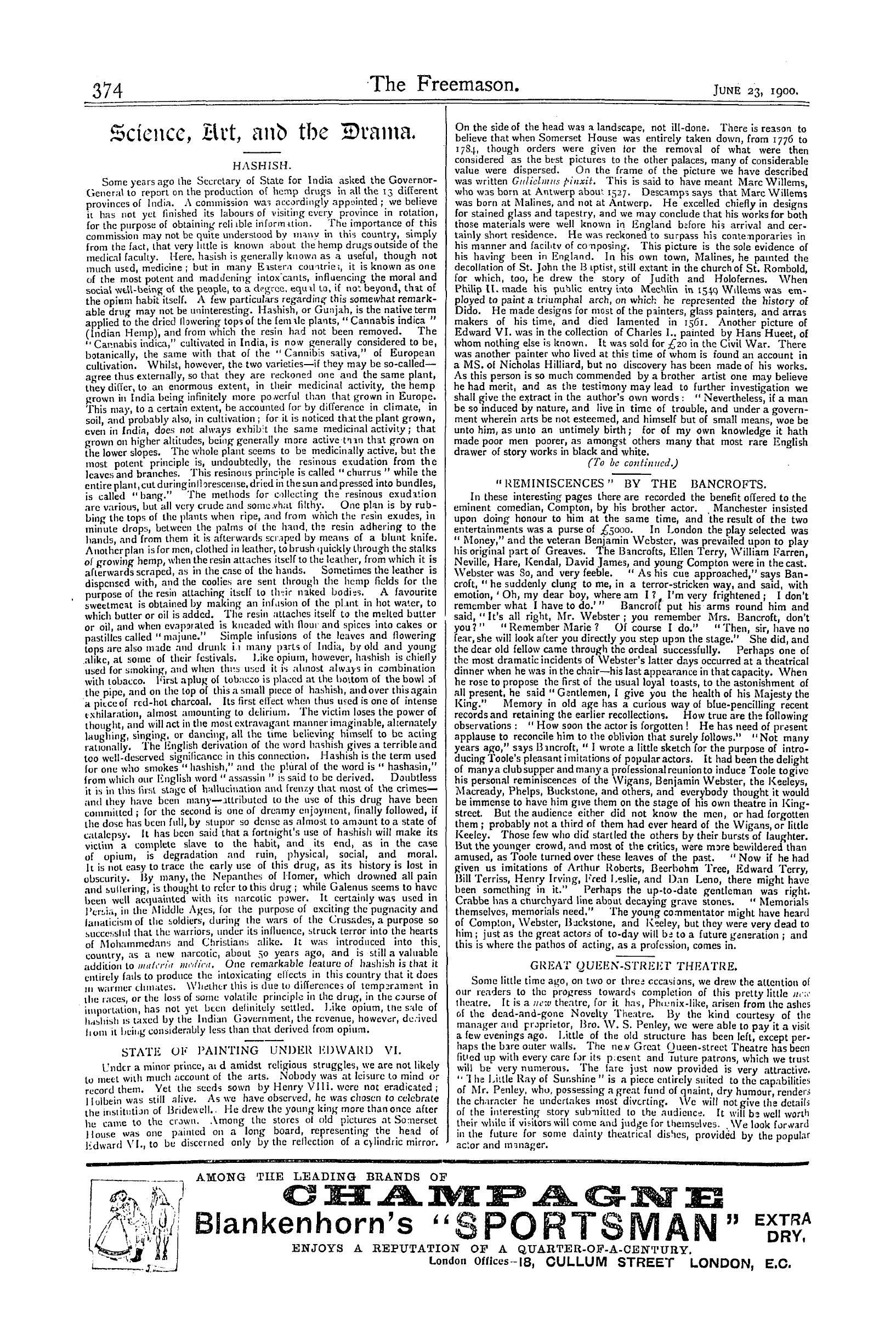
f AMONG TIIE LEADING BRANDS OF ©• AA GMAMFAGMII Mil Blankenhorn ' s "SPORTSMAN" "SB ? . WJ ^ ir H ENJOYS A REPUTATION OP A QUARTER-OF-A-CENTURY . 1 ^* ~ V jAJ London Offices-18 , CULLUM STREET LONDON , E . C .






Note: This text has been automatically extracted via Optical Character Recognition (OCR) software.
Science, Art, And The Drama.
Science , Art , and the Drama .
HASHISH . Some years ago the Secretary of State for India asked the Governor-General to report on the production of hemp drugs in all the 13 different provinces of India . A commission was accordingly appointed ; we believe it has not yet finished its labours of visiting every province in rotation , for the purpose of obtaining rcliible informuion . The importance of this commission may not be quite understood by many in this country , simply
from the fact , lhat very little is known about the hemp drugs outside of the medical faculty . Here , hasish is generally known as a useful , though not much used , medicine ; but in many Eastern countries , it is known as one of the most potent and maddening intox ' cants , influencing the moral and social well-being of the people , to a degree , equal La , if not beyond , that of the opium habit itself . A few particulars regarding this somewhat
remarkable drug may not be uninteresting . Hashish , or Gunjah , is the native term applied to the dried flowering tops of the fern tie plants , " Cannabis indica " ( Indian Hemp ) , and from which the resin had not been removed . The " Cannabis indica , " cultivated in India , is now generally considered to be , botanically , the same with that of the " Cannibis sativa , " of European cultivation . Whilst , however , the two varieties—if they may be
so-calledagree thus externally , so that they are reckoned one and the same plant , they differ , to an enormous extent , in their medicinal activity , the hemp grown iu India being infinitely more powerful than that grown in Europe . This may , to a certain extent , be accounted for by difference in climate , in soil , and probably also , in cultivation ; for it is noticed that the plant grown , even in India , does not always exhibit the same medicinal activity ; that
grown on hig her altitudes , being generally more active tn an that grown on the lower slopes . The whole plant seems to be medicinally active , but the most potent principle is , undoubtedly , the resinous exudation from the leaves and branches . This resinous principle is called " churrus " while the entire plant , cutduringinllorescense , dried in thesunandpressed into bundles , is called " bang . " The methods for collecting tha resinous exudation
arc various , but all very crude and some . vhal filthy . One plan is by rubbing the tops of the plants when ripe , and from which the resin exudes , in minute drops , between the palms of the hand , the resin adhering to the hands , and from them it is afterwards scraped by means of a blunt knife . Anothcrplan is for men , clothed in leather , to brush quickly through the stalks of growing hemp , when the resin attaches itself to the leather , from which it is
afterwards scraped , as in the case of the hands . Sometimes the leather is dispensed with , and the coolies are sent through the hemp fields for the purpose of the resin attaching itself to th *; ir naked bodies . A favourite sweetmeat is obtained by making an infusion of the plant in hot water , to which butter or oil is added . The resin attaches itself to the melted butter or oil , and when evaporated is kneaded with flour and spices into cakes or
pastilles called " majune . " Simple infusions of the leaves and flowering tops are also made and drunk i . i many parts of India , by old and young alike , at some of their festivals . Like opium , however , hashish is chiefly used for smoking , and when thus used it is almost always in combination with tobacco , hirst aplug of tobacco is placed at the bottom of the bowl af the pipe , and on thc top of this a small piece of hashish , and over this again
a pitceof red-hot charcoal . Its first effect when thus used is one of intense txhilaration , almost amounting to delirium . The victim loses the power of thought , and will act in the most extravagant manner imaginable , alternately laughing , sinning , or dancing , all the lime believing himself to be acting rationally . The linglish derivation of the word hashish gives a terrible and too well-deserved significance in this connection . Hashish is the term used
for one who smokes " hashish , " and the plural of the word is " hashasin , from which our English word " assassin " is said to bc derived . Doubtless it is in this lirst stage ot hallucination and frenzy that most of the crimesand ihey havc been many—attributed lo the use of this drug have been committed ; for thc second is one of dreamy enjoyment , finally followed , if the dose has been full , by stupor so dense as almost to amount to a state of
catalepsy . It has been said lhat a fortnight ' s use of hashish will make its victim a complete slave to the habit , and its end , as in the case of opium , is degradation and ruin , physical , social , and moral . It is not easy to trace the early use of this drug , as its history is lost in obscurity . By many , the Nepanthes of Homer , which drowned all pain and sullering , is thought lo refer to this drug ; while Galenus seems to have
been well acquainted with ils narcotic power . It certainly was used in PciAi , in the Middle Ages , for the purpose of exciting thc pugnacity and fanaticism of the soldiers , during the wars of the Crusades , a purpose so success ! ul thai the warriors , under its influence , struck terror into the hearts of Mohammedans and Christians alike . It was introduced into this country , as a new narcotic , about 50 years ago , and is still a valuable
addition to materia nti'dica . One remarkable feature of hashish is that it entirely fails to produce the intoxicating effects in this country that it does 111 warmer climates . Whether this is due to differences of tcmp ; rament in the races , or the loss of some volatile principle in the drug , in the course of importation , has not yet been definitely settled . Like opium , the sale of hashish is taxed by the Indian Government , the revenue , however , derived hotn il being considerably less than that derived from opium .
STATE OF PAINTING UNDER KDWARD VI . Under a minor prince , ai d amidst religious struggles , we are not likely lo meet with much account of the arts . Nobody was at leisure to mind or record them . Yet the seeds sown by Henry Vlli . were not eradicated ; 1 Iolbein was still alive . As we have observed , hc was chosen to celebrate the institution of Bridewell . He drew the young king more than once after he came to the crown . Among ihe stores of old pictures at Somerset House was one painted on a long board , representing the head of Edward VI ., to be discerned only by the reflection of a cylindric mirror .
Science, Art, And The Drama.
On the side of the head was a landscape , not ill-done . There is reason to believe that when Somerset House was entirely taken down , from 1776 to 1784 , though orders were given tor the removal of what were then considered as the best pictures to the other palaces , many of considerable value were dispersed . On the frame of the picture we have described was written Gitlielmus pinxit . This is said to have meant Marc Willems ,
who was born at Antwerp about 1527 . Descamps says that Marc Willems was born at Malines , and not at Antwerp . He excelled chiefly in designs for stained glass and tapestry , and we may conclude that his works for both those materials were well known in England before his arrival and certainly short residence . He was reckoned to surpass his contemporaries in his manner and facility of composing . This picture is the sole evidence of
his having been in England . In his own town , Malines , he painted the decollation of St . John the Btptist , still extant in the church of St . Rombold , for which , too , he drew the story of Judith and Holofernes . When Philip ll . made his public entry into Mechlin in 154 . 9 Willems was employed to paint a triumphal arch , on which he represented the history of Dido . He made designs for most of the painters , glass painters , and arras
makers of his time , and died lamented in 1561 . Another picture of Edward VI . was in the collection of Charles I ., painted by Hans Hueet , of whom nolhing else is known . It was sold for £ 20 in the Civil War . There was another painter who lived at this time of whom is found an account in a MS . of Nicholas Hilliard , but no discovery has been made of his works . As this person is so much commended by a brother artist one may believe he had merit , and as the testimony may lead to further investigation we
shall give the extract in the author ' s own words : " Nevertheless , if a man be so induced by nature , and live in time of trouble , and under a government wherein arts be not esteemed , and himself but of small means , woe be unto him , as unto an untimely birth ; for of my own knowledge it hath made poor men poorer , as amongst others many that most rare English drawer of story works in black and white . ( To be continued . )
" Reminiscences " By The Bancrofts
" REMINISCENCES " BY THE BANCROFTS
In these interesting pages there are recorded the benefit offered to the eminent comedian , Compton , by his brother actor . Manchester insisted upon doing honour to him at the same time , and the result of the two entertainments was a purse of . £ 5000 . In London the play selected was " Money , " and the veteran Benjamin Webster , was prevailed upon to play his original part of Greaves . The Bancrofts , Ellen Terry , William Farren ,
Neville , Hare , Kendal , David James , and young Compton were in the cast . Webster was So , and very feeble . " As his cue approached , " says Bancroft , " he suddenly clung to me , in a terror-stricken way , and said , with emotion , ' Oh , my dear boy , where am I ? I ' m very frightened ; I don ' t remember what I have to do . ' " Bancroft put his arms round him and said , " It's all right , Mr . Webster ; you remember Mrs . Bancroft , don ' t
you ? " " Remember Marie ? Of course I do . " " Then , sir , have no fear , she will look after you directly you step upon the stage . " She did , and the dear old fellow came through the ordeal successfully . Perhaps one of the most dramatic incidents of Webster ' s latter days occurred at a theatrical dinner when he was in the chair—his last appearance in that capacity . When he rose to propose the first of the usual loyal toasts , to the astonishment of
all present , he said " Gentlemen , I give you the health of his Majesty the King . " Memory in old age has a curious way of blue-pencilling recent records and retaining the earlier recollections . How true are the following observations : " How soon the actor is forgotten ! He has need of present applause to reconcile him to the oblivion that surely follows . " "Not many years ago , " says Bancroft , " I wrote a little sketch for the purpose of
introducingloole s pleasant mutations of popular actors . It had been the deli ght of manyaclubsupperandmanyaprofessionalreunionto induce Toole togive his personal reminiscences of the Wigans , Benjamin Webster , the Keeleys , Macready , Phelps , Buckstone , and others , and everybody thought it would be immense to have him give them on the stage of his own theatre in Kingstreet . But the audience either did not know the men , or had forgotten
them ; probably not a third of them had ever heard of the Wigans , or little Keeley . Those few who did startled the others by their bursts of laughter . But the younger crowd , and most of the critics , were more bewildered than amused , as Toole turned over these leaves of the past . " Now if he had given us imitations of Arthur Roberts , Beerbohm Tree , Edward Terry , Bill Terriss , Henry Irving , Fred Leslie , and Dan Leno , there might have
been something 111 it . Perhaps the up-to-date gentleman was right . Crabbe has a churchyard line about decaying grave stones . " Memorials themselves , memorials need . " The young commentator might have heard of Compton , Webster , Buckstone , and K ° eley , but they were very dead to him ; just as the great actors of to-day will bt to a future generation , * and this is where the pathos of acting , as a profession , comes in .
Great Queen-Street Theatre.
GREAT QUEEN-STREET THEATRE .
Some little time ago , on iwo or threa occasions , we drew the attention of our readers to the progress towards completion of this pretty little new iheatre . It is a new theatre , for il has , Phiunix-like , arisen from the ashes of the dead-and-gone Novelty Theatre . By the kind courtesy of the manager and proprietor , Bro . W . S . Penley , we were able to pay it a visit a few evenings ago . Little of the old structure has been left , except
perhaps the bare outer walls . The ne . v Great Queen-street Theatre has been fined up with every care for its p : esent and Tuture patrons , which we trust will be very numerous . The fare just now provided is very attractive . " 1 he Lillie Ray of Sunshine " is a piece entirely suited to the capabilities of Mr . Penley , who , possessingagre . it fund of qnaint , dry humourrenders
, the character he undertakes most diverting . Wc will not give the details of the interesting story submitted to the audiencs . It will bs well worth their while if visitors will come and judge for themselves . , We look forward in the future for some dainty theatrical dishes , provided by the popular ac ' . or and manager .
Ad00404
f AMONG TIIE LEADING BRANDS OF ©• AA GMAMFAGMII Mil Blankenhorn ' s "SPORTSMAN" "SB ? . WJ ^ ir H ENJOYS A REPUTATION OP A QUARTER-OF-A-CENTURY . 1 ^* ~ V jAJ London Offices-18 , CULLUM STREET LONDON , E . C .