-
Articles/Ads
Article MASONIC RECEPTION OF THE M.W. PRO GRAND MASTER, THE EARL OF LATHOM, G.C.B., IN TRINIDAD . ← Page 2 of 2 Article RESIGNATION OF MEMBERSHIP. Page 1 of 2 Article RESIGNATION OF MEMBERSHIP. Page 1 of 2 →
Note: This text has been automatically extracted via Optical Character Recognition (OCR) software.
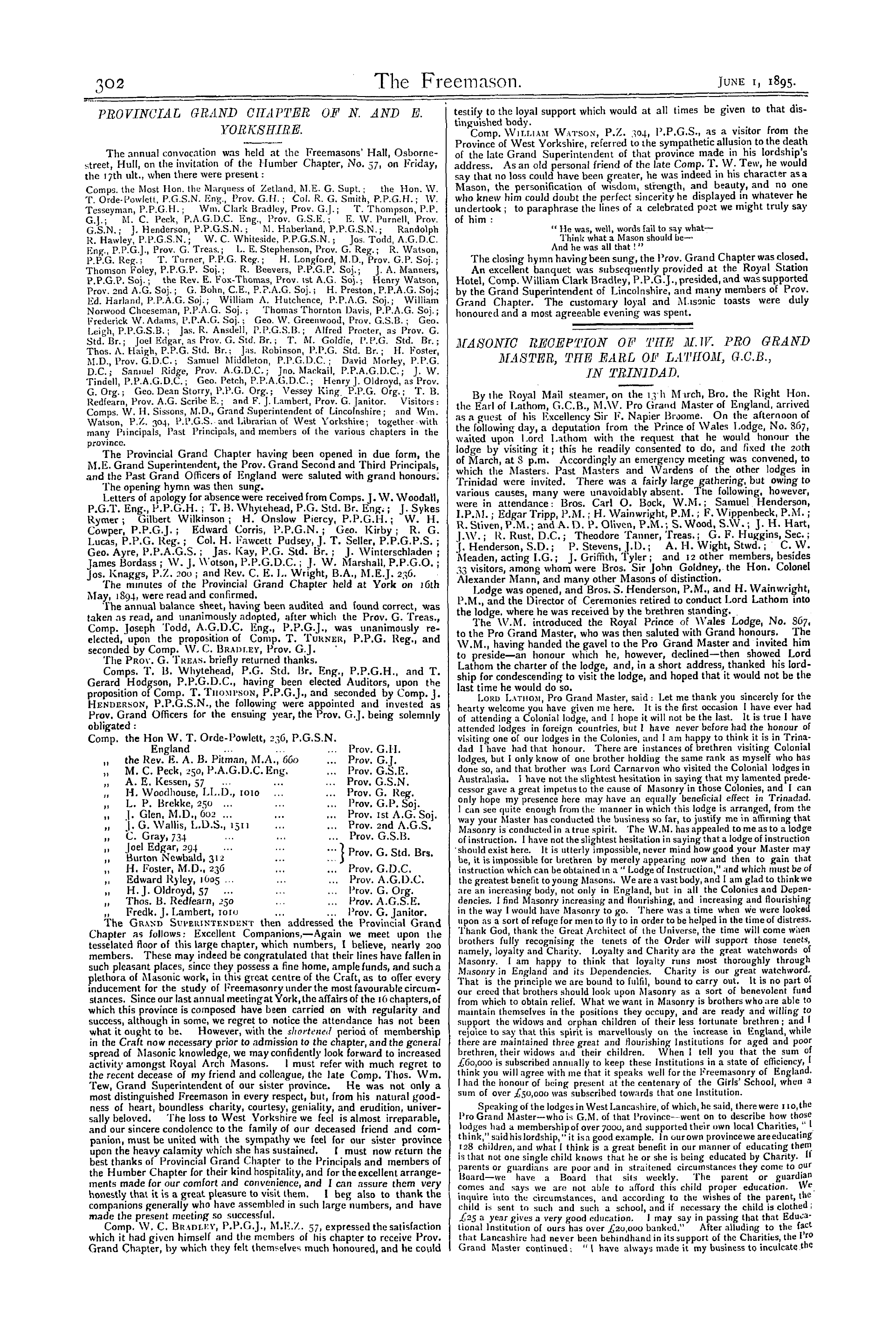
Masonic Reception Of The M.W. Pro Grand Master, The Earl Of Lathom, G.C.B., In Trinidad .
necessity of instituting some local Charities of their own small provinces—I am not speaking of the London ones-and I am happy to say it has answered most thoroughly . Many lodges in the old days were in the habit at their meetings of holding banquets . Now in very many lodges that banquet that used to be held regularly is held only once a year , and on other occasions they have light refreshments . The result is that the funds of our Charities have increased . A man coming into Masonry must not think of it as a benevolent institution , and I would
never allow a man to join our body who was not in a perfectly solvent position . One thing I am perfectly certain of : if a man is admitted into our Brotherhood , and is a true Mason at heart , it is impossible for him to be a bad man . If he carries out Freemasonry as it ought to be carried out , then he is a good man . He will do his best to carry out tho principles of his Order . It has been hinted to me—I won ' t say 1 hinted it myself , but I certainly think it would be very advisable that there should be a District Grand Lodge here . You have some live
lodges—I hope they will increase . Now my reason for saying this is -. 1 think it really impossible that lodges should go on working without any real connection with each other , that , in fact , they should work only through the Grand Secretary at home . No doubt the Grand Secretary is a capable man , but he has a mass of correspondence that he goes into , and he has to keep many clerks . It is utterly impossible that he should attend to minor matters which should be settled on the spot . If you have a District Grand Lodge you will have a
court of appeal . You will have superior officers among you , and if there is any unfortunate disagreement in the lodges it could be referred and be decided . That is why I advocate it . If you take counsel on the subject , and if you will only send in a petition to that effect to the Grand Master , t , in my capacity , shall be most happy to do all I can to grant your petition . Of course , I can promise no more than that , but I do hope and think if your petition is properly worded that it will be granted . As regards his Royal Highness the Grand
Master , who , you know , is the head of all our Craft , I can assure you from my personal knowledge that a truer Mason does not exist in the world . It is not often he is able to take an active part in our meetings ; he generally manages to do so at ^ least once or twice a year . But every matter affecting Masonry , whether in England or in her Dependencies , is referred to him , and he himself goes into that matter before it is decided . Long may he live to be our Grand Master The Duke of York is not a Mason . I cannot tell you why ; 1 do not
know . We are forbidden to induce people to become Masons . He does not seem inclined to join , but we have another Royal Prince who is a true Mason , the Duke of Connaught , District Grand Master of Bombay , and Provincial Grand Master of Sussex . He takes a great deal of interest in Freemasonry , so that we have a very fine warrior Prince to take the place of the Prince of Wales should the latter at any time feel it is duty to retire from his present position . " The speaker concluded by again tendering his sincere thanks for the welcome he had received .
Bro . Sir JOHN GOLDNEY then addressed the lodge , and spoke at some length on the founding of a Charitable Fund , and expressed his readiness to assist it at any time . Bros . EDGAR TITP , P . M ., and SAMUEL HENDERSON , P . M ., also spoke on the subject , and also on the necessity of establishing a District Grand Lodge in Trinidad .
I he Worshipful Masters of the other lodges , who were present , were then introduced to Lord Lathom . Bro . CARL O . BOCK , W . M ., in a few chosen remarks , thanked the visiting brethren for their presence , and was suitably replied to b y Bro . the Hon . Col . ALEXANDER MAN , P . M . The lodge then closed after a most pleasant evening , and one long to be remembered by Freemasons in Trinidad .
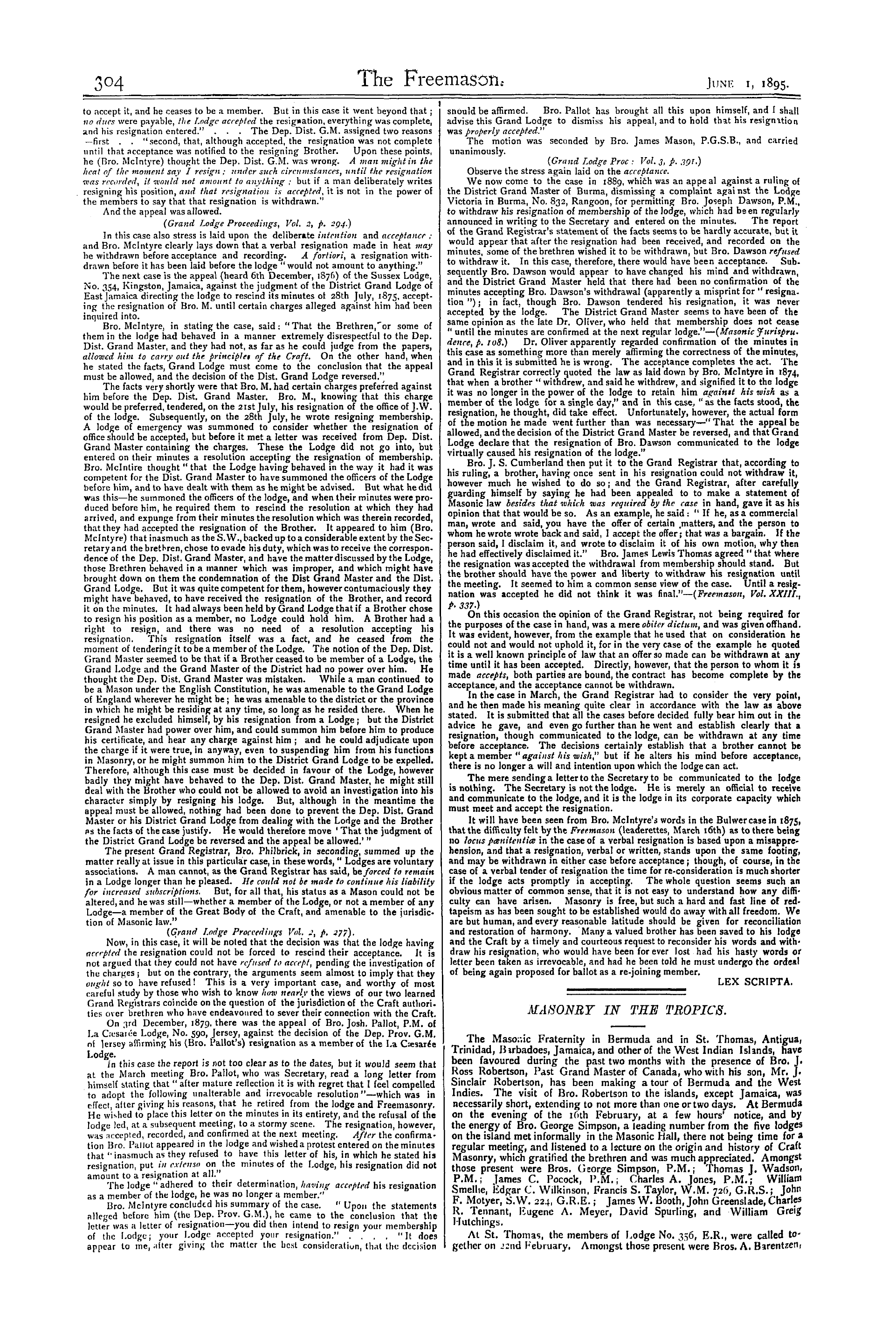
Resignation Of Membership.
RESIGNATION OF MEMBERSHIP .
It is somewhat surprising that the debate in Grand Lodge last March on the Singapore appeal , and the editorial Notes in the Freemason of i 6 th and 23 rd March last have not evoked more comment . The Craft is to be congratulated on the clear exposition of the law by the Grand Registrar and on the decision of Grand Lodge supporting his view . For some time past there has undoubtedly been a widespread—but
erroneous—belief that a resignation once tendered in open lodge , or sent in writing to the Secretary , must be accepted by the lodge at once and without demur or qualification , nor could it be withdrawn , however much the lodge and the brother himself might wish it ; and it has been freely stated that the present Grand Registrar , and also the late Bro . McIntyre , had repeatedly so ruled , and that Grand Lodge had always acted on this ruling .
On the other hand , many brethren have always held that there could not be a Masonic law so opposed to common sense and to the whole theory of the connection between a brother and his lodge , and have unhesitatingly declined to actupon it . In many lodges it has been the practice , in a certain class of cases , on learning thata brother had ivrkten to the Secretary to tender his resignation , for the W . M .
to direct the Secretary not to read the communication till the next lodge , in order that meanwhile the brother may be approached and informed that the lodge Would be sorry to lose him , so that he might reconsider his decision and withdraw his letter , which in that case would never be brought before the lodge at all . If he adheres to his resolution , the leUer is read , and the resignation accepted as from a former lodge meeting .
This practice is in entire accordance with the whole theory of our system . The contract of membership is a mutual one , not one-sided . No brother can be forced to join a lodge , neither can a lodge be forced to receive him as a member . On the other hand no lodge having once received a brother as a member can determine the contract without his assent , unless for good cause , and in strict accordance with the Constitutions and the by-laws of the lodge : neither can the brother determine the contract and abandon his membership without the assent of
the lodge . Assent may be given by tacit acquiescence , but is more usually given , as the Grand Registrar has more than once very justly observed , by a resolution accepting the resignation , frequently accompanied by expressions of regret . " If he resigns mc have a custom , which is lime honoured , perhaps , but which expresses no legal obligation , to move that his resignation be accepted generally with an expression of regret at the resignation of the Brother . Whether that resolution is carried or not , in point of lawthe Society being voluntary , and Masonry being
, uee , the resignation stands . The lodge cannot allow it , or do other than accept the "vill and intention of the Brother . That has been laid down by my predecessor Brother McIntyre ; it has been stated by me on more than one occasion , it is the . understood law . " V . Wor . Bro . Philbrick , G . L ., 6 th March , r 8 n $ . The quotation js given in full , though only the parts italicised are needed for the present purpose , 'he words not italicised must not be taken as assented to .
. The view which the writer submits as the correct one , is that a resignation is incomplete until it has been actually accepted by the lodge , and can be withdrawn * any time before acceptance ; that acceptance cannot , as a rule , be refused if the lod ge is satisfied that the real " will and intention of the Brother" is to resignbut , may be delayed to ascertain whether such " will and intention " does really continue to exist .
,, J ' lere would not be much " freedom " or common sense in a so-called law \ AC k ° und the lodge to act against its own wish , and part with a valued member " deference to a will and intention which no longer existed—or which refined
Resignation Of Membership.
power to delay an unwelcome decision if there were reason to hope that the delay would render the decision unnecessary . Of course , however , snch delay must not be allowed to injure a brother . An examination of the various cases decided by Grand Lodge will enable us to see what has reall y been accepted as law . Bro . McIntyre was first appointed Grand Registrar on 30 th April , 1862 . The first
appeal which he , as Grand Registrar , brought before Grand Lodge , was on the 3 rd September , 1 S 62 , which was an appeal from the Oriental Lodge , No . 9 68 , Constantinople , against a ruling of the Deputy Prov . Grand Master . The facts were that "The resignation of a member was made in writing , received , and read in open Lodge , and recorded on the minutes , and such minutes duly confirmed at the next ensuing regular meeting . " The Deputy Prov . Grand Master considered that the
resignation was not unconditional , and thought that though the resignation had been accepted and entered on the minutes , " the technical acceptance of a resignation under the By-laws of the Lodge ought to be subordinate to the restoration of Masonic harmony , " and " decided that the brother who had sent in his resignation was to be considered still a member . "
" The Grand Registrar observing " .... " that the Brother in question having tendered his resignation and Lodge having accepted such resignation he was no longer a member of the Lodge " . . \ moved that the Appeal be allowed and the decision of the Dep . Prov . G . M . reversed . " Bro . H . Lloyd ( P . S . G . D . ) , seconded , and said that two things were requisite in order that a Brother should cease to be a member of a Lodge—the act of resignation and the acceptance of such resignation . In this instance both had been fully effected and the Brother was therefore no longer a member . " " The question was then put and carried . "
( Grand Lodge Proceedings 3 rd September , rSi > 2 ) . From the passages italicised it is clear that both the Grand Registrar and Bro . Lloyd laid stress on the acceptance of the resignation . The next case to come before Grand Lodge was on 3 rd June , 1 S 74 , and was an appeal from " the Treasurer of the Sandeman Lodge , No . 1374 , Dum Dum , Bengal , against an order of the Dep . Dist . G . M . directing that the resignation of a Brother must be accepted altho' his dues were not paid . "
In this case Bro . McIntyre stated that the dues were payable mantMy and in advance . A brother desired to resign his membership , and for that purpose came to the lodge in January to pay his dues for December . His contention was , " I have come here not as a member but to resign and pay , " and he tendered ' his dues there and then . The lodge contended he was there as a member . " No , he replied , I will pay the December dues and no others . " He tendered in January For December and they refused them . Time rolls on . He says , ' here are my
dues for December . ' They say , " We must have your dues for January , then February , then March ; pay us those and we will give you your Certificate . " The only question between them when they came before the District Grand Master was whether he was there as a member in January or simply came to tender his resignation . " He ( the Grand Registrar ) would not have occupied the time of Grand Lodge in making these remarks did he not know that the impression prevailed , not only in distant districts , but in the provinces of this country , " that if a man
does not pay up his dues at the time he resigns they can keep him on and make him pay from year to year . Standing there as a lawyer he thought that a most erroneous view . A Brother resigns , the Ludgu is not bound to give him his Certificate that he is clear on its books , he being still liable for any dues he may owe at the time of his resignation , but it cannot compel him to continue a member from year to year , thereby making him increase his debt , when he perhaps has not means to discharge his arrears . What he ( Bro . McIntyre ) ventured to submit to
Grand Lodge was , that although a Lodge is not bound la give a Brother a clearance Certificate until his dues are paid , it can only claim dues up to the time he resigns . He would , therefore , move that the appeal be dismissed and 'that a Lodge lias no poioer to compel a Brother to continue a member after his resignation is tendered when his membership of necessity ceases , nor to claim subscriptions from him for any subsequent period . The Lodge can only enforce payment of the arrears then due . ' "
The present Grand Registrar , in seconding , said .- "Masonry is a voluntary system ; a man can only be a Member of a Lodge by his own assent , and while that assent lasts , and he can only continue a member by the consent of himself and the Lodge . The moment a Lodge is entitled to exclude a Brother , or when he says , ' I withdraw myself from membership , ' he is de facto no longer a member . From the moment he says , ' I retire , ' his membershi p is ended and the line is struck . "
Bro . John Savage , P . G . D ., said : " In this case the dues were tendered with the resignation , and the Lodge was bound to accept them . " The motion was then carried .
( Grand Lodge Proceedings , Vol . 2 , p . - / 6 . ) In this case the only question was as to whether the lodge could compel the brother to continue a member and so increase his debt . There was no question of withdrawal , and the brother ' s " will and intention" were clear . In this light the present Grand Registrar ' s words are perfectly intelligible and a correct statement of the law , but they must be read in conjunction with the facts which evoked them .
The question arose incidentally on 2 nd December , 1 S 74 , when Bro . H . Warren moved the non-confirmation of the minutes of the previous Quarterly Communication as far as regarded the resignation of the Marquess of Ripon ( as Grand Master ) . Bro . Havers , P . G . W ., in speaking to the motion , pointing out the act was completed , and that this was not a matter requiring confirmation , remarked that " not only was Grand Lodge bound to accept the Grand Master ' s resignation but it did accept it . "
( Grand Lodge Piocecdings , Vol . 1 , p . . tzS . ) The next case is the appeal of Bro . Temple , W . M . of the Bulwer Lodge , No . 891 , against a decision of the Dep . Dist . G . M . suspending him from all Masonic functions , and also against the ruling of the Dep , Dist . G . M . in having a brother named Taylor installed as Master of the lodge . The facts were very voluminous and complicated , but the gist of them as explained by Bro . McIntyre is , as far as relates to the present question , that Bro . Taylor was elected as Bro . Temple ' : ; successor and the minutes confirmed . Bro . Taylor , however , was not installed at
the next regular lodge , but resigned his membership of the lodge in a letter to the W . M ., and the letter was read and a resolution passed accepting it . Subsequently the Dep . Dist . G . M ., after one or two meeting : ; , directed the S . W . to summon a lodge of emergency , and the summons was ol a pecular character " to receive the answer of the VV . M . elect and the Secretary to the letter requesting them to withdraw their resignations , and , if withdrawn , by special dispensation of the Dep . Dist . G . M . to instal Bro . Taylor Master of the Buhver Lodge . " The lodge of emergency was called , the resignations withdrawn , and Bro . Taylor was installed .
In moving the allowance of the appeal , Bro . McIntyre said : " It has been laid down as a rule , and adopted by Grand Lodge , that a Brother , on sending in his resignation-Masonry being a voluntary Society ceases to be a member of the Lodge ... No Brother can be compelled to continue to be a member of a Lodge when he wishes to cease to be so . In a great many Lodges a resolution is
passed accepting the resignation , when all dues are paid . That form would appear to be an error in fact , because if the member owes any dues , whether he continues a member or not , he is still liable for them . He may be in such a position that he cannot pay his dues . How long then is he to be held a member if he cannot pay ? Is he to be kept on incurring fresh dues ? . . . lj a man sends in his resignation , intending that it shall be accepted , the Lodge is bound








Note: This text has been automatically extracted via Optical Character Recognition (OCR) software.
Masonic Reception Of The M.W. Pro Grand Master, The Earl Of Lathom, G.C.B., In Trinidad .
necessity of instituting some local Charities of their own small provinces—I am not speaking of the London ones-and I am happy to say it has answered most thoroughly . Many lodges in the old days were in the habit at their meetings of holding banquets . Now in very many lodges that banquet that used to be held regularly is held only once a year , and on other occasions they have light refreshments . The result is that the funds of our Charities have increased . A man coming into Masonry must not think of it as a benevolent institution , and I would
never allow a man to join our body who was not in a perfectly solvent position . One thing I am perfectly certain of : if a man is admitted into our Brotherhood , and is a true Mason at heart , it is impossible for him to be a bad man . If he carries out Freemasonry as it ought to be carried out , then he is a good man . He will do his best to carry out tho principles of his Order . It has been hinted to me—I won ' t say 1 hinted it myself , but I certainly think it would be very advisable that there should be a District Grand Lodge here . You have some live
lodges—I hope they will increase . Now my reason for saying this is -. 1 think it really impossible that lodges should go on working without any real connection with each other , that , in fact , they should work only through the Grand Secretary at home . No doubt the Grand Secretary is a capable man , but he has a mass of correspondence that he goes into , and he has to keep many clerks . It is utterly impossible that he should attend to minor matters which should be settled on the spot . If you have a District Grand Lodge you will have a
court of appeal . You will have superior officers among you , and if there is any unfortunate disagreement in the lodges it could be referred and be decided . That is why I advocate it . If you take counsel on the subject , and if you will only send in a petition to that effect to the Grand Master , t , in my capacity , shall be most happy to do all I can to grant your petition . Of course , I can promise no more than that , but I do hope and think if your petition is properly worded that it will be granted . As regards his Royal Highness the Grand
Master , who , you know , is the head of all our Craft , I can assure you from my personal knowledge that a truer Mason does not exist in the world . It is not often he is able to take an active part in our meetings ; he generally manages to do so at ^ least once or twice a year . But every matter affecting Masonry , whether in England or in her Dependencies , is referred to him , and he himself goes into that matter before it is decided . Long may he live to be our Grand Master The Duke of York is not a Mason . I cannot tell you why ; 1 do not
know . We are forbidden to induce people to become Masons . He does not seem inclined to join , but we have another Royal Prince who is a true Mason , the Duke of Connaught , District Grand Master of Bombay , and Provincial Grand Master of Sussex . He takes a great deal of interest in Freemasonry , so that we have a very fine warrior Prince to take the place of the Prince of Wales should the latter at any time feel it is duty to retire from his present position . " The speaker concluded by again tendering his sincere thanks for the welcome he had received .
Bro . Sir JOHN GOLDNEY then addressed the lodge , and spoke at some length on the founding of a Charitable Fund , and expressed his readiness to assist it at any time . Bros . EDGAR TITP , P . M ., and SAMUEL HENDERSON , P . M ., also spoke on the subject , and also on the necessity of establishing a District Grand Lodge in Trinidad .
I he Worshipful Masters of the other lodges , who were present , were then introduced to Lord Lathom . Bro . CARL O . BOCK , W . M ., in a few chosen remarks , thanked the visiting brethren for their presence , and was suitably replied to b y Bro . the Hon . Col . ALEXANDER MAN , P . M . The lodge then closed after a most pleasant evening , and one long to be remembered by Freemasons in Trinidad .
Resignation Of Membership.
RESIGNATION OF MEMBERSHIP .
It is somewhat surprising that the debate in Grand Lodge last March on the Singapore appeal , and the editorial Notes in the Freemason of i 6 th and 23 rd March last have not evoked more comment . The Craft is to be congratulated on the clear exposition of the law by the Grand Registrar and on the decision of Grand Lodge supporting his view . For some time past there has undoubtedly been a widespread—but
erroneous—belief that a resignation once tendered in open lodge , or sent in writing to the Secretary , must be accepted by the lodge at once and without demur or qualification , nor could it be withdrawn , however much the lodge and the brother himself might wish it ; and it has been freely stated that the present Grand Registrar , and also the late Bro . McIntyre , had repeatedly so ruled , and that Grand Lodge had always acted on this ruling .
On the other hand , many brethren have always held that there could not be a Masonic law so opposed to common sense and to the whole theory of the connection between a brother and his lodge , and have unhesitatingly declined to actupon it . In many lodges it has been the practice , in a certain class of cases , on learning thata brother had ivrkten to the Secretary to tender his resignation , for the W . M .
to direct the Secretary not to read the communication till the next lodge , in order that meanwhile the brother may be approached and informed that the lodge Would be sorry to lose him , so that he might reconsider his decision and withdraw his letter , which in that case would never be brought before the lodge at all . If he adheres to his resolution , the leUer is read , and the resignation accepted as from a former lodge meeting .
This practice is in entire accordance with the whole theory of our system . The contract of membership is a mutual one , not one-sided . No brother can be forced to join a lodge , neither can a lodge be forced to receive him as a member . On the other hand no lodge having once received a brother as a member can determine the contract without his assent , unless for good cause , and in strict accordance with the Constitutions and the by-laws of the lodge : neither can the brother determine the contract and abandon his membership without the assent of
the lodge . Assent may be given by tacit acquiescence , but is more usually given , as the Grand Registrar has more than once very justly observed , by a resolution accepting the resignation , frequently accompanied by expressions of regret . " If he resigns mc have a custom , which is lime honoured , perhaps , but which expresses no legal obligation , to move that his resignation be accepted generally with an expression of regret at the resignation of the Brother . Whether that resolution is carried or not , in point of lawthe Society being voluntary , and Masonry being
, uee , the resignation stands . The lodge cannot allow it , or do other than accept the "vill and intention of the Brother . That has been laid down by my predecessor Brother McIntyre ; it has been stated by me on more than one occasion , it is the . understood law . " V . Wor . Bro . Philbrick , G . L ., 6 th March , r 8 n $ . The quotation js given in full , though only the parts italicised are needed for the present purpose , 'he words not italicised must not be taken as assented to .
. The view which the writer submits as the correct one , is that a resignation is incomplete until it has been actually accepted by the lodge , and can be withdrawn * any time before acceptance ; that acceptance cannot , as a rule , be refused if the lod ge is satisfied that the real " will and intention of the Brother" is to resignbut , may be delayed to ascertain whether such " will and intention " does really continue to exist .
,, J ' lere would not be much " freedom " or common sense in a so-called law \ AC k ° und the lodge to act against its own wish , and part with a valued member " deference to a will and intention which no longer existed—or which refined
Resignation Of Membership.
power to delay an unwelcome decision if there were reason to hope that the delay would render the decision unnecessary . Of course , however , snch delay must not be allowed to injure a brother . An examination of the various cases decided by Grand Lodge will enable us to see what has reall y been accepted as law . Bro . McIntyre was first appointed Grand Registrar on 30 th April , 1862 . The first
appeal which he , as Grand Registrar , brought before Grand Lodge , was on the 3 rd September , 1 S 62 , which was an appeal from the Oriental Lodge , No . 9 68 , Constantinople , against a ruling of the Deputy Prov . Grand Master . The facts were that "The resignation of a member was made in writing , received , and read in open Lodge , and recorded on the minutes , and such minutes duly confirmed at the next ensuing regular meeting . " The Deputy Prov . Grand Master considered that the
resignation was not unconditional , and thought that though the resignation had been accepted and entered on the minutes , " the technical acceptance of a resignation under the By-laws of the Lodge ought to be subordinate to the restoration of Masonic harmony , " and " decided that the brother who had sent in his resignation was to be considered still a member . "
" The Grand Registrar observing " .... " that the Brother in question having tendered his resignation and Lodge having accepted such resignation he was no longer a member of the Lodge " . . \ moved that the Appeal be allowed and the decision of the Dep . Prov . G . M . reversed . " Bro . H . Lloyd ( P . S . G . D . ) , seconded , and said that two things were requisite in order that a Brother should cease to be a member of a Lodge—the act of resignation and the acceptance of such resignation . In this instance both had been fully effected and the Brother was therefore no longer a member . " " The question was then put and carried . "
( Grand Lodge Proceedings 3 rd September , rSi > 2 ) . From the passages italicised it is clear that both the Grand Registrar and Bro . Lloyd laid stress on the acceptance of the resignation . The next case to come before Grand Lodge was on 3 rd June , 1 S 74 , and was an appeal from " the Treasurer of the Sandeman Lodge , No . 1374 , Dum Dum , Bengal , against an order of the Dep . Dist . G . M . directing that the resignation of a Brother must be accepted altho' his dues were not paid . "
In this case Bro . McIntyre stated that the dues were payable mantMy and in advance . A brother desired to resign his membership , and for that purpose came to the lodge in January to pay his dues for December . His contention was , " I have come here not as a member but to resign and pay , " and he tendered ' his dues there and then . The lodge contended he was there as a member . " No , he replied , I will pay the December dues and no others . " He tendered in January For December and they refused them . Time rolls on . He says , ' here are my
dues for December . ' They say , " We must have your dues for January , then February , then March ; pay us those and we will give you your Certificate . " The only question between them when they came before the District Grand Master was whether he was there as a member in January or simply came to tender his resignation . " He ( the Grand Registrar ) would not have occupied the time of Grand Lodge in making these remarks did he not know that the impression prevailed , not only in distant districts , but in the provinces of this country , " that if a man
does not pay up his dues at the time he resigns they can keep him on and make him pay from year to year . Standing there as a lawyer he thought that a most erroneous view . A Brother resigns , the Ludgu is not bound to give him his Certificate that he is clear on its books , he being still liable for any dues he may owe at the time of his resignation , but it cannot compel him to continue a member from year to year , thereby making him increase his debt , when he perhaps has not means to discharge his arrears . What he ( Bro . McIntyre ) ventured to submit to
Grand Lodge was , that although a Lodge is not bound la give a Brother a clearance Certificate until his dues are paid , it can only claim dues up to the time he resigns . He would , therefore , move that the appeal be dismissed and 'that a Lodge lias no poioer to compel a Brother to continue a member after his resignation is tendered when his membership of necessity ceases , nor to claim subscriptions from him for any subsequent period . The Lodge can only enforce payment of the arrears then due . ' "
The present Grand Registrar , in seconding , said .- "Masonry is a voluntary system ; a man can only be a Member of a Lodge by his own assent , and while that assent lasts , and he can only continue a member by the consent of himself and the Lodge . The moment a Lodge is entitled to exclude a Brother , or when he says , ' I withdraw myself from membership , ' he is de facto no longer a member . From the moment he says , ' I retire , ' his membershi p is ended and the line is struck . "
Bro . John Savage , P . G . D ., said : " In this case the dues were tendered with the resignation , and the Lodge was bound to accept them . " The motion was then carried .
( Grand Lodge Proceedings , Vol . 2 , p . - / 6 . ) In this case the only question was as to whether the lodge could compel the brother to continue a member and so increase his debt . There was no question of withdrawal , and the brother ' s " will and intention" were clear . In this light the present Grand Registrar ' s words are perfectly intelligible and a correct statement of the law , but they must be read in conjunction with the facts which evoked them .
The question arose incidentally on 2 nd December , 1 S 74 , when Bro . H . Warren moved the non-confirmation of the minutes of the previous Quarterly Communication as far as regarded the resignation of the Marquess of Ripon ( as Grand Master ) . Bro . Havers , P . G . W ., in speaking to the motion , pointing out the act was completed , and that this was not a matter requiring confirmation , remarked that " not only was Grand Lodge bound to accept the Grand Master ' s resignation but it did accept it . "
( Grand Lodge Piocecdings , Vol . 1 , p . . tzS . ) The next case is the appeal of Bro . Temple , W . M . of the Bulwer Lodge , No . 891 , against a decision of the Dep . Dist . G . M . suspending him from all Masonic functions , and also against the ruling of the Dep , Dist . G . M . in having a brother named Taylor installed as Master of the lodge . The facts were very voluminous and complicated , but the gist of them as explained by Bro . McIntyre is , as far as relates to the present question , that Bro . Taylor was elected as Bro . Temple ' : ; successor and the minutes confirmed . Bro . Taylor , however , was not installed at
the next regular lodge , but resigned his membership of the lodge in a letter to the W . M ., and the letter was read and a resolution passed accepting it . Subsequently the Dep . Dist . G . M ., after one or two meeting : ; , directed the S . W . to summon a lodge of emergency , and the summons was ol a pecular character " to receive the answer of the VV . M . elect and the Secretary to the letter requesting them to withdraw their resignations , and , if withdrawn , by special dispensation of the Dep . Dist . G . M . to instal Bro . Taylor Master of the Buhver Lodge . " The lodge of emergency was called , the resignations withdrawn , and Bro . Taylor was installed .
In moving the allowance of the appeal , Bro . McIntyre said : " It has been laid down as a rule , and adopted by Grand Lodge , that a Brother , on sending in his resignation-Masonry being a voluntary Society ceases to be a member of the Lodge ... No Brother can be compelled to continue to be a member of a Lodge when he wishes to cease to be so . In a great many Lodges a resolution is
passed accepting the resignation , when all dues are paid . That form would appear to be an error in fact , because if the member owes any dues , whether he continues a member or not , he is still liable for them . He may be in such a position that he cannot pay his dues . How long then is he to be held a member if he cannot pay ? Is he to be kept on incurring fresh dues ? . . . lj a man sends in his resignation , intending that it shall be accepted , the Lodge is bound