-
Articles/Ads
Article NOTABLE LODGE MEETINGS. Page 1 of 2 Article NOTABLE LODGE MEETINGS. Page 1 of 2 →
Note: This text has been automatically extracted via Optical Character Recognition (OCR) software.
Notable Lodge Meetings.
NOTABLE LODGE MEETINGS .
No . V . —THE NEW QUARTERS OF THE MARK GRAND LODGE .
There is nothing in the general appearance of Great Queenstreet , as it exists at the present time , to indicate that it was once an aristocratic neighbourhood , in which for a prolonged period persons of rank and distinction resided . It is a busy
thoroughfare ; it has been known for more than ioo years as beino- the head-quarters of the art and craft of Freemasonry , and there are many well-known firms who carry on their business both on the north and the south sides of the street . It is ,
moreover , a very busy thoroughfare , forming as it does a part of the main route which connects Charing Cross and the south side of London generally with King ' s Cross , Euston , and St . Pancras to the north . There are also many of the houses on the south side ,
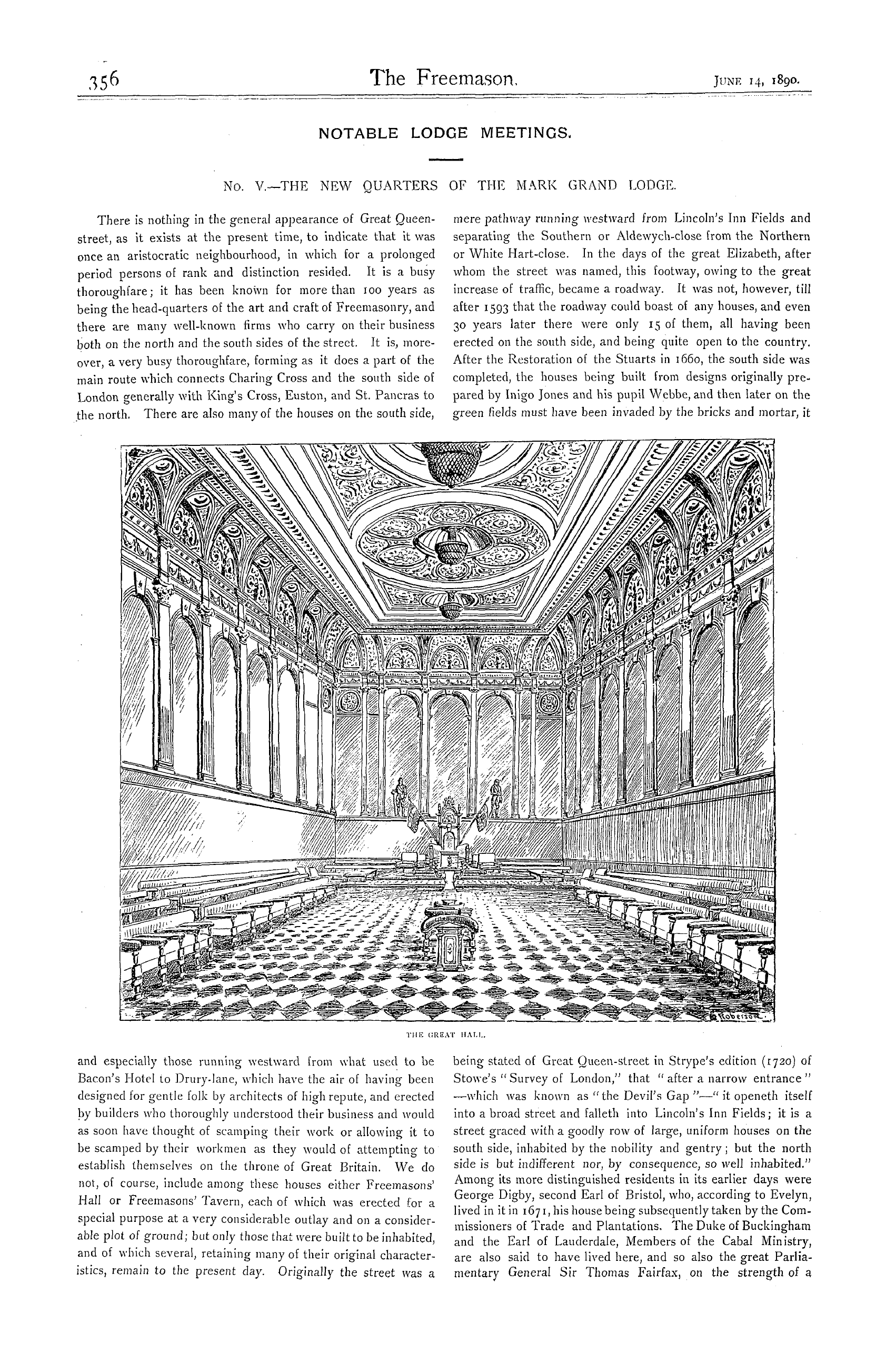
THE GREAT HAT . I ..
and especially those running westward from what used to be Bacon ' s Hotel to Drury-lane , which have the air of having been designed for gentle folk by architects of high repute , and erected by builders who thoroughly understood their business and would
as soon have thought of scamping their work or allowing it to be scamped by their workmen as they would of attempting to establish themselves on the throne of Great Britain . We do not , of course , include among these houses either Freemasons '
Hall or Freemasons' Tavern , each of which was erected for a special purpose at a very considerable outlay and on a considerable plot of ground ; but only those that were built to be inhabited , and of which several , retaining many of their original characteristics , remain to the present day . Originally the street was a
Notable Lodge Meetings.
mere jiathway running westward from Lincoln ' s Inn Fields and separating the Southern or Aldewych-close from the Northern or White Hart-close . In the days of the great Elizabeth , after whom the street was named , this footway , owing to the great
increase of traffic , became a roadway . It was not , however , till after 1593 that the roadway could boast of any houses , and even 30 years later there were only 15 of them , all having been erected on the south side , and being quite open to the country .
After the Restoration of the Stuarts in 1660 , the south side was completed , the houses being built from designs originally prepared by Inigo Jones and his pupil Webbe , and then later on the green fields must have been invaded by the bricks and mortar , it
being stated of Great Queen-street in Strype ' s edition ( 1720 ) of Stowe ' s " Survey of London , " that " after a narrow entrance " —which was known as " the Devil ' s Gap "•— " it openeth itself into a broad street and falleth into Lincoln ' s Inn Fields ; it is a
street graced with a goodly row of large , uniform houses on the south side , inhabited by the nobility and gentry ; but the north side is but indifferent nor , by consequence , so well inhabited . " Among its more distinguished residents in its earlier days were
George Digby , second Earl of Bristol , who , according to Evelyn , lived in it in 1671 , his house being subsequently taken by the Commissioners of Trade and Plantations . The Duke of Buckingham
and the Earl of Lauderdale , Members of the Cabal Ministry , are also said to have lived here , and so also the great Parliamentary General Sir Thomas Fairfax , on the strength of a






Note: This text has been automatically extracted via Optical Character Recognition (OCR) software.
Notable Lodge Meetings.
NOTABLE LODGE MEETINGS .
No . V . —THE NEW QUARTERS OF THE MARK GRAND LODGE .
There is nothing in the general appearance of Great Queenstreet , as it exists at the present time , to indicate that it was once an aristocratic neighbourhood , in which for a prolonged period persons of rank and distinction resided . It is a busy
thoroughfare ; it has been known for more than ioo years as beino- the head-quarters of the art and craft of Freemasonry , and there are many well-known firms who carry on their business both on the north and the south sides of the street . It is ,
moreover , a very busy thoroughfare , forming as it does a part of the main route which connects Charing Cross and the south side of London generally with King ' s Cross , Euston , and St . Pancras to the north . There are also many of the houses on the south side ,
THE GREAT HAT . I ..
and especially those running westward from what used to be Bacon ' s Hotel to Drury-lane , which have the air of having been designed for gentle folk by architects of high repute , and erected by builders who thoroughly understood their business and would
as soon have thought of scamping their work or allowing it to be scamped by their workmen as they would of attempting to establish themselves on the throne of Great Britain . We do not , of course , include among these houses either Freemasons '
Hall or Freemasons' Tavern , each of which was erected for a special purpose at a very considerable outlay and on a considerable plot of ground ; but only those that were built to be inhabited , and of which several , retaining many of their original characteristics , remain to the present day . Originally the street was a
Notable Lodge Meetings.
mere jiathway running westward from Lincoln ' s Inn Fields and separating the Southern or Aldewych-close from the Northern or White Hart-close . In the days of the great Elizabeth , after whom the street was named , this footway , owing to the great
increase of traffic , became a roadway . It was not , however , till after 1593 that the roadway could boast of any houses , and even 30 years later there were only 15 of them , all having been erected on the south side , and being quite open to the country .
After the Restoration of the Stuarts in 1660 , the south side was completed , the houses being built from designs originally prepared by Inigo Jones and his pupil Webbe , and then later on the green fields must have been invaded by the bricks and mortar , it
being stated of Great Queen-street in Strype ' s edition ( 1720 ) of Stowe ' s " Survey of London , " that " after a narrow entrance " —which was known as " the Devil ' s Gap "•— " it openeth itself into a broad street and falleth into Lincoln ' s Inn Fields ; it is a
street graced with a goodly row of large , uniform houses on the south side , inhabited by the nobility and gentry ; but the north side is but indifferent nor , by consequence , so well inhabited . " Among its more distinguished residents in its earlier days were
George Digby , second Earl of Bristol , who , according to Evelyn , lived in it in 1671 , his house being subsequently taken by the Commissioners of Trade and Plantations . The Duke of Buckingham
and the Earl of Lauderdale , Members of the Cabal Ministry , are also said to have lived here , and so also the great Parliamentary General Sir Thomas Fairfax , on the strength of a