-
Articles/Ads
Article Masonic Notes. ← Page 2 of 2 Article Correspondence. Page 1 of 2 Article Correspondence. Page 1 of 2 →
Note: This text has been automatically extracted via Optical Character Recognition (OCR) software.
Masonic Notes.
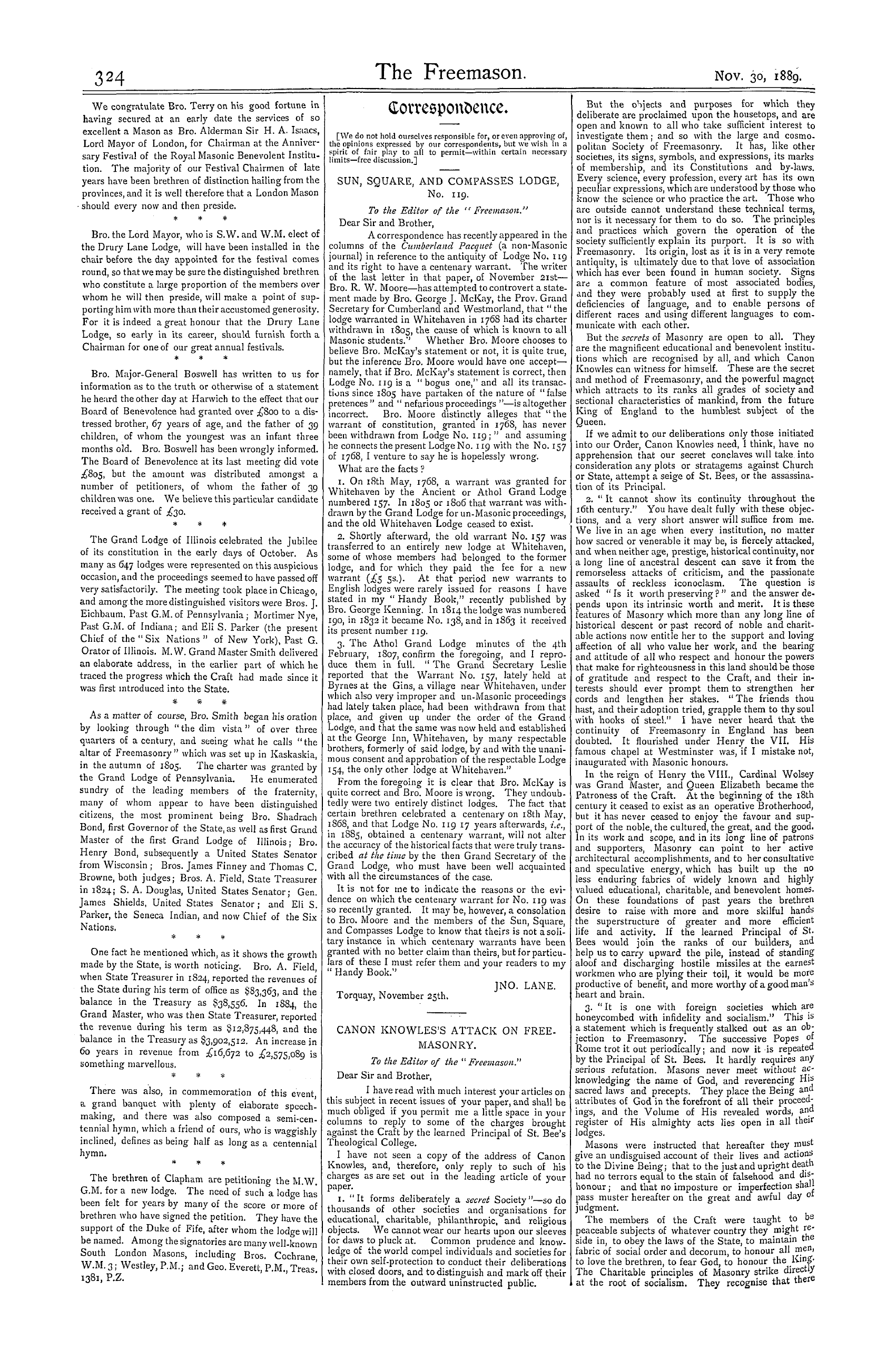
We congratulate Bro . Terry on his good fortune in having secured at an early date the services of so excellent a Mason as Bro . Alderman Sir H . A . Isaacs , Lord Mayor of London , for Chairman at the
Anniversary Festival of the Royal Masonic Benevolent Institution . The majority of our Festival Chairmen of late years have been brethren of distinction hailing from the provinces , and it is well therefore that a London Mason - should every now and then preside .
* * * Bro . the Lord Mayor , who is S . W . and W . M . elect of the Drury Lane Lodge , will have been installed in the chair before the day appointed for the festival comes round , so that we may be sure the distinguished brethren
who constitute a large proportion of the members over whom he will then preside , will make a point of supporting him with more than their accustomed generosity . For it is indeed a great honour that the Drury Lane Lodge , so early in its career , should furnish forth a Chairman for one of our oreat annual festivals .
* * * Bro . Major-General Boswell has written to us for information as to the truth or otherwise of a statement he heard the other day at Harwich to the effect that our Board of Benevolence had granted over £ 800 to a
distressed brother , 6 7 years of age , and the father of 39 children , of whom the youngest was an infant three months old . Bro . Boswell has been wrongly informed . The Board of Benevolence at its last meeting did vote
£ 805 , but the amount was distributed amongst a number of petitioners , of whom the father of 39 children was one . We believe this particular candidate received a grant of - £ 30 .
* * * The Grand Lodge of Illinois celebrated the Jubilee of its constitution in the earl y days of October . As many as 647 lodges were represented on this auspicious occasion , and the proceedings seemed to have passed off
very satisfactorily . The meeting took place in Chicago , and among the more distinguished visitors were Bros . J . Eichbaum , Past G . M . of Pennsylvania ; Mortimer Nye , Past G . M . of Indiana ; and Eli S . Parker ( the present
Chief of the "Six Nations " of New York ) , Past G . Orator of Illinois . M . W . Grand Master Smith delivered an elaborate address , in the earlier part of which he traced the progress which the Craft had made since it was first introduced into the State .
As a matter of course , Bro . Smith began his oration by looking through " the dim vista " of over three quarters of a century , and seeing what he calls "the altar of Freemasonry" which was set up in Kaskaskia , in the autumn of 1805 . The charter was granted by
the Grand Lodge of Pennsylvania . He enumerated sundry of the leading members of the fraternity , many of whom appear to have been distinguished citizens , the most prominent being Bro . Shadrach Bond , first Governor of the State , as well as first Grand
Master of the first Grand Lodge of Illinois ; Bro . Henry Bond , subsequentl y a United States Senator from Wisconsin ; Bros . James Finney and Thomas C . Browne , both judges ; Bros . A . Field , State Treasurer
in 1824 ; S . A . Douglas , United States Senator ; Gen . James Shields , United States Senator ; and Eli S . Parker , the Seneca Indian , and now Chief of the Six Nations .
One fact he mentioned which , as it shows the growth made by the State , is worth noticing . Bro . A . Field , when State Treasurer in 1 S 24 , reported the revenues of the State during his term of office as § 8 3 , 363 , and the balance in the Treasury as 838 , 556 . In 1884 , the
Grand Master , who was then State Treasurer , reported the revenue during his term as § 12 , 8 75 , 448 , and the balance in the Treasury as $ 3 , 902 , 512 . An increase in 60 years in revenue from £ 16 , 6 72 to £ 2 , 575 , 08 9 is something marvellous .
There was also , in commemoration of this event a grand banquet with plenty of elaborate speech making , and there was also composed a semi-cen
tennial hymn , which a friend of ours , who is waggishly inclined , defines as being half as long as a centennial hymn . * * *
The brethren of Clapham are petitioning the M . W . G . M . for a new lodge . The need of such a lodge has been felt for years b y many of the score or more of brethren who have signed the petition . They have the
support of the Duke of Fife , after whom the lodge will be named . Among the signatories are many well-known South London Masons , including Bros . Cochrane W . M . 3 ; Westley , P . M . ; and Geo . Everett , P . M ., Treas ' 1381 , P . Z .
Correspondence.
Correspondence .
[ We do not hold ourselves responsible for , or even approving of , the opinions expressed by our correspondents , but we wish in a spirit of fair play to all to permit—within certain necessary limits—free discussion . ]
SUN , SQUARE , AND COMPASSES LODGE , No . 119 . To the Editor of the "Freemason . " Dear Sir and Brother , A correspondence has recently appeared in the columns of the Cumberland Pacquet ( a non-Masonic
journal ) in reference to the antiquity of Lodge No . 119 and its right to have a centenary warrant . The writer of the last letter in that paper , of November 21 st—Bro . R . W . Moore—has attempted to controvert a statement made by Bro . George J . McKay , the Prov . Grand Secretary for Cumberland and Westmorland , that " the
lodge warranted in Whitehaven in 17 68 had its charter withdrawn in 1805 , the cause of which is known to all Masonic students . " Whether Bro . Moore chooses to believe Bro . McKay's statement or not , it is quite true , but the inference Bro . Moore would have one acceptnamely , that if Bro . McKay ' s statement is correct , then Lodge No . 119 is a " bogus one , " and all its
transactions since 1805 have partaken of the nature of "false pretences " and " nefarious proceedings " —is altogether incorrect . Bro . Moore distinctly alleges that "the warrant of constitution , granted in 17 6 S , has never been withdrawn from Lodge No . 119 ; " and assuming he connects the present Lodge No . 119 with the No . 157 of 1768 , I venture to say he is hopelessly wrong . What are the facts ?
1 . On 18 th May , 1768 , a warrant was granted for Whitehaven by the Ancient or Athol Grand Lodge numbered 157 . In 1805 or 1806 that warrant was withdrawn by the Grand Lodge for un-Masonic proceedings , and the old Whitehaven Lodge ceased to exist . 2 . Shortly afterward , the old warrant No . 157 was
transferred to an entirely new lodge at Whitehaven , some of whose members had belonged to the former lodge , and for which they paid the fee for a new warrant ( £ 5 5 s . ) . At that period new warrants to English lodges were rarely issued for reasons I have stated in my " Handy Book , " recently published by
Bro . George Kenning . In 1814 the lodge was numbered 190 , in 1832 it became No . 138 , and in 186 3 it received its present number 119 . 3 . The Athol Grand Lodge minutes of the 4 th February , 1807 , confirm the foregoing , and I reproduce them in full . " The Grand Secretary Leslie
reported that the Warrant No . 157 , lately held at Byrnes at the Gins , a village near Whitehaven , under which also very improper and un-Masonic proceedings had lately taken place , had been withdrawn from that place , and given up under the order of the Grand
Lodge , and that the same was now held and established at the George Inn , Whitehaven , by many respectable brothers , formerly of said lodge , by and with the unanimous consent and approbation of the respectable Lodge 154 , the only other lodge at Whitehaven . "
From the foregoing it is clear that Bro . McKay is quite correct and Bro . Moore is wrong . They undoubtedly were two entirel y distinct lodges . The fact that certain brethren celebrated a centenary on 18 th May , 1868 , and that Lodge No . 119 17 years afterwards , i . e .,
in 1885 , obtained a centenary warrant , will not alter the accuracy of the historical facts that were truly transcribed at the time b y the then Grand Secretary of the Grand Lodge , who must have been well acquainted with all the circumstances of the case .
It is not for me to indicate the reasons or the evidence on which the centenary warrant for No . 119 was so recently granted . It may be , however , a consolation to Bro . Moore and the members of the Sun , Square , and Compasses Lodge to know that theirs is not a
solitary instance in which centenary warrants have been granted with no better claim than theirs , but for particulars of these I must refer them and your readers to my " Handy Book . " JNO . LANE . Torquay , November 25 th .
CANON KNOWLES'S ATTACK ON FREEMASONRY . To the Editor of the " Freemason . " Dear Sir and Brother , I have read with much interest your articles on this subject in recent issues of your paper , and shall be much obliged if you permit me a little space in your columns to reply to some of the charges brought
against the Craft by the learned Principal of St . Bee ' s Theological College . I have not seen a copy of the address of Canon Knowles , and , therefore , only reply to such of his charges as are set out in the leading article of your paper . 1 . "It forms deliberately a secret Society "—so do
thousands of other societies and organisations for educational , charitable , philanthropic , and religious objects . We cannot wear our hearts upon our sleeves for daws to pluck at . Common prudence and knowledge of the world compel individuals and societies for their own self-protection to conduct their deliberations with closed doors , and to distinguish and mark off their members from the outward uninstructed public .
Correspondence.
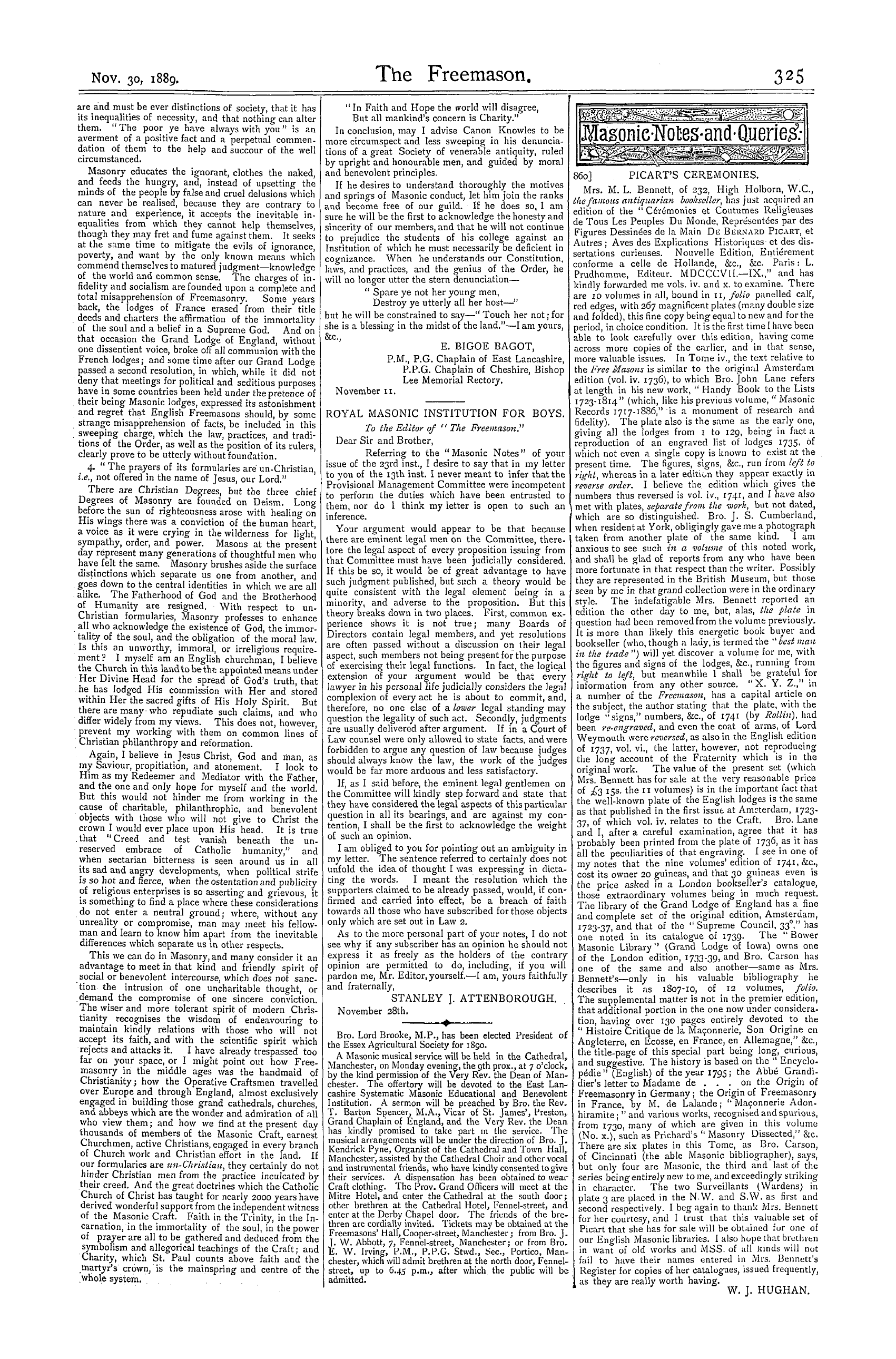
But the objects and purposes for which they deliberate are proclaimed upon the housetops , and are open and known to all who take sufficient interest to investigate them ; and so with the large and cosmopolitan Society of Freemasonry . It has , like other societies , its signs , symbols , and expressions , its marks
of membership , and its Constitutions and by-laws . Every science , every profession , every art has its own peculiar expressions , which are understood by those who know the science or who practice the art . Those who are outside cannot understand these technical terms , nor is it necessary for them to do so . The principles
and practices which govern the operation of the society sufficiently explain its purport . It is so with Freemasonry . Its origin , lost as it is in a very remote antiquity , is ultimately due to that love of association which has ever been found in human society . Signs
are a common feature of most associated bodies , and they were probably used at first to supply the deficiencies of language , and to enable persons of different races and using different languages to communicate with each other .
But the secrets of Masonry are open to all . They are the magnificent educational and benevolent institutions which are recognised by all , and which Canon Knowles can witness for himself . These are the secret and method of Freemasonry , and the powerful magnet which attracts to its ranks all grades of society and
sectional characteristics of mankind , from the future King of England to the humblest subject of the Queen . If we admit to our deliberations only those initiated into our Order , Canon Knowles need , I think , have no apprehension that our secret conclaves will take , into
consideration any plots or stratagems against Church or State , attempt a seige of St . Bees , or the assassination of its Principal . 2 . " It cannot show its continuity throughout the 16 th century . " You have dealt fully with these objections , and a very short answer will suffice from me .
We live in an age when every institution , no matter how sacred or venerable it may be , is fiercely attacked , and when neither age , prestige , historical continuity , nor a long line of ancestral descent can save it from the remorseless attacks of criticism , and the passionate assaults of reckless iconoclasm . The question is
asked " Is it worth preserving ? " and the answer depends upon its intrinsic worth and merit . It is these features of Masonry which more than any long line of historical descent or past record of noble and charitable actions now entitle her to the support and loving affection of all who value her work , and the bearing
and attitude of all who respect and honour the powers that make for ri g hteousness in this land should be those of gratitude and respect to the Craft , and their interests should ever prompt them to strengthen her cords and lengthen her stakes . " The friends thou hast , and their adoption tried , grapple them to thy soul
with hooks of steel . " I have never heard that the continuity of Freemasonry in England has been doubted . It flourished under Henry the VII . His famous chapel at Westminster was , if I mistake not , inaugurated with Masonic honours . In the reign of Henry the VIII ., Cardinal Wolsey
was Grand Master , and Queen Elizabeth became the Patroness of the Craft . At the beginning of the 18 th century it ceased to exist as an operative Brotherhood , but it has never ceased to enjoy the favour and support of the noble , the cultured , the great , and the good , in its work and scope , and in its long line of patrons
and supporters , Masonry can point to her active architectural accomplishments , and to her consultative and speculative energy , which has built up the no less enduring fabrics of widely known and highly valued educational , charitable , and benevolent homes . On these foundations of past years the brethren desire to raise with more and more skilful hands
the superstructure of greater and more efficient life and activity . If the learned Principal of St . Bees would join the ranks of our builders , and help us to carry upward the pile , instead of standing aloof and discharging hostile missiles at the earnest workmen who are plying their toil , it would be more productive of benefit , and more worthy of a good man's heart and brain .
3 . " It is one with foreign societies which are honeycombed with infidelity and socialism . " This is a statement which is frequently stalked out as an objection to Freemasonry . The successive Popes of Rome trot it out periodically ; and now it is repeated by the Principal of St . Bees . It hardly requires any
serious refutation . Masons never meet without acknowled ging the name of God , and reverencing His sacred laws and precepts . They place the Being and attributes of God in the forefront of all their proceedings , and the Volume of His revealed words , and register of His almighty acts lies open in all their
lodges . Masons were instructed that hereafter they must give an undisguised account of their lives and actions to the Divine Being ; that to the just and upright death had no terrors equal to the stain of falsehood and dishonour ; and that no imposture or imperfection shall pass muster hereafter on the great and awful day
judgment . The members of the Craft were taught _ to t > 3 peaceable subjects of whatever country they mig ht reside in , to obey the laws of the State , to maintain the fabric of social order and decorum , to honour all men , to love the brethren , to fear God , to honour the King-The Charitable principles of Masonry strike directly at the root of socialism . They recognise that there

Note: This text has been automatically extracted via Optical Character Recognition (OCR) software.
Masonic Notes.
We congratulate Bro . Terry on his good fortune in having secured at an early date the services of so excellent a Mason as Bro . Alderman Sir H . A . Isaacs , Lord Mayor of London , for Chairman at the
Anniversary Festival of the Royal Masonic Benevolent Institution . The majority of our Festival Chairmen of late years have been brethren of distinction hailing from the provinces , and it is well therefore that a London Mason - should every now and then preside .
* * * Bro . the Lord Mayor , who is S . W . and W . M . elect of the Drury Lane Lodge , will have been installed in the chair before the day appointed for the festival comes round , so that we may be sure the distinguished brethren
who constitute a large proportion of the members over whom he will then preside , will make a point of supporting him with more than their accustomed generosity . For it is indeed a great honour that the Drury Lane Lodge , so early in its career , should furnish forth a Chairman for one of our oreat annual festivals .
* * * Bro . Major-General Boswell has written to us for information as to the truth or otherwise of a statement he heard the other day at Harwich to the effect that our Board of Benevolence had granted over £ 800 to a
distressed brother , 6 7 years of age , and the father of 39 children , of whom the youngest was an infant three months old . Bro . Boswell has been wrongly informed . The Board of Benevolence at its last meeting did vote
£ 805 , but the amount was distributed amongst a number of petitioners , of whom the father of 39 children was one . We believe this particular candidate received a grant of - £ 30 .
* * * The Grand Lodge of Illinois celebrated the Jubilee of its constitution in the earl y days of October . As many as 647 lodges were represented on this auspicious occasion , and the proceedings seemed to have passed off
very satisfactorily . The meeting took place in Chicago , and among the more distinguished visitors were Bros . J . Eichbaum , Past G . M . of Pennsylvania ; Mortimer Nye , Past G . M . of Indiana ; and Eli S . Parker ( the present
Chief of the "Six Nations " of New York ) , Past G . Orator of Illinois . M . W . Grand Master Smith delivered an elaborate address , in the earlier part of which he traced the progress which the Craft had made since it was first introduced into the State .
As a matter of course , Bro . Smith began his oration by looking through " the dim vista " of over three quarters of a century , and seeing what he calls "the altar of Freemasonry" which was set up in Kaskaskia , in the autumn of 1805 . The charter was granted by
the Grand Lodge of Pennsylvania . He enumerated sundry of the leading members of the fraternity , many of whom appear to have been distinguished citizens , the most prominent being Bro . Shadrach Bond , first Governor of the State , as well as first Grand
Master of the first Grand Lodge of Illinois ; Bro . Henry Bond , subsequentl y a United States Senator from Wisconsin ; Bros . James Finney and Thomas C . Browne , both judges ; Bros . A . Field , State Treasurer
in 1824 ; S . A . Douglas , United States Senator ; Gen . James Shields , United States Senator ; and Eli S . Parker , the Seneca Indian , and now Chief of the Six Nations .
One fact he mentioned which , as it shows the growth made by the State , is worth noticing . Bro . A . Field , when State Treasurer in 1 S 24 , reported the revenues of the State during his term of office as § 8 3 , 363 , and the balance in the Treasury as 838 , 556 . In 1884 , the
Grand Master , who was then State Treasurer , reported the revenue during his term as § 12 , 8 75 , 448 , and the balance in the Treasury as $ 3 , 902 , 512 . An increase in 60 years in revenue from £ 16 , 6 72 to £ 2 , 575 , 08 9 is something marvellous .
There was also , in commemoration of this event a grand banquet with plenty of elaborate speech making , and there was also composed a semi-cen
tennial hymn , which a friend of ours , who is waggishly inclined , defines as being half as long as a centennial hymn . * * *
The brethren of Clapham are petitioning the M . W . G . M . for a new lodge . The need of such a lodge has been felt for years b y many of the score or more of brethren who have signed the petition . They have the
support of the Duke of Fife , after whom the lodge will be named . Among the signatories are many well-known South London Masons , including Bros . Cochrane W . M . 3 ; Westley , P . M . ; and Geo . Everett , P . M ., Treas ' 1381 , P . Z .
Correspondence.
Correspondence .
[ We do not hold ourselves responsible for , or even approving of , the opinions expressed by our correspondents , but we wish in a spirit of fair play to all to permit—within certain necessary limits—free discussion . ]
SUN , SQUARE , AND COMPASSES LODGE , No . 119 . To the Editor of the "Freemason . " Dear Sir and Brother , A correspondence has recently appeared in the columns of the Cumberland Pacquet ( a non-Masonic
journal ) in reference to the antiquity of Lodge No . 119 and its right to have a centenary warrant . The writer of the last letter in that paper , of November 21 st—Bro . R . W . Moore—has attempted to controvert a statement made by Bro . George J . McKay , the Prov . Grand Secretary for Cumberland and Westmorland , that " the
lodge warranted in Whitehaven in 17 68 had its charter withdrawn in 1805 , the cause of which is known to all Masonic students . " Whether Bro . Moore chooses to believe Bro . McKay's statement or not , it is quite true , but the inference Bro . Moore would have one acceptnamely , that if Bro . McKay ' s statement is correct , then Lodge No . 119 is a " bogus one , " and all its
transactions since 1805 have partaken of the nature of "false pretences " and " nefarious proceedings " —is altogether incorrect . Bro . Moore distinctly alleges that "the warrant of constitution , granted in 17 6 S , has never been withdrawn from Lodge No . 119 ; " and assuming he connects the present Lodge No . 119 with the No . 157 of 1768 , I venture to say he is hopelessly wrong . What are the facts ?
1 . On 18 th May , 1768 , a warrant was granted for Whitehaven by the Ancient or Athol Grand Lodge numbered 157 . In 1805 or 1806 that warrant was withdrawn by the Grand Lodge for un-Masonic proceedings , and the old Whitehaven Lodge ceased to exist . 2 . Shortly afterward , the old warrant No . 157 was
transferred to an entirely new lodge at Whitehaven , some of whose members had belonged to the former lodge , and for which they paid the fee for a new warrant ( £ 5 5 s . ) . At that period new warrants to English lodges were rarely issued for reasons I have stated in my " Handy Book , " recently published by
Bro . George Kenning . In 1814 the lodge was numbered 190 , in 1832 it became No . 138 , and in 186 3 it received its present number 119 . 3 . The Athol Grand Lodge minutes of the 4 th February , 1807 , confirm the foregoing , and I reproduce them in full . " The Grand Secretary Leslie
reported that the Warrant No . 157 , lately held at Byrnes at the Gins , a village near Whitehaven , under which also very improper and un-Masonic proceedings had lately taken place , had been withdrawn from that place , and given up under the order of the Grand
Lodge , and that the same was now held and established at the George Inn , Whitehaven , by many respectable brothers , formerly of said lodge , by and with the unanimous consent and approbation of the respectable Lodge 154 , the only other lodge at Whitehaven . "
From the foregoing it is clear that Bro . McKay is quite correct and Bro . Moore is wrong . They undoubtedly were two entirel y distinct lodges . The fact that certain brethren celebrated a centenary on 18 th May , 1868 , and that Lodge No . 119 17 years afterwards , i . e .,
in 1885 , obtained a centenary warrant , will not alter the accuracy of the historical facts that were truly transcribed at the time b y the then Grand Secretary of the Grand Lodge , who must have been well acquainted with all the circumstances of the case .
It is not for me to indicate the reasons or the evidence on which the centenary warrant for No . 119 was so recently granted . It may be , however , a consolation to Bro . Moore and the members of the Sun , Square , and Compasses Lodge to know that theirs is not a
solitary instance in which centenary warrants have been granted with no better claim than theirs , but for particulars of these I must refer them and your readers to my " Handy Book . " JNO . LANE . Torquay , November 25 th .
CANON KNOWLES'S ATTACK ON FREEMASONRY . To the Editor of the " Freemason . " Dear Sir and Brother , I have read with much interest your articles on this subject in recent issues of your paper , and shall be much obliged if you permit me a little space in your columns to reply to some of the charges brought
against the Craft by the learned Principal of St . Bee ' s Theological College . I have not seen a copy of the address of Canon Knowles , and , therefore , only reply to such of his charges as are set out in the leading article of your paper . 1 . "It forms deliberately a secret Society "—so do
thousands of other societies and organisations for educational , charitable , philanthropic , and religious objects . We cannot wear our hearts upon our sleeves for daws to pluck at . Common prudence and knowledge of the world compel individuals and societies for their own self-protection to conduct their deliberations with closed doors , and to distinguish and mark off their members from the outward uninstructed public .
Correspondence.
But the objects and purposes for which they deliberate are proclaimed upon the housetops , and are open and known to all who take sufficient interest to investigate them ; and so with the large and cosmopolitan Society of Freemasonry . It has , like other societies , its signs , symbols , and expressions , its marks
of membership , and its Constitutions and by-laws . Every science , every profession , every art has its own peculiar expressions , which are understood by those who know the science or who practice the art . Those who are outside cannot understand these technical terms , nor is it necessary for them to do so . The principles
and practices which govern the operation of the society sufficiently explain its purport . It is so with Freemasonry . Its origin , lost as it is in a very remote antiquity , is ultimately due to that love of association which has ever been found in human society . Signs
are a common feature of most associated bodies , and they were probably used at first to supply the deficiencies of language , and to enable persons of different races and using different languages to communicate with each other .
But the secrets of Masonry are open to all . They are the magnificent educational and benevolent institutions which are recognised by all , and which Canon Knowles can witness for himself . These are the secret and method of Freemasonry , and the powerful magnet which attracts to its ranks all grades of society and
sectional characteristics of mankind , from the future King of England to the humblest subject of the Queen . If we admit to our deliberations only those initiated into our Order , Canon Knowles need , I think , have no apprehension that our secret conclaves will take , into
consideration any plots or stratagems against Church or State , attempt a seige of St . Bees , or the assassination of its Principal . 2 . " It cannot show its continuity throughout the 16 th century . " You have dealt fully with these objections , and a very short answer will suffice from me .
We live in an age when every institution , no matter how sacred or venerable it may be , is fiercely attacked , and when neither age , prestige , historical continuity , nor a long line of ancestral descent can save it from the remorseless attacks of criticism , and the passionate assaults of reckless iconoclasm . The question is
asked " Is it worth preserving ? " and the answer depends upon its intrinsic worth and merit . It is these features of Masonry which more than any long line of historical descent or past record of noble and charitable actions now entitle her to the support and loving affection of all who value her work , and the bearing
and attitude of all who respect and honour the powers that make for ri g hteousness in this land should be those of gratitude and respect to the Craft , and their interests should ever prompt them to strengthen her cords and lengthen her stakes . " The friends thou hast , and their adoption tried , grapple them to thy soul
with hooks of steel . " I have never heard that the continuity of Freemasonry in England has been doubted . It flourished under Henry the VII . His famous chapel at Westminster was , if I mistake not , inaugurated with Masonic honours . In the reign of Henry the VIII ., Cardinal Wolsey
was Grand Master , and Queen Elizabeth became the Patroness of the Craft . At the beginning of the 18 th century it ceased to exist as an operative Brotherhood , but it has never ceased to enjoy the favour and support of the noble , the cultured , the great , and the good , in its work and scope , and in its long line of patrons
and supporters , Masonry can point to her active architectural accomplishments , and to her consultative and speculative energy , which has built up the no less enduring fabrics of widely known and highly valued educational , charitable , and benevolent homes . On these foundations of past years the brethren desire to raise with more and more skilful hands
the superstructure of greater and more efficient life and activity . If the learned Principal of St . Bees would join the ranks of our builders , and help us to carry upward the pile , instead of standing aloof and discharging hostile missiles at the earnest workmen who are plying their toil , it would be more productive of benefit , and more worthy of a good man's heart and brain .
3 . " It is one with foreign societies which are honeycombed with infidelity and socialism . " This is a statement which is frequently stalked out as an objection to Freemasonry . The successive Popes of Rome trot it out periodically ; and now it is repeated by the Principal of St . Bees . It hardly requires any
serious refutation . Masons never meet without acknowled ging the name of God , and reverencing His sacred laws and precepts . They place the Being and attributes of God in the forefront of all their proceedings , and the Volume of His revealed words , and register of His almighty acts lies open in all their
lodges . Masons were instructed that hereafter they must give an undisguised account of their lives and actions to the Divine Being ; that to the just and upright death had no terrors equal to the stain of falsehood and dishonour ; and that no imposture or imperfection shall pass muster hereafter on the great and awful day
judgment . The members of the Craft were taught _ to t > 3 peaceable subjects of whatever country they mig ht reside in , to obey the laws of the State , to maintain the fabric of social order and decorum , to honour all men , to love the brethren , to fear God , to honour the King-The Charitable principles of Masonry strike directly at the root of socialism . They recognise that there