Note: This text has been automatically extracted via Optical Character Recognition (OCR) software.
Annual Festival Of The Royal Masonic Benevolent Institution.
Bro . Lord GEORGE HAMILTON next rose and said he had now the honour to propose the toast of the evening , " Success to the Royal Masonic Benevolent Institution for Aged Freemasons and Widows of Freemasons . " That was a toast which did not require any greatly lengthened speech to recommend it
to the brethren . He thought they would all , agree that whilst there were many good qualities associated with Freemasonry , the arch and foundation of their system was that of brotherly love one towards another , and that brotherly love must assume not
merely the form of kindly intercourse and communication with others in times of prosperity , but it also necessitated their relieving , to ( he best of their ability , the wants of those who were less fortunate than themselves and were in necessitous
circumstances . This had been admitted , he thought , by all who had occupied positions of authority and trust in the Craft , to be the keystone of the Brotherhood . ( Applause . ) They were honoured that night by the presence of ladies , and when he said that the guiding influence of Freemasons was brotherly
love , he hoped the . ladies would not accept that sentiment in a limited sense ; he used it in a broad sense , and one which w as explained to him many years ago by a distinguished pillar of the church , who informed him that in his early life he had a large parish in which there were a considerable number of fair
parishioners of advanced views , and they canie one day to him as a deputation , and protested against his commencing service on the Sunday with the words " Dearly beloved brethren ; " they wished him to add the words " and sisters . " ( Laughter . ) But the reply of his venerable friend routed bis fair plaintiffs , for he
said : " I am a man of experience in the world ' s affairs , and my experience tells me that the brethren embrace the sisterhood " —( laughter)— " and , " he added , " ladies , it is only when your experience points in a contrary direction that I shall add to the word ' brethren' 'and sisters . ' " ( Renewed laughter . ) And it was
in that sense in which his reverend friend interpreted the word "brethren" that he ( Lord George Hamilton ) now used the word . They all knew that benevolence was one of the main objects of individual lodges ; but their forefathers felt some 50 years back that if they were to erect a permanent , durable ,
public institution denoting the benevolent views that influenced the brethren it must not be a spasmodic movement , supported by a lodge here or there , but by the united co-operation of the brethren , and in that sense and with that view that great Benevolent Institution was first established and created . Then it
divided itself into two parts ; there were those who lived in the Institution and received a certain annuity , and there were those who lived at home and received the annuity there . For years past it had been the practice of the House Committee , who were charged with the functions of supervising the houses at Croydon ,
to make an inspection on the day previous to the annual Festival . He ( Lord George Hamilton ) accepted readily the invitation of the House Committee to accompany them on Tuesday in that their quarterly visit . He went there with two distinct objects in his mind . After benevolence , he thought the
next great principle which characterised Freemasons was a sense of equality . No matter what a man ' s station might be , they met on terms of absolute equality . Now , that feeling should characterise them outside lodges when they came in contact with Masons , and he said to himself , " Is it possible that
the House Committee have so far accepted and engrafted in them that doctrine that they will be able to discharge their charitable functions that these poor people can receive the quarterly payments without a sense of seK-degradation and pauperism ? " The result of his experience on Tuesday was most satisfactory .
There were 32 aged persons living in separate tenements of ( heir own , and they received the House Committee not as persons about to give a dole , but as visitors , and from beginning to end there was that sense of equality between those who were giving and those who were receiving which was characteristic of
Freemasons . ( Hear , hear . ) It would be invidious to mention any one member of the House Committee , but he could not hel p noticing that the ubiquity and bonhomie of their old friend , Bro . Terry , had a remarkable effect on all with whom he came in contact . Even those eyes that were dimmed by age lighted up
at his chaff and fun ; even those whose form was bent with disease and suffering were straightened up by the cheery words addressed to them when they received their pension ( cheers ) , and therefore he came away with that satisfactory feeling that if the almsgiving and benevolence of ( he Craft was on a grand
scale it was conveyed in a manner to winch no one could raise any possible objection . But Tuesday was a bright and cheery day and it made him think a little of the future , and ascertain of the fair sisterhood were in ( he gallery now perhaps they would
pardon him if he ventured very humbly to express to the brethren and to them what was the substance of his soliloquy ; there were all sorts and conditions of people in those houses—old widowers , old widows , old bachelors , but there were no old
Annual Festival Of The Royal Masonic Benevolent Institution.
spinsters . ( Laughter . ) Well , he thought that was hard . As a boy he recollected in Ireland being present many , many years ago at the distribution of funds for the benefit of widows , and an elderly lady came up and argued that she was entitled to a certain share , but thev said " vou are not a widow . " She s . mVl
" Not a widow ! Sure , I ' m the worst of widows , for I ' m an old maid . " ( Laughter , and cheers . ) He ( Lord George Hamilton ) was thinking , not in his far , but his immediate future , what would be the brethren's prospects then of the ramparts of man ' s omnipotence being rapidly stormed by the new woman in the
future ? Women competed with men in athletics , and went in for the same examinations with remarkable results ; some of them borrow even part of men ' s garments —( laughter )—and he would say frankly , not with advantage to the women . Women were hammering at the door of the House of Commons , and if they
once set their minds on that object they would soon sit in lod ges and with their numbers and determination , it might be doubted whether the brethren would be the predominant feature in the future . ( Laughter . ) Well , perhaps , when that came they might deal more mercifull y with the brethren than the brethren had
with them , and if the members of the Benevolent Institution could be allowed to be bachelors , ladies would remember they were the worst of all widows , for they had never been married . ( Laughter . ) Now he had to ask the brethren to recollect that that annual meeting was one of serious business import . He
had been informed by those who were competent to advise him , that the annual expenditure in connection with that Institution was about £ 16 , 300 ; that was permanent expenditure ; but the permanent income was only £ 5300 , and there was a permanent deficit of no less than £ 11 , 000 , or 79 per cent , of the net
expenditure , in other words , if the permanent income could not be supplemented , no less than 70 per cent , of the 472 recipients of the brethren ' s bounty would be precluded from receiving it every year . Now , these annual Festivals made good that deficiency , and he was glad to say they had done more than that ; there was
generally some slight surplus to be invested , which enabled those who managed the funds to increase the number of reci pients . He wished to be quite frank ; he had some hesitation in accepting the chairmanship of that Festival ; he felt he was asked to do so not from any merits of his own , but from being head of the Province of Middlesex . The Province of Middlesex had
not yet had an opportunity , through circumstances over which it had no control ; lodges had not had the advantage of coming personally in contact with him as they would if he had been less busily engaged ; and , therefore , he consulted his friends and advisers—Bro . Thrupp , the Deputy Provincial Grand Master , and Bro . Room—as to whether , under those circumstances , he would
be justified in acceptingthe position , and whether he could rely on the province ' s hearty support . Bros . Thrupp and Room told him there could be littte doubt as to the loyalty and fidelity of the Province as to the way they would respond . When the brethren
heard the lists read , they would be able to judge of that ; but a little bird had whispered to him that the Province of Middlesex had nobly responded , and he believed it not only beat the record , but it did so by a very substantial amount . ( Cheers ) . Well , if that be the result of the contributions from the Province of
Middlesex , he was hopeful that the provinces outside would respond to an equal extent ; and he would especially appeal to those who were residents in London . He had been thirty years in London , and had seen that great metropolis expand and extend during that period in an incredible degree , and in all the
outward attributes of . wealth , splendour , luxury , and civilisation , it had advanced enormously . London was not only the capital of England , but the capital of the greatest empire the world had ever seen ; that empire occupied one-fifth of the habitable globe . But side by side with this great increase of wealth
and of luxury , there were certain deterrent causes ; competition in many phases of life was far severer than it was thirty years ago ; the race that had to be run could only be won by the swift ; and although there might be very great ability , still , if from any exceptional circumstances—from bad health , ill luck , or
other unfortunate combinations—a competitor got left behind , as it often happened , he never could get again in the rank . Therefore , speaking , as he then was , to people in prosperous conditions , he would say let them be generous to those less successful I let them remember that the annual vacancies were few and ( he
applicants many ; let them hope that the result of that aim > w Festival would not only make good the deficiency between '" come and expenditure , but leave something for the Treasurer that the Institution might increase the number of those to who " that fund contributed .
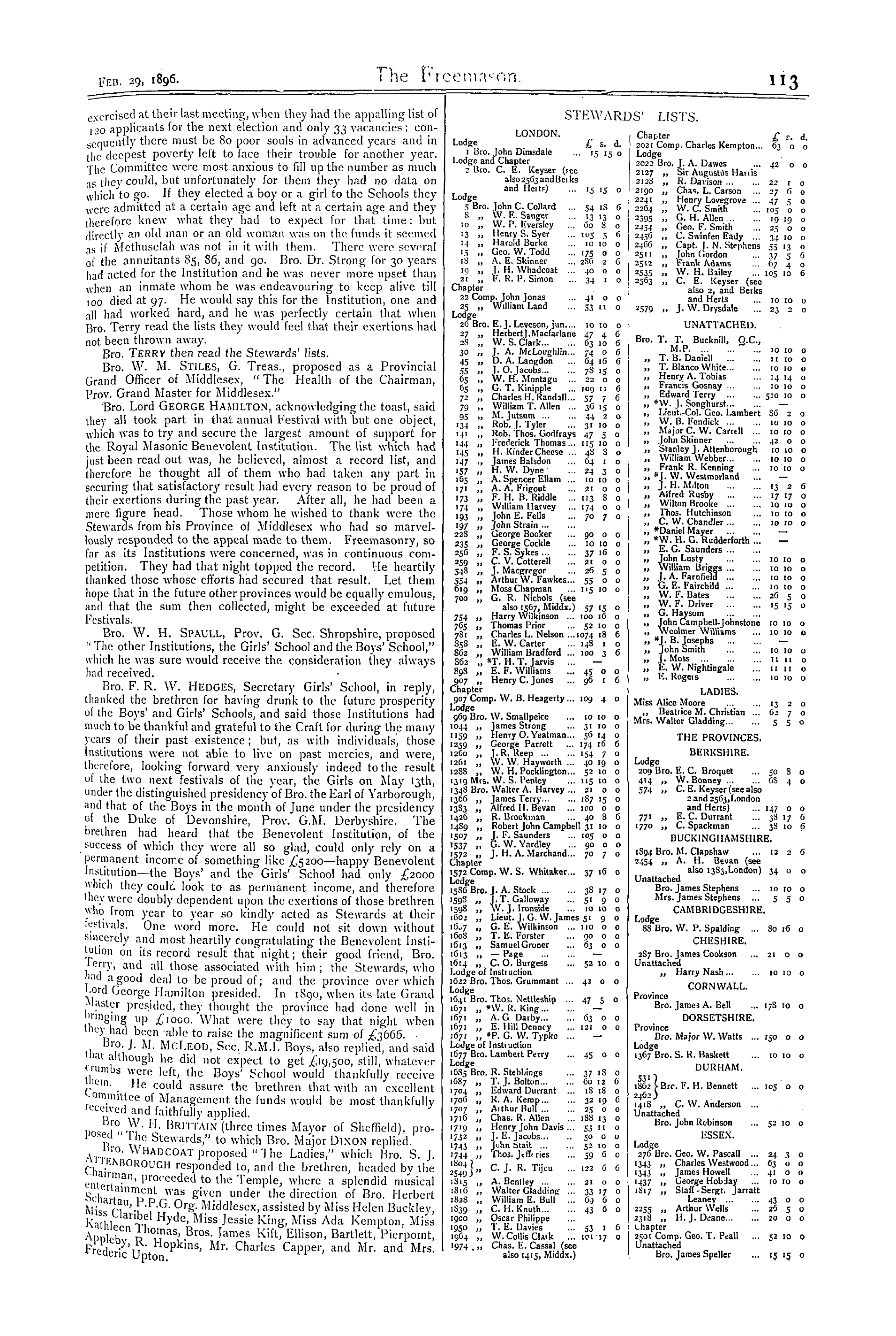
Bro . J . A . FARNKIEI . D , Treasurer , President of the Board ol Stewards , in reply , said as it was his bounden duty to do <•" behalf of the Institution he represented , he thanked Lord Geoi'g ' Hamilton for having put the cause of the Institution so forcibly before ( he brethren . The Committee of Management were » 1 UC






Note: This text has been automatically extracted via Optical Character Recognition (OCR) software.
Annual Festival Of The Royal Masonic Benevolent Institution.
Bro . Lord GEORGE HAMILTON next rose and said he had now the honour to propose the toast of the evening , " Success to the Royal Masonic Benevolent Institution for Aged Freemasons and Widows of Freemasons . " That was a toast which did not require any greatly lengthened speech to recommend it
to the brethren . He thought they would all , agree that whilst there were many good qualities associated with Freemasonry , the arch and foundation of their system was that of brotherly love one towards another , and that brotherly love must assume not
merely the form of kindly intercourse and communication with others in times of prosperity , but it also necessitated their relieving , to ( he best of their ability , the wants of those who were less fortunate than themselves and were in necessitous
circumstances . This had been admitted , he thought , by all who had occupied positions of authority and trust in the Craft , to be the keystone of the Brotherhood . ( Applause . ) They were honoured that night by the presence of ladies , and when he said that the guiding influence of Freemasons was brotherly
love , he hoped the . ladies would not accept that sentiment in a limited sense ; he used it in a broad sense , and one which w as explained to him many years ago by a distinguished pillar of the church , who informed him that in his early life he had a large parish in which there were a considerable number of fair
parishioners of advanced views , and they canie one day to him as a deputation , and protested against his commencing service on the Sunday with the words " Dearly beloved brethren ; " they wished him to add the words " and sisters . " ( Laughter . ) But the reply of his venerable friend routed bis fair plaintiffs , for he
said : " I am a man of experience in the world ' s affairs , and my experience tells me that the brethren embrace the sisterhood " —( laughter)— " and , " he added , " ladies , it is only when your experience points in a contrary direction that I shall add to the word ' brethren' 'and sisters . ' " ( Renewed laughter . ) And it was
in that sense in which his reverend friend interpreted the word "brethren" that he ( Lord George Hamilton ) now used the word . They all knew that benevolence was one of the main objects of individual lodges ; but their forefathers felt some 50 years back that if they were to erect a permanent , durable ,
public institution denoting the benevolent views that influenced the brethren it must not be a spasmodic movement , supported by a lodge here or there , but by the united co-operation of the brethren , and in that sense and with that view that great Benevolent Institution was first established and created . Then it
divided itself into two parts ; there were those who lived in the Institution and received a certain annuity , and there were those who lived at home and received the annuity there . For years past it had been the practice of the House Committee , who were charged with the functions of supervising the houses at Croydon ,
to make an inspection on the day previous to the annual Festival . He ( Lord George Hamilton ) accepted readily the invitation of the House Committee to accompany them on Tuesday in that their quarterly visit . He went there with two distinct objects in his mind . After benevolence , he thought the
next great principle which characterised Freemasons was a sense of equality . No matter what a man ' s station might be , they met on terms of absolute equality . Now , that feeling should characterise them outside lodges when they came in contact with Masons , and he said to himself , " Is it possible that
the House Committee have so far accepted and engrafted in them that doctrine that they will be able to discharge their charitable functions that these poor people can receive the quarterly payments without a sense of seK-degradation and pauperism ? " The result of his experience on Tuesday was most satisfactory .
There were 32 aged persons living in separate tenements of ( heir own , and they received the House Committee not as persons about to give a dole , but as visitors , and from beginning to end there was that sense of equality between those who were giving and those who were receiving which was characteristic of
Freemasons . ( Hear , hear . ) It would be invidious to mention any one member of the House Committee , but he could not hel p noticing that the ubiquity and bonhomie of their old friend , Bro . Terry , had a remarkable effect on all with whom he came in contact . Even those eyes that were dimmed by age lighted up
at his chaff and fun ; even those whose form was bent with disease and suffering were straightened up by the cheery words addressed to them when they received their pension ( cheers ) , and therefore he came away with that satisfactory feeling that if the almsgiving and benevolence of ( he Craft was on a grand
scale it was conveyed in a manner to winch no one could raise any possible objection . But Tuesday was a bright and cheery day and it made him think a little of the future , and ascertain of the fair sisterhood were in ( he gallery now perhaps they would
pardon him if he ventured very humbly to express to the brethren and to them what was the substance of his soliloquy ; there were all sorts and conditions of people in those houses—old widowers , old widows , old bachelors , but there were no old
Annual Festival Of The Royal Masonic Benevolent Institution.
spinsters . ( Laughter . ) Well , he thought that was hard . As a boy he recollected in Ireland being present many , many years ago at the distribution of funds for the benefit of widows , and an elderly lady came up and argued that she was entitled to a certain share , but thev said " vou are not a widow . " She s . mVl
" Not a widow ! Sure , I ' m the worst of widows , for I ' m an old maid . " ( Laughter , and cheers . ) He ( Lord George Hamilton ) was thinking , not in his far , but his immediate future , what would be the brethren's prospects then of the ramparts of man ' s omnipotence being rapidly stormed by the new woman in the
future ? Women competed with men in athletics , and went in for the same examinations with remarkable results ; some of them borrow even part of men ' s garments —( laughter )—and he would say frankly , not with advantage to the women . Women were hammering at the door of the House of Commons , and if they
once set their minds on that object they would soon sit in lod ges and with their numbers and determination , it might be doubted whether the brethren would be the predominant feature in the future . ( Laughter . ) Well , perhaps , when that came they might deal more mercifull y with the brethren than the brethren had
with them , and if the members of the Benevolent Institution could be allowed to be bachelors , ladies would remember they were the worst of all widows , for they had never been married . ( Laughter . ) Now he had to ask the brethren to recollect that that annual meeting was one of serious business import . He
had been informed by those who were competent to advise him , that the annual expenditure in connection with that Institution was about £ 16 , 300 ; that was permanent expenditure ; but the permanent income was only £ 5300 , and there was a permanent deficit of no less than £ 11 , 000 , or 79 per cent , of the net
expenditure , in other words , if the permanent income could not be supplemented , no less than 70 per cent , of the 472 recipients of the brethren ' s bounty would be precluded from receiving it every year . Now , these annual Festivals made good that deficiency , and he was glad to say they had done more than that ; there was
generally some slight surplus to be invested , which enabled those who managed the funds to increase the number of reci pients . He wished to be quite frank ; he had some hesitation in accepting the chairmanship of that Festival ; he felt he was asked to do so not from any merits of his own , but from being head of the Province of Middlesex . The Province of Middlesex had
not yet had an opportunity , through circumstances over which it had no control ; lodges had not had the advantage of coming personally in contact with him as they would if he had been less busily engaged ; and , therefore , he consulted his friends and advisers—Bro . Thrupp , the Deputy Provincial Grand Master , and Bro . Room—as to whether , under those circumstances , he would
be justified in acceptingthe position , and whether he could rely on the province ' s hearty support . Bros . Thrupp and Room told him there could be littte doubt as to the loyalty and fidelity of the Province as to the way they would respond . When the brethren
heard the lists read , they would be able to judge of that ; but a little bird had whispered to him that the Province of Middlesex had nobly responded , and he believed it not only beat the record , but it did so by a very substantial amount . ( Cheers ) . Well , if that be the result of the contributions from the Province of
Middlesex , he was hopeful that the provinces outside would respond to an equal extent ; and he would especially appeal to those who were residents in London . He had been thirty years in London , and had seen that great metropolis expand and extend during that period in an incredible degree , and in all the
outward attributes of . wealth , splendour , luxury , and civilisation , it had advanced enormously . London was not only the capital of England , but the capital of the greatest empire the world had ever seen ; that empire occupied one-fifth of the habitable globe . But side by side with this great increase of wealth
and of luxury , there were certain deterrent causes ; competition in many phases of life was far severer than it was thirty years ago ; the race that had to be run could only be won by the swift ; and although there might be very great ability , still , if from any exceptional circumstances—from bad health , ill luck , or
other unfortunate combinations—a competitor got left behind , as it often happened , he never could get again in the rank . Therefore , speaking , as he then was , to people in prosperous conditions , he would say let them be generous to those less successful I let them remember that the annual vacancies were few and ( he
applicants many ; let them hope that the result of that aim > w Festival would not only make good the deficiency between '" come and expenditure , but leave something for the Treasurer that the Institution might increase the number of those to who " that fund contributed .
Bro . J . A . FARNKIEI . D , Treasurer , President of the Board ol Stewards , in reply , said as it was his bounden duty to do <•" behalf of the Institution he represented , he thanked Lord Geoi'g ' Hamilton for having put the cause of the Institution so forcibly before ( he brethren . The Committee of Management were » 1 UC