-
Articles/Ads
Article CENTENARY OF No. 279, LEICESTER. ← Page 2 of 2 Article THE SCHOOL OF FREEMASONRY. Page 1 of 1 Article THE SCHOOL OF FREEMASONRY. Page 1 of 1 Article AN OLD MASONIC CERTIFICATE. Page 1 of 1
Note: This text has been automatically extracted via Optical Character Recognition (OCR) software.
Centenary Of No. 279, Leicester.
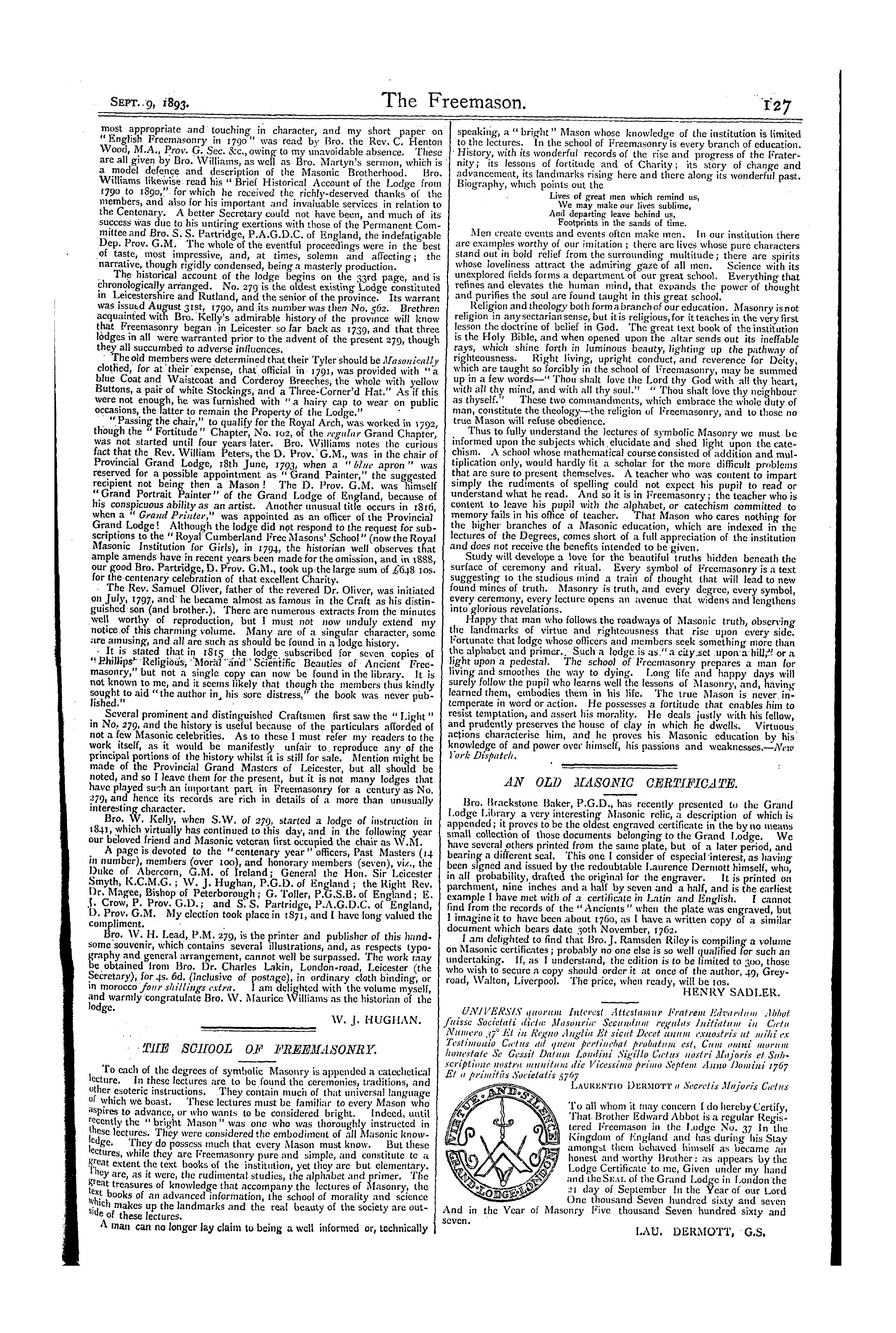
most appropriate and touching in character , and my short paper on "English Freemasonry in 1790 " was read by Bro . the Rev . C . Henton Wood , M . A ., Prov . G . Sec . & c , owing to my unavoidable absence . These are all given by Bro . Williams , as well as Bro . Martyn's sermon , which is a model defence and description of the Masonic Brotherhood . Bro . Williams likewise read his " Brief Historical Account of the Lodge from 1 790 to 1890 , " for which he received the richly-deserved thanks of the
members , and also lor his important and invaluable services in relation to the Centenary . A better Secretary could not have been , and much of its success was due to his untiring exertions with those of the Permanent Committee and Bro . S . S . Partridge , P . A . G . D . C . of England , the indefatigable Dep . Prov . G . M . The whole of the eventful proceedings were in the best of taste , most impressive , and , at times , solemn and affecting ; thc narrative , though rigidly condensed , being a masterly production .
The historical account of the lodge begins on the 33 rd page , and is chronologically arranged . No . 279 is the oldest existing Lodge constituted in Leicestershire and Rutland , and the senior of the province . Its warrant was issutd August 31 st , 1790 , and its numberwas then No . 562 . Brethren acquainted with Bro . Kelly ' s admirable history of the province will know that Freemasonry began in Leicester so far back as 1739 , and that three lodges in all were warranted prior to the advent of the present 279 , though they all succumbed to adverse influences .
The old members were determined that their Tyler should be Masonically clothed , for at their expense , that official in 1791 , was provided with " a blue Coat and Waistcoat and Corderoy Breeches , the whole with yellow Buttons , a pair of white Stockings , and a Three-Corner'd Hat . " As if this were not enough , he was furnished with " a hairy cap to wear on oublic occasions , the latter to remain the Property of the Lodge . " ' '
massing the chair , to qualify for the Royal Arch , was worked in 1792 , though the " Fortitude " Chapter , No . 102 , of the regular Grand Chapter , was not started until four years later . Bro . Williams notes the curious fact that the Rev . William Peters , the D . Prov . G . M ., was in the chair of Provincial Grand Lodge , 18 th June , 1793 , when a " blue apron " was reserved for a possible appointment as " Grand Painter , " the sueeested
recipient not being then a Mason ! The D . Prov . G . M . was himself "Grand Portrait Painter" of the Grand Lodge of England , because of his conspicuous ability as an artist . Another unusual title occurs in 1816 , when a " Grand Printer , " was appointed as an officer of the Provincial Grand Lodge ! Although the lodge did not respond to the request for subscriptions to the " Royal Cumberland Free Masons' School" ( now the Roval
Masonic Institution for Girls ) , in 1794 , the historian well observes that ample amends have in recent years been made for the omission , and in t 888 , our good Bro . Partridge , D . Prov . G . M ., took up the large sum of £ 648 ios . for the centenary celebration of that excellent Charity . The Rev . Samuel Oliver , father of the revered Dr . Oliver , was initiated on July , 1797 , and' he became almost as famous in thc Craft as his distinguished son ( and brother . ) . There are numerous extracts from the minutes
well worthy of reproduction , but I must not now unduly extend my notice of this charming volume . Many are of a singular character , some are amusing , and all are such as should be found in a lodge history . It is stated that in 1815 the lodge subscribed for seven copies of " Phillips ^ Religious , '"' MorSl " and * Scientific Beauties of Ancient Freemasonry , " but not a single copy can now be found in the library . It is not known to me , and it seems likely that though the members thus kindly sought to aid " the author in , his sore distress , " the book was never published . "
Several prominent and distinguished Craftsmen first saw the " Light " in No . 279 , and the history is useful because of the particulars afforded of not a few Masonic celebrities . As to these I must refer my readers to the work itself , as it would be manifestly unfair to . reproduce any of the principal portions of the history whilst it is still for sale . Mention mi ght be made of the Provincial Grand Masters of Leicester , but all should be
noted , and so I leave them for the present , but it is not many lodges that have played such an important part in Freemasonry for a century as No . 279 , and hence its records are rich in details of a more than unusually interesting character . Bro . W . Kelly , when S . W . ol 279 , started a lodge of instruction in 1841 , which virtually has continued to this dav , and in the following year our beloved friend and Masonic veteran iirst occupied the chair as W . M . A Dace is devoted to the . " enntcnarv vrar " nffii-ore P _ icf MHI ^/ H
in number ) , members ( over 100 ) , and honorary members ( seven ) , viz ., the Duke of Abercorn , G . M . of Ireland ; General the Hon . Sir Leicester Smyth , K . C . M . G . ; W . J . Hughan , P . G . D . of England j the Right Rev . Dr . Magee , Bishop of Peterborough ; G . Toller , P . G . S . B . of England ; E . j . Crow , P . Prov . G . D . ; and S . S . Partridge , P . A . G . D . C . of England , D . Prov . G . M . My election took place in 1871 , and I have long valued thc compliment .
Bro . W . H . Lead , P . M . 279 , is the printer and publisher of this handsome souvenir , which contains several illustrations , and , as respects typography and general arrangement , cannot well be surpassed . Thc work may be obtained lrom Bro . Dr . Charles Lakin , London-road , Leicester ( the Secretary ) , for 4 s . 6 d . ( inclusive ol postage ) , in ordinary cloth binding , or in morocco four shillings extra . I am delighted with the volume myself , and warmly congratulate Bro . W . Maurice Williams as thc historian of the lodge . ^ W . J . HUGHAN .
The School Of Freemasonry.
THE SCHOOL OF FREEMASONRY .
lo each of the degrees of symbolic Masonry is appended a catechetical lecture . In these lectures are to be found the ceremonies , traditions , and "ther esoteric instructions . They contain much of that universal language 0 ( which we boast . These lectures must be familiar to every Mason who aspires to advance , or who wants to be considered bright . Indeed , until recentl y the " bright Mason " was one who was thoroughly instructed in tnesc lectures . They were considered the embodiment of all Masonic
know-| tage . I hey do possess much that every Mason must know . But these cctures , while they are Freemasonry pure and simple , and constitute tc a / j . ^ at extent the text books of the institution , yet they are but elementary . ney are , as it were , the rudimental studies , the alphabet and primer . The | > ea < -treasures of knowledge that accompany the lectures of Masonry , the ivh r " ** 5 of an advanced information , the school of morality and science Jw makes up the landmarks and the real beauty of the society are out->« e of these lectures . A man can no longer lay claim to being a well informed or , technically
The School Of Freemasonry.
speaking , a " bright" Mason whose knowledge of the institution is limited to the lectures . In the school of Freemasonry is every branch of education . History , with its wonderful records of the rise and progress of the Fraternity ; its lessons of fortitude and of Charity ; its story of change and advancement , its landmarks rising here and there along its wonderful past . Biography , which points out the
Lives of great men which remind us , We may make our lives sublime , And departing leave behind us , Footprints in the sands of time . Men create events and events often make men . In our institution there are examples worthy of our imitation ; there are lives whose pure characters stand out in bold relief from the surrounding multitude ; there are spirits
whose loveliness attract the admiring gaze of all men . Science with its unexplored fields forms a department of our great school . Everything that refines and elevates the human mind , that expands the power of thought and purifies the soul are found taught in this great school . Religion and theology both form a branch ol our education . Masonry is not religion in anysectarian sense , but it is religious , for it teaches in theveryfirst lesson the doctrine of belief in God . The great text book of the institution is the Holy Bible , and when opened upon the altar sends out its ineffable
rays , which shine forth in luminous beauty , lighting up the pathway of righteousness . Right living , upright conduct , and reverence for Deity , which are taught so forcibly in the school of Freemasonry , may be summed up in a few words— " Thou shalt love the Lord th y God with al ! thy heart , with all thy mind , and with all thy soul . " " Thou shalt love thy neighbour as thyself . " These two commandments , which embrace the whole duty of man , constitute the theology—the religion of Freemasonry , and to those no true Mason will refuse obedience .
Thus to fully understand the lectures of symbolic Masonry wc must be informed upon the subjects which , elucidate and shed light upon the catechism . A school whose mathematical course consisted of addition and multiplication only , would hardly lit a scholar for the more difficult problems that are sure to present themselves . A teacher who was content to impart simply the rudiments of spelling could not expect his pupil to read or
understand what he read . And so it is in Freemasonry ; the teacher who is content to leave his pupil with the al p habet , or catechism committed to memory fails in his office of teacher . That Mason who cares nothing for the higher branches of a Masonic education , which are indexed in thc lectures of the Degrees , comes short of a full appreciation of the institution and does not receive the benefits intended to be given .
Study will develope a love for the beautiful truths hidden beneath the surface of ceremony and ritual . Every symbol of Freemasonry is a text suggesting to the studious mind a train of thought that will lead to new found mines of truth . Masonry is truth , and every degree , every symbol , every ceremony , every lecture opens an avenue that widens and lengthens into glorious revelations .
Happy that man who follows the roadways of Masonic truth , observing the landmarks of virtue and ri ghteousness that rise upon every side . Fortunate that lodge whose officers and members seek something more than the alphabet and primer .. Such a lodge . is as . " a city . set upona hiU , - or a light upon a pedestal . The school of Freemasonry prepares a man for living and smoothes the way to dying . Long life and happy days will surely follow the pupil who learns well the lessons of Masonry , andhaving
, learned them , embodies them in his life . Thc true Mason is never , intemperate in word or action . He possesses a fortitude that enables him to resist temptation , and assert his morality . He deals justly with his fellow , and prudently preserves the house of clay in which he dwells . Virtuous actions characterise him , and he proves his Masonic education by his knowledge of and power over himself , his passions and weaknesses . —New York Dispatch .
An Old Masonic Certificate.
AN OLD MASONIC CERTIFICATE .
Bro . Brackstone Baker , P . G . D ., has recently presented to the Grand Lodge Library a very interesting Masonic relic , a description of which is appended ; it proves to bc the oldest engraved certificate in the by no means small collection of those documents belonging to the Grand Lodge . Wc have several others printed from the same plate , but of a later period , and bearing a different seal . This one I consider of especial interest , as having ' been signed and issued by the redoubtable Laurence Dermott himself , who .
in all probability , drafted the original for the engraver . It is printed on parchment , nine inches and a half by seven and a half , and is the earliest example I have met with of a certificate in Latin and English . I cannot find from the records of the "Ancients " when the plate was engraved , but I imagine it to have been about 1760 , as I have a written copy of a similar
document which bears date 30 th November , 1762 . I am delighted to find that Bro . J . Ramsden Riley is compiling a volume on Masonic certificates ; probably no one else is so well qualified for such an undertaking . If , as I understand , the edition is to be limited to 300 , those who wish to secure a copy should order it at once of the author , 49 , Greyroad , Walton , Liverpool . The price , when ready , will be ios . HENRY SADLER .
NNIVEliSlS quorum Interest Attcslnmur Fratrem Edvardtint Abbot fiusse Societaii dicta : Masonriic Secundum regains luitiiiliiin in Cietti Niimero ,, 7 ° El in Regno Anglia Et sicut Dec . et iiniim exnostris ttt nii / ii ex fesliiuonio Cains tid i / ueiu pcrtinebat probatitm est , Cunt muni morn 111 Iionestatc Se Gessit Datum Londini Sigillo Cicttts nostri Maj ' oris et Subscriptionc nostra intiuitiim die Vicessimo priiuo Septan Anno Domini 1767 Et a pi'iniitits Societatis 5767
LAURENTIO DERMOTT a Secret is Majoris Ctetin To all whom it may concern I do hereby Certify , That Brother Edward Abbot is a regular Registered Freemason in thc Lodge No . 37 In thc
Kingdom of England and has during his Stay amongst them behaved himself as became an honest and worthy Brother : as appears by thc Lodge Certificate to mc , Given under my hand and theSEAL of the Grand Lodge in London the 21 day of September In the Year of our Lord One thousand Seven hundred sixty and seven
And in thc Year of Masonry Five thousand Seven hundred sixty and seven . LAU . DERMOTT , G . S .







Note: This text has been automatically extracted via Optical Character Recognition (OCR) software.
Centenary Of No. 279, Leicester.
most appropriate and touching in character , and my short paper on "English Freemasonry in 1790 " was read by Bro . the Rev . C . Henton Wood , M . A ., Prov . G . Sec . & c , owing to my unavoidable absence . These are all given by Bro . Williams , as well as Bro . Martyn's sermon , which is a model defence and description of the Masonic Brotherhood . Bro . Williams likewise read his " Brief Historical Account of the Lodge from 1 790 to 1890 , " for which he received the richly-deserved thanks of the
members , and also lor his important and invaluable services in relation to the Centenary . A better Secretary could not have been , and much of its success was due to his untiring exertions with those of the Permanent Committee and Bro . S . S . Partridge , P . A . G . D . C . of England , the indefatigable Dep . Prov . G . M . The whole of the eventful proceedings were in the best of taste , most impressive , and , at times , solemn and affecting ; thc narrative , though rigidly condensed , being a masterly production .
The historical account of the lodge begins on the 33 rd page , and is chronologically arranged . No . 279 is the oldest existing Lodge constituted in Leicestershire and Rutland , and the senior of the province . Its warrant was issutd August 31 st , 1790 , and its numberwas then No . 562 . Brethren acquainted with Bro . Kelly ' s admirable history of the province will know that Freemasonry began in Leicester so far back as 1739 , and that three lodges in all were warranted prior to the advent of the present 279 , though they all succumbed to adverse influences .
The old members were determined that their Tyler should be Masonically clothed , for at their expense , that official in 1791 , was provided with " a blue Coat and Waistcoat and Corderoy Breeches , the whole with yellow Buttons , a pair of white Stockings , and a Three-Corner'd Hat . " As if this were not enough , he was furnished with " a hairy cap to wear on oublic occasions , the latter to remain the Property of the Lodge . " ' '
massing the chair , to qualify for the Royal Arch , was worked in 1792 , though the " Fortitude " Chapter , No . 102 , of the regular Grand Chapter , was not started until four years later . Bro . Williams notes the curious fact that the Rev . William Peters , the D . Prov . G . M ., was in the chair of Provincial Grand Lodge , 18 th June , 1793 , when a " blue apron " was reserved for a possible appointment as " Grand Painter , " the sueeested
recipient not being then a Mason ! The D . Prov . G . M . was himself "Grand Portrait Painter" of the Grand Lodge of England , because of his conspicuous ability as an artist . Another unusual title occurs in 1816 , when a " Grand Printer , " was appointed as an officer of the Provincial Grand Lodge ! Although the lodge did not respond to the request for subscriptions to the " Royal Cumberland Free Masons' School" ( now the Roval
Masonic Institution for Girls ) , in 1794 , the historian well observes that ample amends have in recent years been made for the omission , and in t 888 , our good Bro . Partridge , D . Prov . G . M ., took up the large sum of £ 648 ios . for the centenary celebration of that excellent Charity . The Rev . Samuel Oliver , father of the revered Dr . Oliver , was initiated on July , 1797 , and' he became almost as famous in thc Craft as his distinguished son ( and brother . ) . There are numerous extracts from the minutes
well worthy of reproduction , but I must not now unduly extend my notice of this charming volume . Many are of a singular character , some are amusing , and all are such as should be found in a lodge history . It is stated that in 1815 the lodge subscribed for seven copies of " Phillips ^ Religious , '"' MorSl " and * Scientific Beauties of Ancient Freemasonry , " but not a single copy can now be found in the library . It is not known to me , and it seems likely that though the members thus kindly sought to aid " the author in , his sore distress , " the book was never published . "
Several prominent and distinguished Craftsmen first saw the " Light " in No . 279 , and the history is useful because of the particulars afforded of not a few Masonic celebrities . As to these I must refer my readers to the work itself , as it would be manifestly unfair to . reproduce any of the principal portions of the history whilst it is still for sale . Mention mi ght be made of the Provincial Grand Masters of Leicester , but all should be
noted , and so I leave them for the present , but it is not many lodges that have played such an important part in Freemasonry for a century as No . 279 , and hence its records are rich in details of a more than unusually interesting character . Bro . W . Kelly , when S . W . ol 279 , started a lodge of instruction in 1841 , which virtually has continued to this dav , and in the following year our beloved friend and Masonic veteran iirst occupied the chair as W . M . A Dace is devoted to the . " enntcnarv vrar " nffii-ore P _ icf MHI ^/ H
in number ) , members ( over 100 ) , and honorary members ( seven ) , viz ., the Duke of Abercorn , G . M . of Ireland ; General the Hon . Sir Leicester Smyth , K . C . M . G . ; W . J . Hughan , P . G . D . of England j the Right Rev . Dr . Magee , Bishop of Peterborough ; G . Toller , P . G . S . B . of England ; E . j . Crow , P . Prov . G . D . ; and S . S . Partridge , P . A . G . D . C . of England , D . Prov . G . M . My election took place in 1871 , and I have long valued thc compliment .
Bro . W . H . Lead , P . M . 279 , is the printer and publisher of this handsome souvenir , which contains several illustrations , and , as respects typography and general arrangement , cannot well be surpassed . Thc work may be obtained lrom Bro . Dr . Charles Lakin , London-road , Leicester ( the Secretary ) , for 4 s . 6 d . ( inclusive ol postage ) , in ordinary cloth binding , or in morocco four shillings extra . I am delighted with the volume myself , and warmly congratulate Bro . W . Maurice Williams as thc historian of the lodge . ^ W . J . HUGHAN .
The School Of Freemasonry.
THE SCHOOL OF FREEMASONRY .
lo each of the degrees of symbolic Masonry is appended a catechetical lecture . In these lectures are to be found the ceremonies , traditions , and "ther esoteric instructions . They contain much of that universal language 0 ( which we boast . These lectures must be familiar to every Mason who aspires to advance , or who wants to be considered bright . Indeed , until recentl y the " bright Mason " was one who was thoroughly instructed in tnesc lectures . They were considered the embodiment of all Masonic
know-| tage . I hey do possess much that every Mason must know . But these cctures , while they are Freemasonry pure and simple , and constitute tc a / j . ^ at extent the text books of the institution , yet they are but elementary . ney are , as it were , the rudimental studies , the alphabet and primer . The | > ea < -treasures of knowledge that accompany the lectures of Masonry , the ivh r " ** 5 of an advanced information , the school of morality and science Jw makes up the landmarks and the real beauty of the society are out->« e of these lectures . A man can no longer lay claim to being a well informed or , technically
The School Of Freemasonry.
speaking , a " bright" Mason whose knowledge of the institution is limited to the lectures . In the school of Freemasonry is every branch of education . History , with its wonderful records of the rise and progress of the Fraternity ; its lessons of fortitude and of Charity ; its story of change and advancement , its landmarks rising here and there along its wonderful past . Biography , which points out the
Lives of great men which remind us , We may make our lives sublime , And departing leave behind us , Footprints in the sands of time . Men create events and events often make men . In our institution there are examples worthy of our imitation ; there are lives whose pure characters stand out in bold relief from the surrounding multitude ; there are spirits
whose loveliness attract the admiring gaze of all men . Science with its unexplored fields forms a department of our great school . Everything that refines and elevates the human mind , that expands the power of thought and purifies the soul are found taught in this great school . Religion and theology both form a branch ol our education . Masonry is not religion in anysectarian sense , but it is religious , for it teaches in theveryfirst lesson the doctrine of belief in God . The great text book of the institution is the Holy Bible , and when opened upon the altar sends out its ineffable
rays , which shine forth in luminous beauty , lighting up the pathway of righteousness . Right living , upright conduct , and reverence for Deity , which are taught so forcibly in the school of Freemasonry , may be summed up in a few words— " Thou shalt love the Lord th y God with al ! thy heart , with all thy mind , and with all thy soul . " " Thou shalt love thy neighbour as thyself . " These two commandments , which embrace the whole duty of man , constitute the theology—the religion of Freemasonry , and to those no true Mason will refuse obedience .
Thus to fully understand the lectures of symbolic Masonry wc must be informed upon the subjects which , elucidate and shed light upon the catechism . A school whose mathematical course consisted of addition and multiplication only , would hardly lit a scholar for the more difficult problems that are sure to present themselves . A teacher who was content to impart simply the rudiments of spelling could not expect his pupil to read or
understand what he read . And so it is in Freemasonry ; the teacher who is content to leave his pupil with the al p habet , or catechism committed to memory fails in his office of teacher . That Mason who cares nothing for the higher branches of a Masonic education , which are indexed in thc lectures of the Degrees , comes short of a full appreciation of the institution and does not receive the benefits intended to be given .
Study will develope a love for the beautiful truths hidden beneath the surface of ceremony and ritual . Every symbol of Freemasonry is a text suggesting to the studious mind a train of thought that will lead to new found mines of truth . Masonry is truth , and every degree , every symbol , every ceremony , every lecture opens an avenue that widens and lengthens into glorious revelations .
Happy that man who follows the roadways of Masonic truth , observing the landmarks of virtue and ri ghteousness that rise upon every side . Fortunate that lodge whose officers and members seek something more than the alphabet and primer .. Such a lodge . is as . " a city . set upona hiU , - or a light upon a pedestal . The school of Freemasonry prepares a man for living and smoothes the way to dying . Long life and happy days will surely follow the pupil who learns well the lessons of Masonry , andhaving
, learned them , embodies them in his life . Thc true Mason is never , intemperate in word or action . He possesses a fortitude that enables him to resist temptation , and assert his morality . He deals justly with his fellow , and prudently preserves the house of clay in which he dwells . Virtuous actions characterise him , and he proves his Masonic education by his knowledge of and power over himself , his passions and weaknesses . —New York Dispatch .
An Old Masonic Certificate.
AN OLD MASONIC CERTIFICATE .
Bro . Brackstone Baker , P . G . D ., has recently presented to the Grand Lodge Library a very interesting Masonic relic , a description of which is appended ; it proves to bc the oldest engraved certificate in the by no means small collection of those documents belonging to the Grand Lodge . Wc have several others printed from the same plate , but of a later period , and bearing a different seal . This one I consider of especial interest , as having ' been signed and issued by the redoubtable Laurence Dermott himself , who .
in all probability , drafted the original for the engraver . It is printed on parchment , nine inches and a half by seven and a half , and is the earliest example I have met with of a certificate in Latin and English . I cannot find from the records of the "Ancients " when the plate was engraved , but I imagine it to have been about 1760 , as I have a written copy of a similar
document which bears date 30 th November , 1762 . I am delighted to find that Bro . J . Ramsden Riley is compiling a volume on Masonic certificates ; probably no one else is so well qualified for such an undertaking . If , as I understand , the edition is to be limited to 300 , those who wish to secure a copy should order it at once of the author , 49 , Greyroad , Walton , Liverpool . The price , when ready , will be ios . HENRY SADLER .
NNIVEliSlS quorum Interest Attcslnmur Fratrem Edvardtint Abbot fiusse Societaii dicta : Masonriic Secundum regains luitiiiliiin in Cietti Niimero ,, 7 ° El in Regno Anglia Et sicut Dec . et iiniim exnostris ttt nii / ii ex fesliiuonio Cains tid i / ueiu pcrtinebat probatitm est , Cunt muni morn 111 Iionestatc Se Gessit Datum Londini Sigillo Cicttts nostri Maj ' oris et Subscriptionc nostra intiuitiim die Vicessimo priiuo Septan Anno Domini 1767 Et a pi'iniitits Societatis 5767
LAURENTIO DERMOTT a Secret is Majoris Ctetin To all whom it may concern I do hereby Certify , That Brother Edward Abbot is a regular Registered Freemason in thc Lodge No . 37 In thc
Kingdom of England and has during his Stay amongst them behaved himself as became an honest and worthy Brother : as appears by thc Lodge Certificate to mc , Given under my hand and theSEAL of the Grand Lodge in London the 21 day of September In the Year of our Lord One thousand Seven hundred sixty and seven
And in thc Year of Masonry Five thousand Seven hundred sixty and seven . LAU . DERMOTT , G . S .