-
Articles/Ads
Article SIR WALTER SCOTT AND FREEMASONRY. ← Page 2 of 2 Article THE DANGERS OF SUCCESS. Page 1 of 1 Article THE DANGERS OF SUCCESS. Page 1 of 1 Article THE ILLUMINATING POWER OF FREEMASONRY. Page 1 of 1
Note: This text has been automatically extracted via Optical Character Recognition (OCR) software.
Sir Walter Scott And Freemasonry.
Amongst the more commonplace allusions to the Craft are the following : There prevailed amongst the highlanders who pretended to the second sight a sort of Freemasonry , etc . —Legend of Montrose . In youth , however , there is a sort of Freemasonry which , without much conversation , teaches young persons to estimate each others character . —The Monastery .
If they see a person in company , though a perfect stranger , who is by nature fond of children , the little imps seem to discover it by a sort of Freemasonry . — The Abbot . J J
It is I believe a piece of Freemasonry amongst the Scottish lower orders , etc . —Antiquary . Instinctive Freemasonry of love . —Talisman . But there are other allusions less general and more specific . In the
preface to _ "Rob Roy" the following passage occurs : "As it may be necessary in the present edition ( 1829 ) to speak upon the square . " In " Quentin Durward , " Lord Crawford , addressing his company of Scottish archers , is made to say , " Well , lads , we must live within compass . " There are many other passages worth y of notice . For instance :
The Latin reply had upon the schoolmaster the effect which the Masons sign is said to produce upon the brethren of the trowel . —Kenilworth . It was followed by a solemn and peculiar tap , such as a kind of Freemasonry had introduced among Royalists , and by which they were accustomed to make themselves and their principles known to each other when they met by accident . — Woodstock .
The parties met in the Masons' lodge , at Kippletringan . —Guy Mannering . They recognised each other with a single word , sometimes only with a grip of the hand , exchanged some private sign , doubtless . —Redgauntlet . And when he had exchanged some of those words and signals b y which , as surely as by those of Freemasonry , young people recognise a mutual wish , etc . — The Fortunes of Nigel .
_ Her body was burnt at the stake , and her ashes were scattered to the four winds . —Itianhoe .
In "Anne of Gierstien , " a work which introduces the Vehmic tribunals , there are numerous passages which have a smack of Masonry—to quote one only : Measurers of good and evil , Bring the square , the line , the level . In the " Antiquary , " the following passage will be found :
Ay , ay , rejoined Oldbuck , you mean , I suppose , Mair and Boece , the Zachin and Boaz , not of history , but of falsification and forgery . The following passages are not uninteresting to Royal Arch Masons : The destroying angel hath stood still , as of old , by the threshing floor of Araunah , the Jebusite . —Talisman . An almost identical passage to the above is to be found in "Peverii of the Peak . "
Put oft thy shoes , he said to his attendant , the ground on which thou standest is holy . —Talisman . We find copestones mentioned in " Ivanhoe , " and in " Kenilworth " " a Treatise on the letter Tau " is spoken of . To members of the less recognised Degrees the subjoined passages will convey a hidden meaning :
By which Temple , said the Marquis of Montserrat , swearest thou by that on the Hill of Sion , which was built b y King Solomon , or by that symbolical emblematical edifice which is said to be spoken of in the councils held in the vaults of your preceptories , as something which infers the aggrandisement of thy valiant and venerable order . —Talisman . Certain it is that he professed to be a brother of the mystical rosy cross . — Kenilworth .
No one' but thyself could have gulled thee , and thou hast gulled the whole brotherhood of the Rosy Cross besides . —Ibid . Description and illustration of the Arch of Steel . —Pirate . The war cry of the Templars " Beasdant . "—Talisman . While the challenger rode round the lists in the course of the sun—that is from right to left—the defender made the same circuit widdersins—that is from left to right—which is in most countries held ominous . —Talisman .
In the " Monastery" there occurs a foot-note explanatory of expressions used by the Euphuist , Sir Piercie Shafton , as follows : I think there is some remnant of the foppery preserved in Masonic lodges where each brother is distinguished b y a name in the lodge , signifying some abstract quality as discretion or the like .
There may be other passages which have a bearing upon Freemasonry scattered through the writings of Scotland ' s great novelist , but the specimens given are sufficient for the writer ' s purpose , which is to show that Sir Walter Scott ( taking it for granted that he was never actuall y admitted into Freemasonry ) was not altogether i gnorant of the traditions and symbolism of the
< -ratt . Me was of that peculiar temperament which loves to live in the past , whose active brain was stored with tradition , whose power of acquiring knowled ge of out-of-the-way facts was almost unique , that had Sir Walter thought fit to join our Order , Masonry would have delighted him , and he would have honoured Masonry .
The Dangers Of Success.
THE DANGERS OF SUCCESS .
During the past few years , all over the State of New York , the lodges have been busy with candidates . Freemasonry has been exceedingly popular , and men from outside have been seeking admission b y scores . Nor has this state of prosperity been confined to this jurisdiction ; the same thing is true , to
a greater or less degree , all over the world . From Scotland comes the statement that they crowd so at the portals of the lod ge room that 40 or more are brought to li ght at a single communication . In England new l 0 d ges are formed , and numbers are travelling toward the li ght . However pleasant prosperity may be , it is sometimes dano-erous . When is well with
^ erything going us , and the skies clear and our spirits free trom care , we are apt to forget the days of darkness or the hours of uespondency . We go with an open hand and feel at peace with all mankind when we are flushed with success . As long as the sun shines bri ghtly we do not fear the storm . What a pleasant condition ! It is right and to
Proper enjoy to the fullest extent the blessings of success , but there is no » me perhaps when there is a greater need for a signal light of warning-. 1 here is danger ahead . b There is danger that we may over estimate our ability and strain our 1 owers . We may imagine that we will always be prosperous . In the affairs me we are depressed or sanguine according to the outlook of crops or usiness . The reports from the world ' s great storehouses are carefull y
The Dangers Of Success.
studied , and we see nothing but good times ahead . We are elevated in spirits , and proud of our good judgment in the conduct of our affairs . Suddenly we wake up some morning with a chill sensation . We look ont and a nipping frost has cut down the flowers and killed the fruit . Dead , dying , withering beneath the touch of destroying cold , the face of Nature
assumes a gloomy appearance . Our hearts are chilled . Our calculations are gone over , and we find in our former studies this element of danger had been forgotten . It does not mean bankruptcy , but it means a necessity for a more careful watching of our business , lest a greater calamity overtake us , when this ni pping frost has ruined our neighbour ' s prospects .
The same is true in our lodge work . This success too often leads us to think that it will always be so . Storms can never destroy the work we do . If the lodge treasury is full , we feel that we can afford the luxuries of lodge life , and a hundred dollars is expended here , another hundred there , new robes , new jewels , banquets , presentations
and all such thing's—good and necessary , but sometimes too lavishl y indulged in . Better be satisfied with the old paraphernalia , fix up the old jewels , than deplete the treasury , relying upon past success for future prosperity . Success often leads us to live beyond our income and draw upon our capital . As soon as a man begins to draw upon his capital , so soon does he start on the road to debt and ruin .
Success in numbers is dangerous . The lodge last year raised 20 ; it must raise 25 this year . In order to " break the record , " which seems to be the effort in everything now-a-days , we violate one of the fundamental princi p les of our Institution , and urge men to join the lodge . Instead of having the" profane , " as we call him , seek us , we seek the "profane , " and urge him to come in with us . He does not come of " his own free will and accord , "
but from our will and persistency . In no other way can the large number of propositions be presented that we sometimes see coming into our lodges . The evil is two-fold . The man who joins Masonry because he is urged to will make but an indifferent member . He will take but little interest in the Institution , and in a few years he will be found in the army , every year growing larger , of unaffiliates . He has come , not oi his own will , not from
a desire really to participate in our works of Charity , or to improve himself in morality , but out of curiosity , and because his friend Brown wanted him to join . As soon as his curiosity is satisfied , and Brown has accomplished his purpose , that of keeping up the record , away he goes back to his old haunts . And then this urging men to join the lodge , just to perpetuate its
prosperity , often leads to the admission of unworth y material , and the very prosperity is turned to a frost that chills the ardour of the faithful and leads to depressing circumstances . Trials for un-Masonic conduct , always to be regretted in a lodge ( but there ought to be more of them ) , causes much ' trouble and many heart burnings , and before we are aware of it the work ceases , and we are no longer prosperous .
Thare are many other dangers of success that space does not permit us even to mention , but the suggestion of the subject we hope will lead to thought , and a shutting off of the throttle before we run away to ruinous practices . —New York Dispatch .
The Illuminating Power Of Freemasonry.
THE ILLUMINATING POWER OF FREEMASONRY .
Freemasonry illumines the understanding . Of itself it is a liberal education to him who pursues its study with diligence . It inspires nobility of mind . It introduces to the company of the learned , the proficient , the thoughtful . It inculcates wisdom—the wisdom of Solomon , traditionally ; the wisdom of the " First Great Light , " in thought , word , and deed actually . And then , whoever pursues the history of the Craft—as every Freemason should—in these days when such
Masonic histories as those of Gould , Fort , Lyon , Findel , Steinbrenner , and Stillson are so easily to be obtained , and almost every Masonic jurisdiction has its Masonic journal , another light dawns upon the mind . The investigator basks in perpetual sunshine . The student of Freemasonry finds a fourth great light shining upon him , the light of past history to explain the present , and enable him to enjoy all of its usages and customs . Freemasonry came out of the past , and
no Freemason who lives merely in the present secures all of the instruction and enjoyment to which , as a Craftsman , he is entitled . He should have among his intimates William of Sens , the architect of Canterbury Cathedral ; William of Wykeham , that of Winchester ; Elias Ashmole , the earliest known English speculative Freemason ; Benjamin Franklin , the early and all-round Freemason , who
served the Craft in all of its stations , from Secretary of his lodge to Grand Master of his Grand Lodge . By familiarising ourselves with the Masonic records of such great men and Masons we may make them our associates , receive inspiration from their words and works , and rejoice in their active connection with our Fraternity .
The sun rises and sets upon Freemasons ; who that is one of them should not rejoice in his heritage of g lory ? The sun brightens our morning hours , and gilds our evening labour and refreshment . The three Great Lights of the Craft illuminate the life of every brother who is a true " son of Light , " and make him a brighter , happier , holier man , a man who is a thinking , speaking , acting embodiment of " sweetness and light . "—Keystone .
SIR CHRISTOPHER WREN . —Born in 1632 , died in 1723 ; and though one of the most distinguished architects , was , at the advanced age of 86 , after 50 years of useful , active , and laborious self-devotion to the services of the public , dismissed from the office of Surveyor-General . We state this on the authority of Sir William Chambers , in his " Civil Architecture : " London , 1862 , who characterises the circumstance as an " eternal disgrace of the reign of George the First . " Wren
was a great genius , and though not actually educated as an architect , he has left as his monument the Cathedral of St . Paul ' s—one of the grandest edifices the world has ever seen , which was commenced in 1675 , and completed in 1710 . He was knighted in 1672 , but never seems to have received the notice due to his great genius , In Freemasonry it has been general for many years to credit Sir Christopher Wren with everything great and good before the " Revival , " but on very slender
evidence . He is said to have been a member of the " Lodge of Antiquity " for many years ; " and the maul and trowel used at the laying of the stone of St . Paul ' s , with a pair of carved mahogany candlesticks , were presented " by him , and are in possession of the lodge . Dr . Anderson chronicles him as Grand Master in 1685 ; but according to a manuscript of Aubrey ' s in the Royal Society , he was not admitted a brother Freemason until 1691 . Unfortunately , the early records
of the celebrated "Lodge of Antiquity" have been lost or destroyed , so there is literally nothing certain as to Wren ' s Masonic career , and what little has been circulated is contradictory . It is , of course , more than likely he took an active part in Freemasonry , though he was not a member of the Masons' Company ; but as the records are wanting , it is idle to speculate , and absurd to credit to his labours on behalf of our Society what there is not a tittle of evidence to prove . —Kenning ' s Cyclopaedia of Freemasonry .





Note: This text has been automatically extracted via Optical Character Recognition (OCR) software.
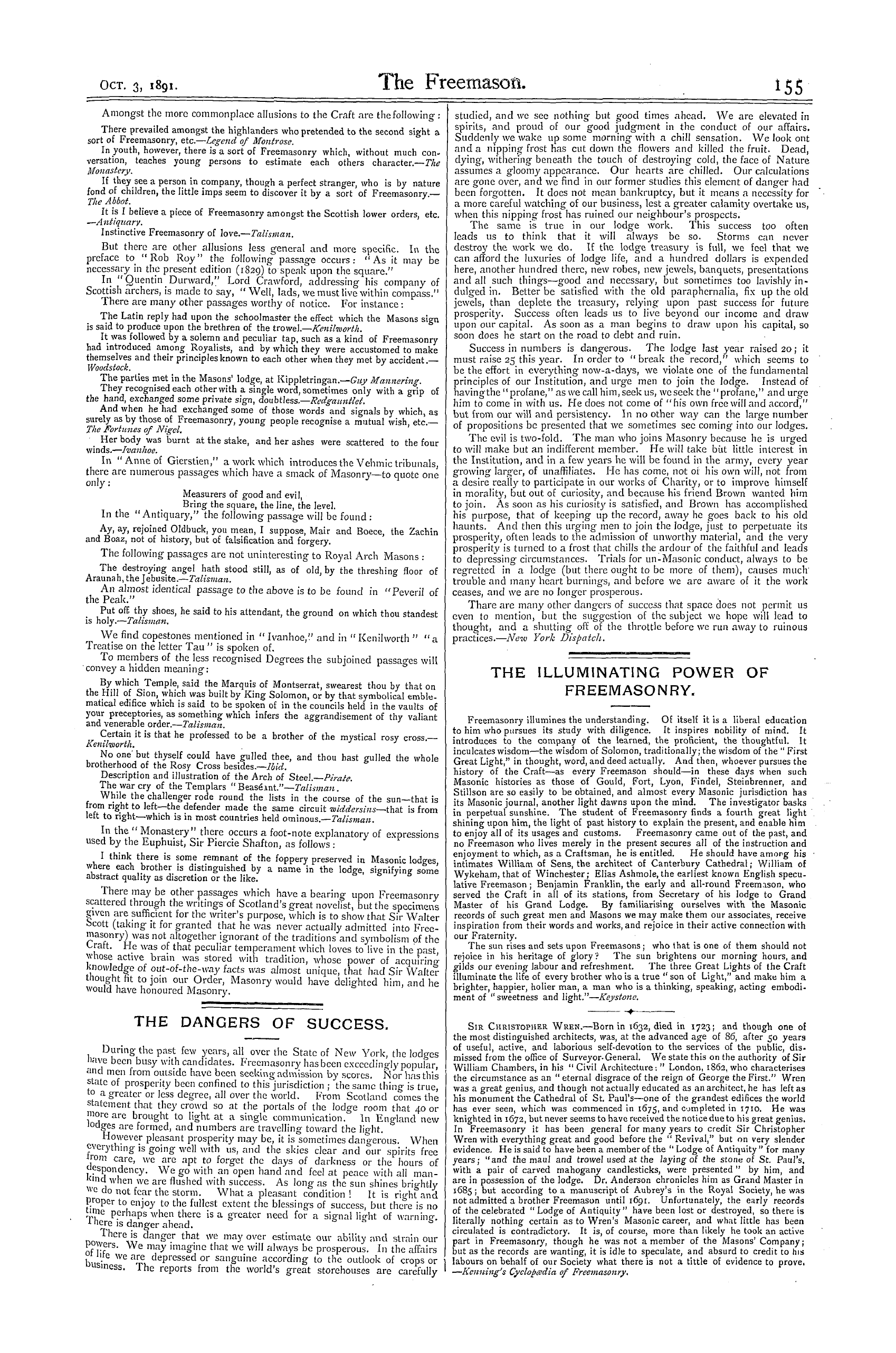
Sir Walter Scott And Freemasonry.
Amongst the more commonplace allusions to the Craft are the following : There prevailed amongst the highlanders who pretended to the second sight a sort of Freemasonry , etc . —Legend of Montrose . In youth , however , there is a sort of Freemasonry which , without much conversation , teaches young persons to estimate each others character . —The Monastery .
If they see a person in company , though a perfect stranger , who is by nature fond of children , the little imps seem to discover it by a sort of Freemasonry . — The Abbot . J J
It is I believe a piece of Freemasonry amongst the Scottish lower orders , etc . —Antiquary . Instinctive Freemasonry of love . —Talisman . But there are other allusions less general and more specific . In the
preface to _ "Rob Roy" the following passage occurs : "As it may be necessary in the present edition ( 1829 ) to speak upon the square . " In " Quentin Durward , " Lord Crawford , addressing his company of Scottish archers , is made to say , " Well , lads , we must live within compass . " There are many other passages worth y of notice . For instance :
The Latin reply had upon the schoolmaster the effect which the Masons sign is said to produce upon the brethren of the trowel . —Kenilworth . It was followed by a solemn and peculiar tap , such as a kind of Freemasonry had introduced among Royalists , and by which they were accustomed to make themselves and their principles known to each other when they met by accident . — Woodstock .
The parties met in the Masons' lodge , at Kippletringan . —Guy Mannering . They recognised each other with a single word , sometimes only with a grip of the hand , exchanged some private sign , doubtless . —Redgauntlet . And when he had exchanged some of those words and signals b y which , as surely as by those of Freemasonry , young people recognise a mutual wish , etc . — The Fortunes of Nigel .
_ Her body was burnt at the stake , and her ashes were scattered to the four winds . —Itianhoe .
In "Anne of Gierstien , " a work which introduces the Vehmic tribunals , there are numerous passages which have a smack of Masonry—to quote one only : Measurers of good and evil , Bring the square , the line , the level . In the " Antiquary , " the following passage will be found :
Ay , ay , rejoined Oldbuck , you mean , I suppose , Mair and Boece , the Zachin and Boaz , not of history , but of falsification and forgery . The following passages are not uninteresting to Royal Arch Masons : The destroying angel hath stood still , as of old , by the threshing floor of Araunah , the Jebusite . —Talisman . An almost identical passage to the above is to be found in "Peverii of the Peak . "
Put oft thy shoes , he said to his attendant , the ground on which thou standest is holy . —Talisman . We find copestones mentioned in " Ivanhoe , " and in " Kenilworth " " a Treatise on the letter Tau " is spoken of . To members of the less recognised Degrees the subjoined passages will convey a hidden meaning :
By which Temple , said the Marquis of Montserrat , swearest thou by that on the Hill of Sion , which was built b y King Solomon , or by that symbolical emblematical edifice which is said to be spoken of in the councils held in the vaults of your preceptories , as something which infers the aggrandisement of thy valiant and venerable order . —Talisman . Certain it is that he professed to be a brother of the mystical rosy cross . — Kenilworth .
No one' but thyself could have gulled thee , and thou hast gulled the whole brotherhood of the Rosy Cross besides . —Ibid . Description and illustration of the Arch of Steel . —Pirate . The war cry of the Templars " Beasdant . "—Talisman . While the challenger rode round the lists in the course of the sun—that is from right to left—the defender made the same circuit widdersins—that is from left to right—which is in most countries held ominous . —Talisman .
In the " Monastery" there occurs a foot-note explanatory of expressions used by the Euphuist , Sir Piercie Shafton , as follows : I think there is some remnant of the foppery preserved in Masonic lodges where each brother is distinguished b y a name in the lodge , signifying some abstract quality as discretion or the like .
There may be other passages which have a bearing upon Freemasonry scattered through the writings of Scotland ' s great novelist , but the specimens given are sufficient for the writer ' s purpose , which is to show that Sir Walter Scott ( taking it for granted that he was never actuall y admitted into Freemasonry ) was not altogether i gnorant of the traditions and symbolism of the
< -ratt . Me was of that peculiar temperament which loves to live in the past , whose active brain was stored with tradition , whose power of acquiring knowled ge of out-of-the-way facts was almost unique , that had Sir Walter thought fit to join our Order , Masonry would have delighted him , and he would have honoured Masonry .
The Dangers Of Success.
THE DANGERS OF SUCCESS .
During the past few years , all over the State of New York , the lodges have been busy with candidates . Freemasonry has been exceedingly popular , and men from outside have been seeking admission b y scores . Nor has this state of prosperity been confined to this jurisdiction ; the same thing is true , to
a greater or less degree , all over the world . From Scotland comes the statement that they crowd so at the portals of the lod ge room that 40 or more are brought to li ght at a single communication . In England new l 0 d ges are formed , and numbers are travelling toward the li ght . However pleasant prosperity may be , it is sometimes dano-erous . When is well with
^ erything going us , and the skies clear and our spirits free trom care , we are apt to forget the days of darkness or the hours of uespondency . We go with an open hand and feel at peace with all mankind when we are flushed with success . As long as the sun shines bri ghtly we do not fear the storm . What a pleasant condition ! It is right and to
Proper enjoy to the fullest extent the blessings of success , but there is no » me perhaps when there is a greater need for a signal light of warning-. 1 here is danger ahead . b There is danger that we may over estimate our ability and strain our 1 owers . We may imagine that we will always be prosperous . In the affairs me we are depressed or sanguine according to the outlook of crops or usiness . The reports from the world ' s great storehouses are carefull y
The Dangers Of Success.
studied , and we see nothing but good times ahead . We are elevated in spirits , and proud of our good judgment in the conduct of our affairs . Suddenly we wake up some morning with a chill sensation . We look ont and a nipping frost has cut down the flowers and killed the fruit . Dead , dying , withering beneath the touch of destroying cold , the face of Nature
assumes a gloomy appearance . Our hearts are chilled . Our calculations are gone over , and we find in our former studies this element of danger had been forgotten . It does not mean bankruptcy , but it means a necessity for a more careful watching of our business , lest a greater calamity overtake us , when this ni pping frost has ruined our neighbour ' s prospects .
The same is true in our lodge work . This success too often leads us to think that it will always be so . Storms can never destroy the work we do . If the lodge treasury is full , we feel that we can afford the luxuries of lodge life , and a hundred dollars is expended here , another hundred there , new robes , new jewels , banquets , presentations
and all such thing's—good and necessary , but sometimes too lavishl y indulged in . Better be satisfied with the old paraphernalia , fix up the old jewels , than deplete the treasury , relying upon past success for future prosperity . Success often leads us to live beyond our income and draw upon our capital . As soon as a man begins to draw upon his capital , so soon does he start on the road to debt and ruin .
Success in numbers is dangerous . The lodge last year raised 20 ; it must raise 25 this year . In order to " break the record , " which seems to be the effort in everything now-a-days , we violate one of the fundamental princi p les of our Institution , and urge men to join the lodge . Instead of having the" profane , " as we call him , seek us , we seek the "profane , " and urge him to come in with us . He does not come of " his own free will and accord , "
but from our will and persistency . In no other way can the large number of propositions be presented that we sometimes see coming into our lodges . The evil is two-fold . The man who joins Masonry because he is urged to will make but an indifferent member . He will take but little interest in the Institution , and in a few years he will be found in the army , every year growing larger , of unaffiliates . He has come , not oi his own will , not from
a desire really to participate in our works of Charity , or to improve himself in morality , but out of curiosity , and because his friend Brown wanted him to join . As soon as his curiosity is satisfied , and Brown has accomplished his purpose , that of keeping up the record , away he goes back to his old haunts . And then this urging men to join the lodge , just to perpetuate its
prosperity , often leads to the admission of unworth y material , and the very prosperity is turned to a frost that chills the ardour of the faithful and leads to depressing circumstances . Trials for un-Masonic conduct , always to be regretted in a lodge ( but there ought to be more of them ) , causes much ' trouble and many heart burnings , and before we are aware of it the work ceases , and we are no longer prosperous .
Thare are many other dangers of success that space does not permit us even to mention , but the suggestion of the subject we hope will lead to thought , and a shutting off of the throttle before we run away to ruinous practices . —New York Dispatch .
The Illuminating Power Of Freemasonry.
THE ILLUMINATING POWER OF FREEMASONRY .
Freemasonry illumines the understanding . Of itself it is a liberal education to him who pursues its study with diligence . It inspires nobility of mind . It introduces to the company of the learned , the proficient , the thoughtful . It inculcates wisdom—the wisdom of Solomon , traditionally ; the wisdom of the " First Great Light , " in thought , word , and deed actually . And then , whoever pursues the history of the Craft—as every Freemason should—in these days when such
Masonic histories as those of Gould , Fort , Lyon , Findel , Steinbrenner , and Stillson are so easily to be obtained , and almost every Masonic jurisdiction has its Masonic journal , another light dawns upon the mind . The investigator basks in perpetual sunshine . The student of Freemasonry finds a fourth great light shining upon him , the light of past history to explain the present , and enable him to enjoy all of its usages and customs . Freemasonry came out of the past , and
no Freemason who lives merely in the present secures all of the instruction and enjoyment to which , as a Craftsman , he is entitled . He should have among his intimates William of Sens , the architect of Canterbury Cathedral ; William of Wykeham , that of Winchester ; Elias Ashmole , the earliest known English speculative Freemason ; Benjamin Franklin , the early and all-round Freemason , who
served the Craft in all of its stations , from Secretary of his lodge to Grand Master of his Grand Lodge . By familiarising ourselves with the Masonic records of such great men and Masons we may make them our associates , receive inspiration from their words and works , and rejoice in their active connection with our Fraternity .
The sun rises and sets upon Freemasons ; who that is one of them should not rejoice in his heritage of g lory ? The sun brightens our morning hours , and gilds our evening labour and refreshment . The three Great Lights of the Craft illuminate the life of every brother who is a true " son of Light , " and make him a brighter , happier , holier man , a man who is a thinking , speaking , acting embodiment of " sweetness and light . "—Keystone .
SIR CHRISTOPHER WREN . —Born in 1632 , died in 1723 ; and though one of the most distinguished architects , was , at the advanced age of 86 , after 50 years of useful , active , and laborious self-devotion to the services of the public , dismissed from the office of Surveyor-General . We state this on the authority of Sir William Chambers , in his " Civil Architecture : " London , 1862 , who characterises the circumstance as an " eternal disgrace of the reign of George the First . " Wren
was a great genius , and though not actually educated as an architect , he has left as his monument the Cathedral of St . Paul ' s—one of the grandest edifices the world has ever seen , which was commenced in 1675 , and completed in 1710 . He was knighted in 1672 , but never seems to have received the notice due to his great genius , In Freemasonry it has been general for many years to credit Sir Christopher Wren with everything great and good before the " Revival , " but on very slender
evidence . He is said to have been a member of the " Lodge of Antiquity " for many years ; " and the maul and trowel used at the laying of the stone of St . Paul ' s , with a pair of carved mahogany candlesticks , were presented " by him , and are in possession of the lodge . Dr . Anderson chronicles him as Grand Master in 1685 ; but according to a manuscript of Aubrey ' s in the Royal Society , he was not admitted a brother Freemason until 1691 . Unfortunately , the early records
of the celebrated "Lodge of Antiquity" have been lost or destroyed , so there is literally nothing certain as to Wren ' s Masonic career , and what little has been circulated is contradictory . It is , of course , more than likely he took an active part in Freemasonry , though he was not a member of the Masons' Company ; but as the records are wanting , it is idle to speculate , and absurd to credit to his labours on behalf of our Society what there is not a tittle of evidence to prove . —Kenning ' s Cyclopaedia of Freemasonry .