-
Articles/Ads
Article PUBLIC INSTALLATIONS ← Page 2 of 2 Article THE MYSTERY OF MASONRY'S DESCENT. Page 1 of 2 Article THE MYSTERY OF MASONRY'S DESCENT. Page 1 of 2 →
Note: This text has been automatically extracted via Optical Character Recognition (OCR) software.
Public Installations
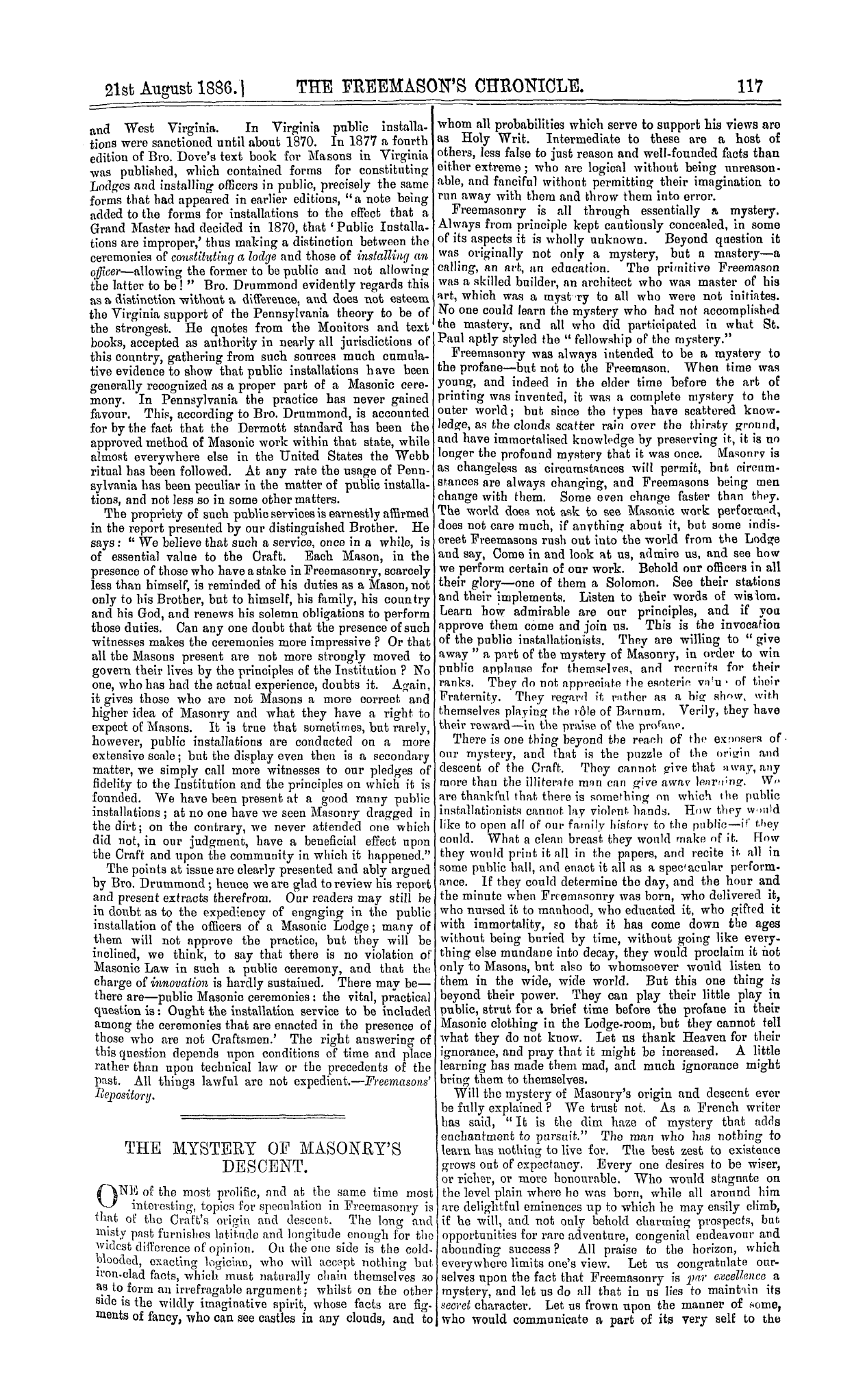
and West Virginia . In Virginia public installa
tions were sanctioned until about 1870 . In 1877 a fourth
edition of Bro . Dove ' s text book for Masons in Virginia was published , which contained forms for constituting Lodges and installing officers in public , precisely the same forms that had appeared in earlier editions , " a note being
added to the forms for installations to the effect that a Grand Master had decided in 1870 , that ' Public Installations are improper / thus making a distinction between the ceremonies of constihding a lodge and those of installing an
officer—allowing the former to be public and not allowing the latter to be ! " Bro . Drummond evidently regards this as a distinction without a difference , aud does not esteem the Virginia support of the Pennsylvania theory to be of
the strongest . He quotes from the Monitors and text books , accepted as authority in nearly all jurisdictions of this country , gathering from such sources much cumulative evidence to show that nublic installations have been
generally recognized as a proper part of a Masonic ceremony . In Pennsylvania the practice has never gained favour . This , according to Bro . Drummond , is accounted for by the fact that the Dermott standard has been the
approved method of Masonic work within that state , while almost everywhere else in the United States the Webb ritual has been followed . At any rate the usage of Pennsylvania has been peculiar in the matter of public installations , and not less so in some other matters .
The propriety of such public services is earnestly affirmed in the report presented by our distinguished Brother . He says : " We believe that such a service , once in a while , is of essential value to the Craft . Each Mason , in the
presence of those who have a stake in Freemasonry , scarcely less than himself , is reminded of his duties as a Mason , not only to his Brother , but to himself , his family , his country and his God , and renews his solemn obligations to perform
those duties . Can any one doubt that the presence of such witnesses makes the ceremonies more impressive ? Or that all the Masons present are not more strongly moved to govern their lives by the principles of the Institution ? No
one , who has had the actual experience , doubts it . Again , it gives those who are not Masons a more correct and higher idea of Masonry and what they have a right to expect of Masons . It is true that sometimes , but rarely ,
however , public installations are conducted on a more extensive scale ; but the display even then is a secondary matter , we simply call more witnesses to our pledges of fidelity to the Institution and the principles on which it is
founded . We have been present at a good many public installations ; at no one have we seen Masonry dragged in the dirt ; on the contrary , we never attended one which did not , in our judgment , have a beneficial effect upon
the Craft and upon the community in which it happened . " The points at issue are clearly presented and abl y argued by Bro . Drummond ; hence we are glad to review his report and present extracts therefrom . Our readers may still be
in doubt as to the expediency of engaging in the public installation of the officers of a Masonic Lodge ; many of them will not approve the practice , but they will be inclined , we think , to say that there is no violation of
Masonic Law in such a public ceremony , and that the charge of innovation is hardly sustained . There may bethere are—public Masonic ceremonies : the vital , practical question is : Ought the installation service to be included
among the ceremonies that are enacted in the presence of those who are not Craftsmen . ' The right answering- of this question depends upon conditions of time and place
rather than upon technical law or the precedents of the past . All things lawful are not expedient . —Freemasons ' Repository .
The Mystery Of Masonry's Descent.
THE MYSTERY OF MASONRY'S DESCENT .
NE of the most prolific , and at the same time most v _ > interesting , topics for speculation in Freemasonry is that of the Craft ' s origin and descent . The long and misty past furnishes latitude and longitude enough for tho widest difference of opinion . On the one side is the
coldplooded , exacting logician , who will accept nothing but iron . clad facts , which must naturall y chain themselves so as to form an irrefragable argument ; whilst on the other side is the wildly imaginative spirit , whose facts are fi gments of fancy , who can see castles in any clouds , and to
The Mystery Of Masonry's Descent.
whom all probabilities which serve to support his views are as Holy Writ . Intermediate to these are a host of others , less false to just reason and well-founded facts than
either extreme ; who are logical without being unreasonable , and fanciful without permitting their imagination to run away with them and throw them into error .
Freemasonry is all through essentially a mystery . Always from principle kept cautiously concealed , in some of its aspects it is wholl y unknown . Beyond question it was originally not onlv a mystery , but a mastery—a
calling , an art , an education . The primitive Freemason was a skilled builder , an architect who was master of his art , which was a myst ry to all who were not initiates .
No one could learn the mystery who had not accomplished the mastery , and all who did participated in what St . Paul aptly styled the " fellowship of the mystery . "
Freemasonry was always intended to be a mystery to the profane—but not to the Freemason . When time was young , and indeed in the elder time before the art of printing was invented , it was a complete mystery to the
outer world ; but since the types have scattered knowledge , as the clouds scatter rain over the thirsty ground , and have immortalised knowledge by preserving it , it is no longer the profound mystery that it was once . Masonry is
as changeless as circumstances will permit , but circumstances are always changing , and Freemasons being men change with them . Some even change faster than thpy . The world does not ask to see Masonic work performed ,
does not care much , if anything about it , but some indiscreet Freemasons rush out into the world from the Lodge and say , Come in and look at us , admire us , and see how we perform certain of our work . Behold our officers in all
their glory—one of them a Solomon . See their stations and their implements . Listen to their words of wis lorn . Learn how admirable are our principles , and if you approve them come and join us . This is the invocation
of the public installationists . They are willing to give away " a part of the mystery of Masonry , in order to win public applause for themselves , and recruits for their
ranks . They do not appreciate the esoteric vn ' u * of tneir Fraternity . They regard it rather as a big show , with themselves playing the role of Barnum . Verily , they have their reward—in the praise of the pvo ' ane .
There is one thing beyond the rearch of the exoosers of our mystery , and that is the puzzle of the origin and descent of the Craft . They cannot give that away , any more thau the illiterate man can give awav learu ng . W »>
are thankful that there is something on which the public installationists cannot lay violent , hands . Hnvv they would like to open all of our family history to the public—it' they could . What a clean breast they would make of it . How
they would print it all in the papers , and recite it all in some public hall , and enact it all as a spec ' acular performance . If they could determine the day , and the hour and the minute when Freemasonry was born , who delivered it ,
who nursed it to manhood , who educated it , who gifted it with immortality , so that it has come down the ages without being buried by time , without going like everything else mundane into decay , they would proclaim it hot
only to Masons , but also to whomsoever would listen to them in the wide , wide world . But this one thing is beyond their power . They can play their little play in public , strut for a brief time before the profane in their
Masonic clothing in the Lodge-room , but they cannot tell what they do not know . Let us thank Heaven for their ignorance , and pray that it might be increased . A little learning has made them mad , and much ignorance might bring them to themselves .
Will the mystery of Masonry ' s origin and descent ever be fully explained ? We trust not . As a French writer has said , " lb is the dim haze of mystery that adds enchantment to pursuit . " The man who has nothing to learn has nothing to live for . The best zest to existence
grows out of expectancy . Every one desires to be wiser , or richer , or more honourable . Who would stagnate on the level plain where he was born , while all around him are delightful eminences up to which he may easily climb ,
if he will , and not only behold charming prospects , bub opportunities for rare adventure , congenial endeavour and abounding success ? All praise to the horizon , which everywhere limits one ' s view . Let us congratulate
ourselves upon the fact that Freemasonry is par excellence a mystery , and let us do all that in us lies to maintain its secret character . Let us frown upon the manner of some , who would communicate a part of its very self to the







Note: This text has been automatically extracted via Optical Character Recognition (OCR) software.
Public Installations
and West Virginia . In Virginia public installa
tions were sanctioned until about 1870 . In 1877 a fourth
edition of Bro . Dove ' s text book for Masons in Virginia was published , which contained forms for constituting Lodges and installing officers in public , precisely the same forms that had appeared in earlier editions , " a note being
added to the forms for installations to the effect that a Grand Master had decided in 1870 , that ' Public Installations are improper / thus making a distinction between the ceremonies of constihding a lodge and those of installing an
officer—allowing the former to be public and not allowing the latter to be ! " Bro . Drummond evidently regards this as a distinction without a difference , aud does not esteem the Virginia support of the Pennsylvania theory to be of
the strongest . He quotes from the Monitors and text books , accepted as authority in nearly all jurisdictions of this country , gathering from such sources much cumulative evidence to show that nublic installations have been
generally recognized as a proper part of a Masonic ceremony . In Pennsylvania the practice has never gained favour . This , according to Bro . Drummond , is accounted for by the fact that the Dermott standard has been the
approved method of Masonic work within that state , while almost everywhere else in the United States the Webb ritual has been followed . At any rate the usage of Pennsylvania has been peculiar in the matter of public installations , and not less so in some other matters .
The propriety of such public services is earnestly affirmed in the report presented by our distinguished Brother . He says : " We believe that such a service , once in a while , is of essential value to the Craft . Each Mason , in the
presence of those who have a stake in Freemasonry , scarcely less than himself , is reminded of his duties as a Mason , not only to his Brother , but to himself , his family , his country and his God , and renews his solemn obligations to perform
those duties . Can any one doubt that the presence of such witnesses makes the ceremonies more impressive ? Or that all the Masons present are not more strongly moved to govern their lives by the principles of the Institution ? No
one , who has had the actual experience , doubts it . Again , it gives those who are not Masons a more correct and higher idea of Masonry and what they have a right to expect of Masons . It is true that sometimes , but rarely ,
however , public installations are conducted on a more extensive scale ; but the display even then is a secondary matter , we simply call more witnesses to our pledges of fidelity to the Institution and the principles on which it is
founded . We have been present at a good many public installations ; at no one have we seen Masonry dragged in the dirt ; on the contrary , we never attended one which did not , in our judgment , have a beneficial effect upon
the Craft and upon the community in which it happened . " The points at issue are clearly presented and abl y argued by Bro . Drummond ; hence we are glad to review his report and present extracts therefrom . Our readers may still be
in doubt as to the expediency of engaging in the public installation of the officers of a Masonic Lodge ; many of them will not approve the practice , but they will be inclined , we think , to say that there is no violation of
Masonic Law in such a public ceremony , and that the charge of innovation is hardly sustained . There may bethere are—public Masonic ceremonies : the vital , practical question is : Ought the installation service to be included
among the ceremonies that are enacted in the presence of those who are not Craftsmen . ' The right answering- of this question depends upon conditions of time and place
rather than upon technical law or the precedents of the past . All things lawful are not expedient . —Freemasons ' Repository .
The Mystery Of Masonry's Descent.
THE MYSTERY OF MASONRY'S DESCENT .
NE of the most prolific , and at the same time most v _ > interesting , topics for speculation in Freemasonry is that of the Craft ' s origin and descent . The long and misty past furnishes latitude and longitude enough for tho widest difference of opinion . On the one side is the
coldplooded , exacting logician , who will accept nothing but iron . clad facts , which must naturall y chain themselves so as to form an irrefragable argument ; whilst on the other side is the wildly imaginative spirit , whose facts are fi gments of fancy , who can see castles in any clouds , and to
The Mystery Of Masonry's Descent.
whom all probabilities which serve to support his views are as Holy Writ . Intermediate to these are a host of others , less false to just reason and well-founded facts than
either extreme ; who are logical without being unreasonable , and fanciful without permitting their imagination to run away with them and throw them into error .
Freemasonry is all through essentially a mystery . Always from principle kept cautiously concealed , in some of its aspects it is wholl y unknown . Beyond question it was originally not onlv a mystery , but a mastery—a
calling , an art , an education . The primitive Freemason was a skilled builder , an architect who was master of his art , which was a myst ry to all who were not initiates .
No one could learn the mystery who had not accomplished the mastery , and all who did participated in what St . Paul aptly styled the " fellowship of the mystery . "
Freemasonry was always intended to be a mystery to the profane—but not to the Freemason . When time was young , and indeed in the elder time before the art of printing was invented , it was a complete mystery to the
outer world ; but since the types have scattered knowledge , as the clouds scatter rain over the thirsty ground , and have immortalised knowledge by preserving it , it is no longer the profound mystery that it was once . Masonry is
as changeless as circumstances will permit , but circumstances are always changing , and Freemasons being men change with them . Some even change faster than thpy . The world does not ask to see Masonic work performed ,
does not care much , if anything about it , but some indiscreet Freemasons rush out into the world from the Lodge and say , Come in and look at us , admire us , and see how we perform certain of our work . Behold our officers in all
their glory—one of them a Solomon . See their stations and their implements . Listen to their words of wis lorn . Learn how admirable are our principles , and if you approve them come and join us . This is the invocation
of the public installationists . They are willing to give away " a part of the mystery of Masonry , in order to win public applause for themselves , and recruits for their
ranks . They do not appreciate the esoteric vn ' u * of tneir Fraternity . They regard it rather as a big show , with themselves playing the role of Barnum . Verily , they have their reward—in the praise of the pvo ' ane .
There is one thing beyond the rearch of the exoosers of our mystery , and that is the puzzle of the origin and descent of the Craft . They cannot give that away , any more thau the illiterate man can give awav learu ng . W »>
are thankful that there is something on which the public installationists cannot lay violent , hands . Hnvv they would like to open all of our family history to the public—it' they could . What a clean breast they would make of it . How
they would print it all in the papers , and recite it all in some public hall , and enact it all as a spec ' acular performance . If they could determine the day , and the hour and the minute when Freemasonry was born , who delivered it ,
who nursed it to manhood , who educated it , who gifted it with immortality , so that it has come down the ages without being buried by time , without going like everything else mundane into decay , they would proclaim it hot
only to Masons , but also to whomsoever would listen to them in the wide , wide world . But this one thing is beyond their power . They can play their little play in public , strut for a brief time before the profane in their
Masonic clothing in the Lodge-room , but they cannot tell what they do not know . Let us thank Heaven for their ignorance , and pray that it might be increased . A little learning has made them mad , and much ignorance might bring them to themselves .
Will the mystery of Masonry ' s origin and descent ever be fully explained ? We trust not . As a French writer has said , " lb is the dim haze of mystery that adds enchantment to pursuit . " The man who has nothing to learn has nothing to live for . The best zest to existence
grows out of expectancy . Every one desires to be wiser , or richer , or more honourable . Who would stagnate on the level plain where he was born , while all around him are delightful eminences up to which he may easily climb ,
if he will , and not only behold charming prospects , bub opportunities for rare adventure , congenial endeavour and abounding success ? All praise to the horizon , which everywhere limits one ' s view . Let us congratulate
ourselves upon the fact that Freemasonry is par excellence a mystery , and let us do all that in us lies to maintain its secret character . Let us frown upon the manner of some , who would communicate a part of its very self to the