-
Articles/Ads
Article RED, WHITE, AND BLUE. ← Page 3 of 3 Article PUBLIC INSTALLATIONS Page 1 of 2 Article PUBLIC INSTALLATIONS Page 1 of 2 →
Note: This text has been automatically extracted via Optical Character Recognition (OCR) software.
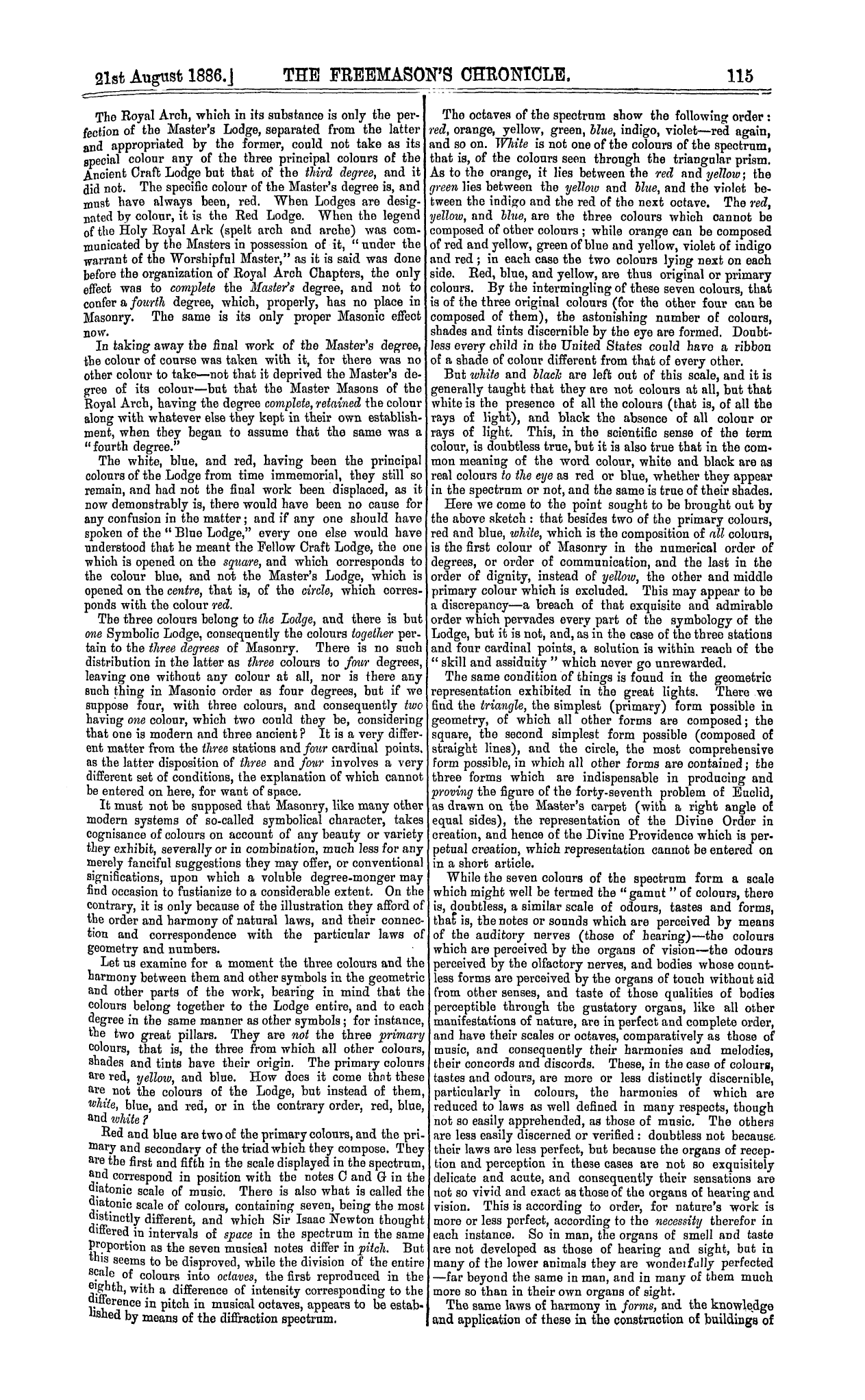
Red, White, And Blue.
every sort , is the perfection of the art of architecture , and these laws so conform to those of statics , that strength and beauty are conjoined iu harmony , and this is why the pillar of beauty is a support .
From these and other considerations , which cannot be introduced here , it can be understood in part why such an institution as Masonry should have to do with colours . Whether any particular combination of colours should be
exhibited as proper colours of the Lodge depends on the peculiar aspect of natural things and their laws which is intended to be set forth , for Masonry cannot attempt to bring forward all things of its own , either in its work or
symbology . To do so in a system necessarily confined to three degrees would render the latter interminable , and require volumes of scientific and symbolic lore without number . For such reasons we must be content when
partial representations are drawn from such sources only as present the most perspicuous and comprehensive illustrations of sublime truths , leaving many allied subjects
to be discerned and brought forward in their order , by the searcher of Masonic lore , as time and opportunity may permit .
Tbe three colours in question are wonderfully well chosen for the purpose they subserve , to wit , the exposition in part of the correspondence and interweaving of the laws which control the complex of things visible and invisible , and their co-ordination with those of the moral and intellectual
degrees—the will and understanding of man . Thus , the colour red is , and always was , recognised by the common perception of men , and would be if no system of Masonry were in existence , as the representative of the affections ,
especially of love , charity , benevolence , and the like , and Masonic symbology teaches its correspondence with the odour and the taste which we call sweet ; with tbe circle among the figures of geometry , and with the sphere among
the forms of solids . Blue , the most intense and persistent of colours , is equally recognised as the sign or symbol of truth , of fidelity , and of integrity . It corresponds with the square ( right angle and quadrangle ) in geometry—the
square on which the Fellow Craft ' s Lodge is opened and closed in proper work—and with the cube among solids ; with all things of the intellect of man , as red cori'espouds with those of the ivill : hence these two , red and blue ,
represent charity and faith . They are the two extremes of the primary colours of the prismatic spectrum , yellow being the middle one of the three in the prismatic , and the middle of all in the diffraction spectrum . But yellow is
omitted , and white takes its place in the Masonic scale , for it is in the design of the Lodge to present those phenomena which illustrate most clearly the correspondence between physical , intellectual and moral laws .
White is the union of all colours . It shows that which
no colour of the spectrum can . It represents the communion and harmony of minds of different capacities and faiths which constitute the true essence of fraternity . It is the colour of light—even the embodiment of light itself in
its fulness ; unlike the other colours , which are partial , and by the universal perception of mankind it has been always hailed as the sign and type of purity—the badge of innocence ; those prime qualities of heart and life which must
be the foundation of the first degree . Hence we have the three : White—innocence , purity , light , union . Bluetruth , understanding , fidelity , integrity . Bed—charity , fervency , devotion , brotherly love , benevolence . And what
for the Royal Arch ? Let it be content with the three colours , as well as with the white apron of the Master , or otherwise add the fourth , viz ., purple . The old Royal Arch aprons were embroidered with indented work of white , blue , red and purple . —Voice of Masonry .
Public Installations
PUBLIC INSTALLATIONS
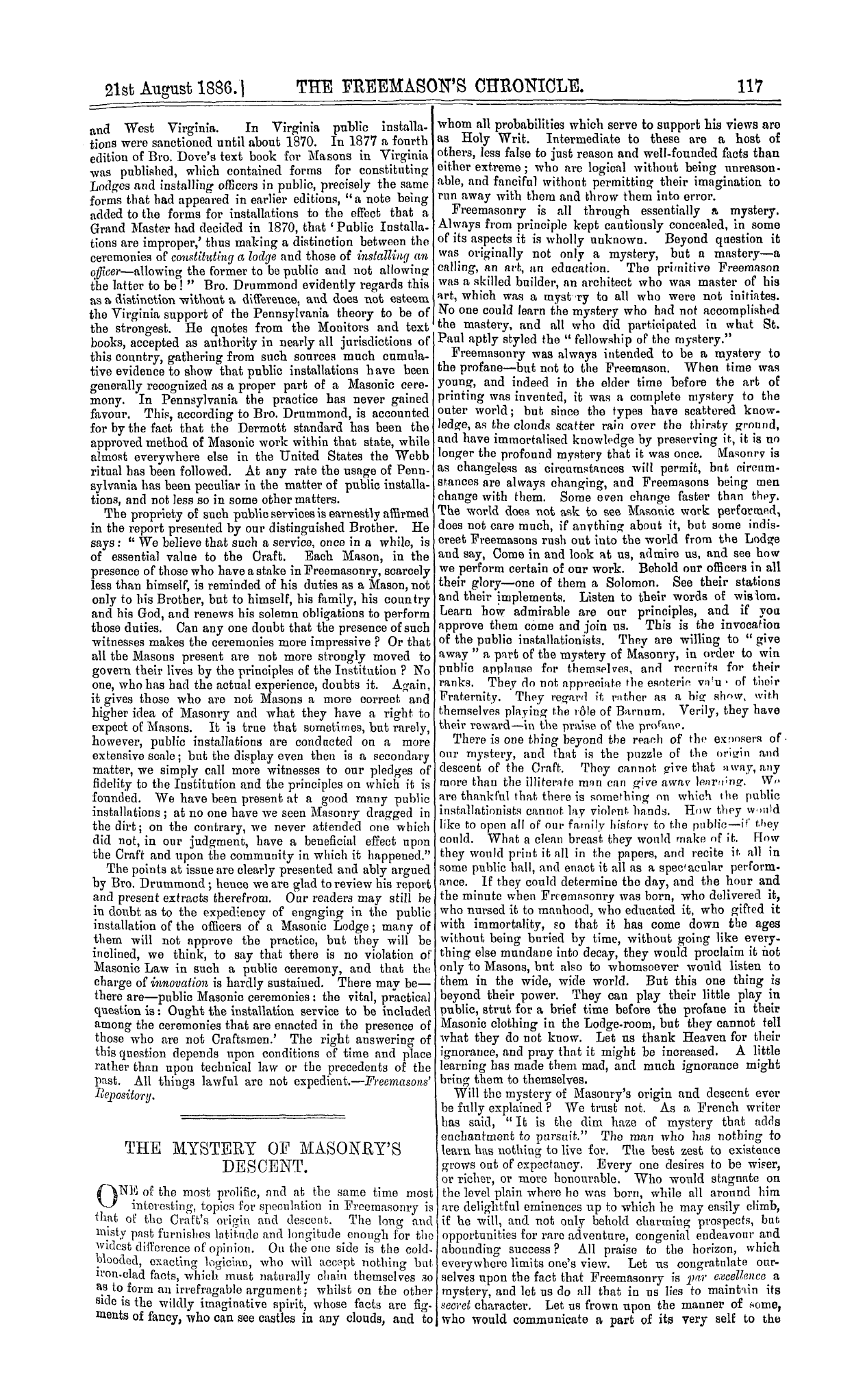
THE propriety of holding public Masonic installations has been frequently discussed of late , both in the periodicals representing the Craft and by Committees of Correspondence in the published Proceedings of Grand Bodies . On the one band the argument has been made
that giving publicity to such an installing service is uncalled for , as there are plenty of other occasions when brethren may invite their friends not in the Order , including ladies , to the Lodge room . It is held by those who
oppose public installations that they serve no good purpose , and that , regarded from the mere utilitarian point of view
Public Installations
they have little claim to support . But beyond this line of objection do such eminent writers as Bros . Vaux and Mac Calla , of Pennsylvania , advance ; for they take the ground that public installations are innovations , and that reall y it
is an infringement upon Masonic law and teaching to countenance them . Bro . MacCalla ' s arguments and criticisms , in the Keystone , relating to this subject have often been brought to the notice of readers of this magazine .
Those who have followed the discussion with care , have seen , we think , that there are some strong reasons for opposing tho practice of public installations now so common . Not altogether persuaded by the reasoning of our brother
whose zeal in opposing what he considers an innovation ig most admirable , we have yet appreciated the force of many of his statements , and have not hesitated to express our thought that public installations ought to be held but
seldom , not being in keeping with the common , ancient usage of the Craft , and hardly in accord with the spirit of such an organization as ours , which avoids notoriety , and enacts but few of its ceremonies before the public gaze .
On the other side , however , favouring the practice of which we speak , are prominent brethren and able writers who join issue with the avowal that public installations constitute an innovation , and uphold such services as every
way proper and helpful . Bro . J . H . Drummond , of Mainej in his report , as Committee of Correspondence , made to the Grand Lodge of that State at its recent session , gives a very exhaustive treatment of the subject under review .
He deals first with the proposition that there cannot be public Masonic ceremonies , and shows by reference to the law and practice of various jurisdictions that such a proposition cannot be maintained . Lodges are open and
Masonic work is done by these organizations respectively at the laying of corner stones and the burial of departed brethren . There is no need that we should present Bro . Drummond ' s statement , for the fact is beyond dispute . He
admits , however , that because there are public Masonic ceremonies , it by no means follows that public installations are proper . Their propriety depends upon the nature of the ceremonies and the usages of the Craft . In meeting
this question , Bro . Drummond says : " From the fact that the full ceremonies have been published with the express sanction of Grand Lodges in many cases , and the implied sanction of Grand Lodges in many other cases , it is folly
to say that there is anything in the nahire of the ceremonies which renders their public use improper . It is not necessary to enumerate the Monitors , Ahiman Rezous , and Text Books which contain these ceremonies , as scarcely
one published since 1792 does not contain them . In fine , these ceremonies have been fully published all these years , and their publication has never been forbidden , nor even condemned until since this discussion has commenced , and
then only by Bros . Vaux and MacCalla . " Passing to consider what the usage has been , Bro . Drummond affirms that the practice of public installations prevailed in England previous too 1800 . To support this statement , he gives the following references : " Shakespeare
Lodge , No . 586 , was dedicated 4 th June 1793 , and the
ceremonies , as described in a Masonic magazine , were public . In tbe Memoirs of the Life and Writings of Richard Gardiner is an account of the constitution of a Lodge , 17 th December 1764 , at Swaffham , in the County
of Norfolk . A Deputy was commissioned to instal the new Master ; the Lodges formed , marched to the church , where a sermon was preached , and after the divine service the new Master was installed with the usual ceremonies .
According to contemporaneous account , the Royal Brunswick Lodge was publicly constituted 28 th July 1794 , and a collection was made for the charity school for poor girls . The charity girls sung a Masonic hymn at the consecration and installation of the Royal Brunswick Lodge . "
In this country he claims that the public constitution of Lodges and installation of their Officers has always been common . Under this head he cites the institution of the Grand Lodge of Maine , 24 th June 1820 , the service on
that occasion being open to the general public , as was the installation of the Grand Officers . Mention is made of other services of a like character to which the public were admitted . Referring to the well approved forms for
constituting Lodges and installing officers , our brother finds that the following jurisdictions expressly provide for the performing of such a service in public , viz .: Canada , Illinois , Indiana , Maine , Massachusetts , Michigan , Mississippi , New Hampshire , New Jersey , New York ,
North Carolina , Ohio , Tennesse , Texas , Vermont







Note: This text has been automatically extracted via Optical Character Recognition (OCR) software.
Red, White, And Blue.
every sort , is the perfection of the art of architecture , and these laws so conform to those of statics , that strength and beauty are conjoined iu harmony , and this is why the pillar of beauty is a support .
From these and other considerations , which cannot be introduced here , it can be understood in part why such an institution as Masonry should have to do with colours . Whether any particular combination of colours should be
exhibited as proper colours of the Lodge depends on the peculiar aspect of natural things and their laws which is intended to be set forth , for Masonry cannot attempt to bring forward all things of its own , either in its work or
symbology . To do so in a system necessarily confined to three degrees would render the latter interminable , and require volumes of scientific and symbolic lore without number . For such reasons we must be content when
partial representations are drawn from such sources only as present the most perspicuous and comprehensive illustrations of sublime truths , leaving many allied subjects
to be discerned and brought forward in their order , by the searcher of Masonic lore , as time and opportunity may permit .
Tbe three colours in question are wonderfully well chosen for the purpose they subserve , to wit , the exposition in part of the correspondence and interweaving of the laws which control the complex of things visible and invisible , and their co-ordination with those of the moral and intellectual
degrees—the will and understanding of man . Thus , the colour red is , and always was , recognised by the common perception of men , and would be if no system of Masonry were in existence , as the representative of the affections ,
especially of love , charity , benevolence , and the like , and Masonic symbology teaches its correspondence with the odour and the taste which we call sweet ; with tbe circle among the figures of geometry , and with the sphere among
the forms of solids . Blue , the most intense and persistent of colours , is equally recognised as the sign or symbol of truth , of fidelity , and of integrity . It corresponds with the square ( right angle and quadrangle ) in geometry—the
square on which the Fellow Craft ' s Lodge is opened and closed in proper work—and with the cube among solids ; with all things of the intellect of man , as red cori'espouds with those of the ivill : hence these two , red and blue ,
represent charity and faith . They are the two extremes of the primary colours of the prismatic spectrum , yellow being the middle one of the three in the prismatic , and the middle of all in the diffraction spectrum . But yellow is
omitted , and white takes its place in the Masonic scale , for it is in the design of the Lodge to present those phenomena which illustrate most clearly the correspondence between physical , intellectual and moral laws .
White is the union of all colours . It shows that which
no colour of the spectrum can . It represents the communion and harmony of minds of different capacities and faiths which constitute the true essence of fraternity . It is the colour of light—even the embodiment of light itself in
its fulness ; unlike the other colours , which are partial , and by the universal perception of mankind it has been always hailed as the sign and type of purity—the badge of innocence ; those prime qualities of heart and life which must
be the foundation of the first degree . Hence we have the three : White—innocence , purity , light , union . Bluetruth , understanding , fidelity , integrity . Bed—charity , fervency , devotion , brotherly love , benevolence . And what
for the Royal Arch ? Let it be content with the three colours , as well as with the white apron of the Master , or otherwise add the fourth , viz ., purple . The old Royal Arch aprons were embroidered with indented work of white , blue , red and purple . —Voice of Masonry .
Public Installations
PUBLIC INSTALLATIONS
THE propriety of holding public Masonic installations has been frequently discussed of late , both in the periodicals representing the Craft and by Committees of Correspondence in the published Proceedings of Grand Bodies . On the one band the argument has been made
that giving publicity to such an installing service is uncalled for , as there are plenty of other occasions when brethren may invite their friends not in the Order , including ladies , to the Lodge room . It is held by those who
oppose public installations that they serve no good purpose , and that , regarded from the mere utilitarian point of view
Public Installations
they have little claim to support . But beyond this line of objection do such eminent writers as Bros . Vaux and Mac Calla , of Pennsylvania , advance ; for they take the ground that public installations are innovations , and that reall y it
is an infringement upon Masonic law and teaching to countenance them . Bro . MacCalla ' s arguments and criticisms , in the Keystone , relating to this subject have often been brought to the notice of readers of this magazine .
Those who have followed the discussion with care , have seen , we think , that there are some strong reasons for opposing tho practice of public installations now so common . Not altogether persuaded by the reasoning of our brother
whose zeal in opposing what he considers an innovation ig most admirable , we have yet appreciated the force of many of his statements , and have not hesitated to express our thought that public installations ought to be held but
seldom , not being in keeping with the common , ancient usage of the Craft , and hardly in accord with the spirit of such an organization as ours , which avoids notoriety , and enacts but few of its ceremonies before the public gaze .
On the other side , however , favouring the practice of which we speak , are prominent brethren and able writers who join issue with the avowal that public installations constitute an innovation , and uphold such services as every
way proper and helpful . Bro . J . H . Drummond , of Mainej in his report , as Committee of Correspondence , made to the Grand Lodge of that State at its recent session , gives a very exhaustive treatment of the subject under review .
He deals first with the proposition that there cannot be public Masonic ceremonies , and shows by reference to the law and practice of various jurisdictions that such a proposition cannot be maintained . Lodges are open and
Masonic work is done by these organizations respectively at the laying of corner stones and the burial of departed brethren . There is no need that we should present Bro . Drummond ' s statement , for the fact is beyond dispute . He
admits , however , that because there are public Masonic ceremonies , it by no means follows that public installations are proper . Their propriety depends upon the nature of the ceremonies and the usages of the Craft . In meeting
this question , Bro . Drummond says : " From the fact that the full ceremonies have been published with the express sanction of Grand Lodges in many cases , and the implied sanction of Grand Lodges in many other cases , it is folly
to say that there is anything in the nahire of the ceremonies which renders their public use improper . It is not necessary to enumerate the Monitors , Ahiman Rezous , and Text Books which contain these ceremonies , as scarcely
one published since 1792 does not contain them . In fine , these ceremonies have been fully published all these years , and their publication has never been forbidden , nor even condemned until since this discussion has commenced , and
then only by Bros . Vaux and MacCalla . " Passing to consider what the usage has been , Bro . Drummond affirms that the practice of public installations prevailed in England previous too 1800 . To support this statement , he gives the following references : " Shakespeare
Lodge , No . 586 , was dedicated 4 th June 1793 , and the
ceremonies , as described in a Masonic magazine , were public . In tbe Memoirs of the Life and Writings of Richard Gardiner is an account of the constitution of a Lodge , 17 th December 1764 , at Swaffham , in the County
of Norfolk . A Deputy was commissioned to instal the new Master ; the Lodges formed , marched to the church , where a sermon was preached , and after the divine service the new Master was installed with the usual ceremonies .
According to contemporaneous account , the Royal Brunswick Lodge was publicly constituted 28 th July 1794 , and a collection was made for the charity school for poor girls . The charity girls sung a Masonic hymn at the consecration and installation of the Royal Brunswick Lodge . "
In this country he claims that the public constitution of Lodges and installation of their Officers has always been common . Under this head he cites the institution of the Grand Lodge of Maine , 24 th June 1820 , the service on
that occasion being open to the general public , as was the installation of the Grand Officers . Mention is made of other services of a like character to which the public were admitted . Referring to the well approved forms for
constituting Lodges and installing officers , our brother finds that the following jurisdictions expressly provide for the performing of such a service in public , viz .: Canada , Illinois , Indiana , Maine , Massachusetts , Michigan , Mississippi , New Hampshire , New Jersey , New York ,
North Carolina , Ohio , Tennesse , Texas , Vermont