Note: This text has been automatically extracted via Optical Character Recognition (OCR) software.
How An American Grand Secretary Writes Masonic History.
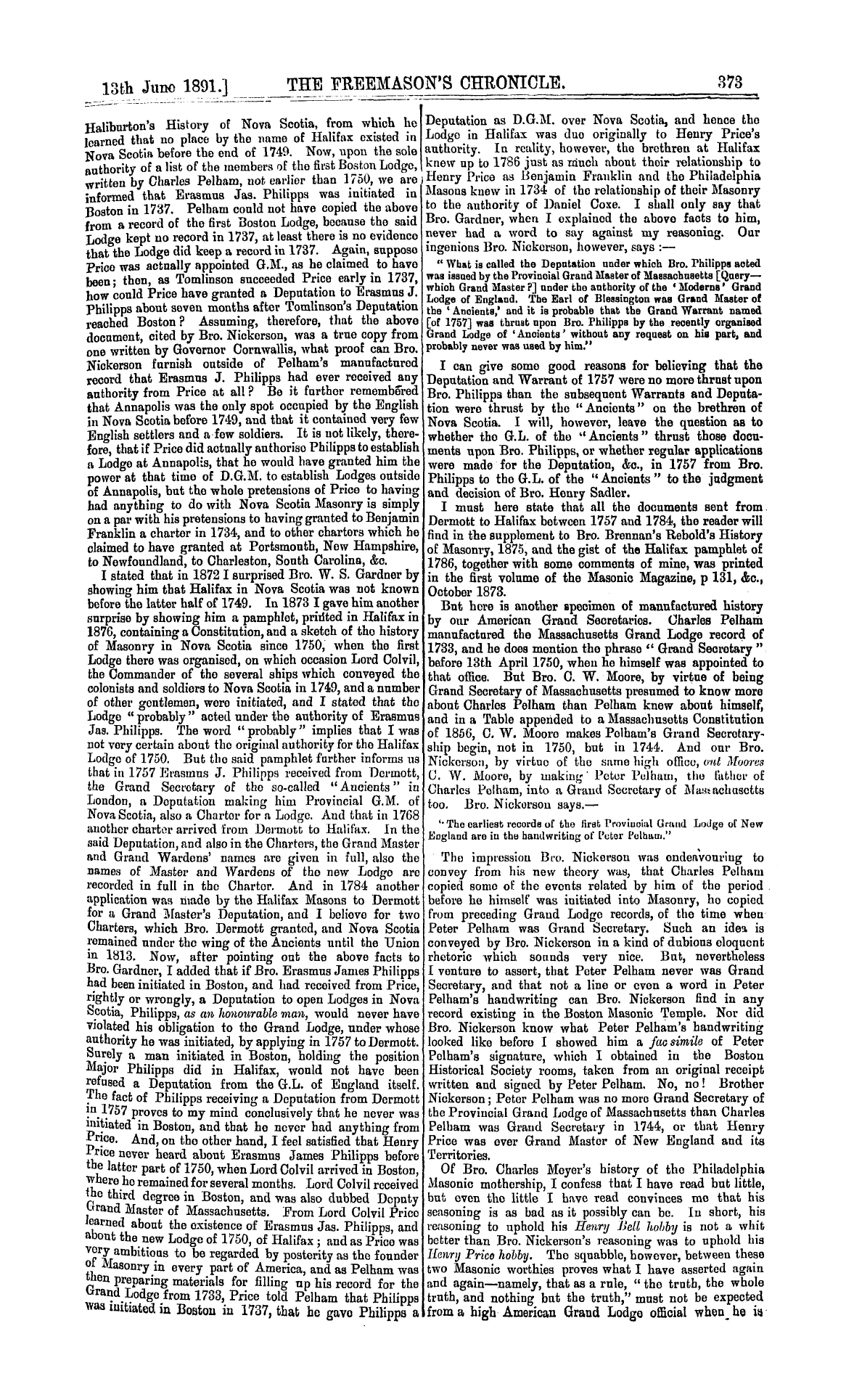
Haliburton's History of Nova Scotia , from which he loarned that no place by the name of Halifax existed in Nova Scotia before the end of 1749 . Now , upon the sole authority of a list of the members of tho first Boston Lodgo , written bv Charles Pelham , not earlier than 1750 , we are
informed that Erasmus Jas . Philipps was initiated in Boston in 1737 . Pelham could not have copied the above from a record of the first Boston Lodge , because the said Lodge kept no record in 1737 , at least there is no evidence that the Lodge did keep a record in 1737 . Again , suppose
Price waa actually appointed G . M ., as he claimed to havo been ; then , as Tomlinson succeeded Price early in 1737 , how could Price have granted a Deputation to Erasmus J . Philipps about seven months after Tomlinson ' s Deputation reached Boston ? Assuming , therefore , that the above
document , cited by Bro . Nickerson , was a true copy from one written by Governor Cornwallis , what proof can Bro . Nickerson furnish outside of Pelham ' s manufactured record that Erasmus J . Philipps had ever received any authority from Price at all ? Be it furthor remembered
that Annapolis was the only spot occupied by the English in Nova Scotia before 1749 , and that it contained very few English settlers and a few soldiers . It is not likely , therefore , that if Price did actually authoriso Philipps to establish a Lodge at Annapolis , that he would have granted him the
power at that time of D . G . M . to establish Lodges outside of Annapolis , but the whole pretensions of Price to having had anything to do with Nova Scotia Masonry is simply
on a par with his pretensions to having granted to Benjamin Franklin a charter in 1734 , and to other chartors which he claimed to have granted at Portsmouth , Now Hampshire , to Newfoundland , to Charleston , South Carolina , & c .
I stated that in 1872 I surprised Bro . W . S . Gardner by showing him that Halifax in Nova Scotia was not known before the latter half of 1749 . In 1873 I gave him another surprise by showing him a pamphlet , printed in Halifax in 1876 , containing a Constitution , and a sketch of tho history
of Masonry in Nova Scotia since 1750 , when the first Lodge there was organised , on which occasion Lord Colvil , the Commander of the several ships which conveyed tho colonists and soldiers to Nova Scotia in 1749 , and a number of other gentlemen , woro initiated , and I stated that tho
Lodge " probably " acted under the authority of Erasmus Jas . Philipps . The word " probably " implies that I was not very certain about tho original authority for the Halifax Lodgo of 1750 . But tho said pamphlet farther informs us
that in 1757 Erasmus J . Philipps received from Derinott , the Grand Secretary of the so-called " Ancients" iu London , a Deputation making him Provincial G . M . of Nova Scotia , also a Chartor for a Lodge . And that in 1768 another chartor arrived from DermoU to Halifax . In the
said Deputation , and also in the Charters , the Grand Master and Grand Wardens' names are given in full , also the names of Master and Wardens of tho new Lodgo aro recorded in full in tho Chartor . And in 1784 another application was made bv the Halifax Masons to Dermott
for a Grand Master ' s Deputation , and I believe for two Charters , which Bro . Dermott granted , and Nova Scotia remained under tho wing of the Ancients until the Union in 1813 . Now , after pointing out the above facts to Bro . Gardner , I added that if Bro . Erasmus James Philipps
had been initiated in Boston , and had received from Price , rightl y or wrongly , a Deputation to open Lodges in Nova Scotia , Philipps , as an honourable man , would never have violated his obligation to the Grand Lodge , under whose authorit y he was initiated , by applying in 1757 to Dermott .
burel y a man initiated in Boston , holding the position Major Philipps did in Halifax , would not have been refused a Deputation from the G . L . of England itself . I he fact of Philipps receiving a Deputation from Dermott in 1757 proves to my mind conclusively that he never was
initiated in Boston , and that he never had anything from Price . And , on tho other hand , I feel satisfied that Henry Price never heard about Erasmus James Philipps before the latter part of 1750 , when Lord Colvil arrived in Boston , where ho remained for several months . Lord Colvil received
tno third degree in Boston , and was also dubbed Deputy wand Master of Massachusetts . From Lord Colvil Price learned about the existence of Erasmus Jas . Philipps , and about the new Lodge of 1750 , of Halifax : and as Prino was
V p ry ambitious to be regarded by posterity as the founder ot Masonry in every part of America , and as Pelham was "ion preparing materials for filling up his record for the ^ rand Lod ge from 1733 , Price told Pelham that Philipps waa initiated in Boaton in 1737 , that he gavo Philipps a
How An American Grand Secretary Writes Masonic History.
Deputation as D . G . M . over Nova Scotia , and hence tho Lodge in Halifax was duo originally to Henry Price ' s authority . In reality , however , the brethren at Halifax knew up to 1786 just as much about thoir relationship to Henry Price as Benjamin Franklin and the Philadelphia
Masons knew in 1734 of the relationship of their Masonry to the authority of Daniel Coxe . I shall only say that Bro . Gardner , when I explained the above facts to him , never had a word to say against my reasoning . Our ingenious Bro . Nickorson , however , says : —
" What is called the Deputation under whioh Bro . Philipps acted was issued by the Provincial Grand Master of Massachusetts [ Querywhioh Grand Master P ] nnder tho authority of the ' Moderna' Grand Lodge of England . The Earl of Blessington waa Grand Master of
the ' Anoients , and it is probable that the Grand Warrant named [ of 1757 ] was thrust upon Bro . PhilippB by the recently organised Grand Lodge of 'Ancients' without any request on his part , and probably never was used by him . "
I can g ive some good reasons for believing that the Deputation and Warrant of 1757 were no more thrust upon Bro . Philipps than the subsequent Warrants and Deputation wero thrust by the " Ancients" on the brethren of Nova Scotia . I will , however , leave the question as to
whether tho G . L . of tho " Ancients thrust those documents upon Bro . Philipps , or whether regular applications were made for the Deputation , & c , in 1757 from Bro . Philipps to tho G . L . of the "Ancients " to the judgment and decision of Bro . Henry Sadler . I must here state that all the documents sent from
Dermott to Halifax between 1757 and 1784 , the reader will find in the supplement to Bro . Brennan ' s Rebold's History of Masonry , 1875 , and the gist of the Halifax pamphlet of 1786 , together with some comments of mine , was printed in the first volume of the Masonic Magazine , p 131 , & c , October 1873 .
But here is another specimen of manufactured history by onr American Grand Secretaries . Charles Pelham manufactured the Massachusetts Grand Lodge record of 1733 , and he does mention the phrase " Grand Secretary " before 13 th April 1750 , when ho himself was appointed to
that office . But Bro . C . W . Moore , by virtue of being Grand Secretary of Massachusetts presumed to know more about Charles Pelham than Pelham knew about himself , and in a Table appended to a Massachusetts Constitution of 1856 , C . W . Mooro makes Pelham ' s Grand
Secretaryship begin , not in 1750 , but in 1744 . And our Bro . Nickorson , by virtue of tho same high office , out Moores 0 . W . Moore , by making' Peter Pelham , tho father of Charles Pelham , into a Grand Secretary of Massachusetts too . Bro . Nickorson says . —
' •The earliest records of the first Provincial Grand Lodge or New England are in the handwriting of Peter Pelhuui . " The impression Bro . Nickerson was endeavouring to convey from his new theory was , that Charles Pelham copied some of the events related by him of the period
before he himself was initiated into Masonry , ho copied from preceding Grand Lodge records , of the time when Peter Pelham was Grand Secretary . Such an idea is conveyed by Bro . Nickerson in a kind of dubious eloquent rhetoric which sounds very nice . But , nevertheless
I venture to assert , that Peter Pelham never was Grand Secretary , and that not a line or even a word in Peter Pelham ' s handwriting can Bro . Nickerson find in any record existing in the Boston Masonic Temple . Nor did Bro . Nickerson know what Peter Pelham ' s handwriting
looked like before I showed him a facsimile of Peter Pelham ' s signature , which I obtained in the Boston Historical Society rooms , taken from an original receipt written and signed by Peter Pelham . No , no ! Brother
Nickerson ; Peter Pelham was no more Grand Secretary of the Provincial Grand Lodge of Massachusetts than Charles Pelham was Grand Secretary in 1744 , or that Henry Price was ever Grand Master of New England and its Territories .
Of Bro . Charles Meyer ' s history of tho Philadelphia Masonic mothership , I confess that I have read but little , but even the little I have read convinces mo that his seasoning is as bad as it possibly can be . In short , his reasoning to uphold his Henry Bell hobby is not a whit
better than Bro . Nickerson ' s reasoning was to uphold his Henry Price hobby . The squabble , however , between these two Masonic worthies proves what I have asserted again and again—namely , that as a rule , " the truth , the whole truth , and nothing but the truth , " must not be expected from a hi gh American Grand Lodge official when _ he ia






Note: This text has been automatically extracted via Optical Character Recognition (OCR) software.
How An American Grand Secretary Writes Masonic History.
Haliburton's History of Nova Scotia , from which he loarned that no place by the name of Halifax existed in Nova Scotia before the end of 1749 . Now , upon the sole authority of a list of the members of tho first Boston Lodgo , written bv Charles Pelham , not earlier than 1750 , we are
informed that Erasmus Jas . Philipps was initiated in Boston in 1737 . Pelham could not have copied the above from a record of the first Boston Lodge , because the said Lodge kept no record in 1737 , at least there is no evidence that the Lodge did keep a record in 1737 . Again , suppose
Price waa actually appointed G . M ., as he claimed to havo been ; then , as Tomlinson succeeded Price early in 1737 , how could Price have granted a Deputation to Erasmus J . Philipps about seven months after Tomlinson ' s Deputation reached Boston ? Assuming , therefore , that the above
document , cited by Bro . Nickerson , was a true copy from one written by Governor Cornwallis , what proof can Bro . Nickerson furnish outside of Pelham ' s manufactured record that Erasmus J . Philipps had ever received any authority from Price at all ? Be it furthor remembered
that Annapolis was the only spot occupied by the English in Nova Scotia before 1749 , and that it contained very few English settlers and a few soldiers . It is not likely , therefore , that if Price did actually authoriso Philipps to establish a Lodge at Annapolis , that he would have granted him the
power at that time of D . G . M . to establish Lodges outside of Annapolis , but the whole pretensions of Price to having had anything to do with Nova Scotia Masonry is simply
on a par with his pretensions to having granted to Benjamin Franklin a charter in 1734 , and to other chartors which he claimed to have granted at Portsmouth , Now Hampshire , to Newfoundland , to Charleston , South Carolina , & c .
I stated that in 1872 I surprised Bro . W . S . Gardner by showing him that Halifax in Nova Scotia was not known before the latter half of 1749 . In 1873 I gave him another surprise by showing him a pamphlet , printed in Halifax in 1876 , containing a Constitution , and a sketch of tho history
of Masonry in Nova Scotia since 1750 , when the first Lodge there was organised , on which occasion Lord Colvil , the Commander of the several ships which conveyed tho colonists and soldiers to Nova Scotia in 1749 , and a number of other gentlemen , woro initiated , and I stated that tho
Lodge " probably " acted under the authority of Erasmus Jas . Philipps . The word " probably " implies that I was not very certain about tho original authority for the Halifax Lodgo of 1750 . But tho said pamphlet farther informs us
that in 1757 Erasmus J . Philipps received from Derinott , the Grand Secretary of the so-called " Ancients" iu London , a Deputation making him Provincial G . M . of Nova Scotia , also a Chartor for a Lodge . And that in 1768 another chartor arrived from DermoU to Halifax . In the
said Deputation , and also in the Charters , the Grand Master and Grand Wardens' names are given in full , also the names of Master and Wardens of tho new Lodgo aro recorded in full in tho Chartor . And in 1784 another application was made bv the Halifax Masons to Dermott
for a Grand Master ' s Deputation , and I believe for two Charters , which Bro . Dermott granted , and Nova Scotia remained under tho wing of the Ancients until the Union in 1813 . Now , after pointing out the above facts to Bro . Gardner , I added that if Bro . Erasmus James Philipps
had been initiated in Boston , and had received from Price , rightl y or wrongly , a Deputation to open Lodges in Nova Scotia , Philipps , as an honourable man , would never have violated his obligation to the Grand Lodge , under whose authorit y he was initiated , by applying in 1757 to Dermott .
burel y a man initiated in Boston , holding the position Major Philipps did in Halifax , would not have been refused a Deputation from the G . L . of England itself . I he fact of Philipps receiving a Deputation from Dermott in 1757 proves to my mind conclusively that he never was
initiated in Boston , and that he never had anything from Price . And , on tho other hand , I feel satisfied that Henry Price never heard about Erasmus James Philipps before the latter part of 1750 , when Lord Colvil arrived in Boston , where ho remained for several months . Lord Colvil received
tno third degree in Boston , and was also dubbed Deputy wand Master of Massachusetts . From Lord Colvil Price learned about the existence of Erasmus Jas . Philipps , and about the new Lodge of 1750 , of Halifax : and as Prino was
V p ry ambitious to be regarded by posterity as the founder ot Masonry in every part of America , and as Pelham was "ion preparing materials for filling up his record for the ^ rand Lod ge from 1733 , Price told Pelham that Philipps waa initiated in Boaton in 1737 , that he gavo Philipps a
How An American Grand Secretary Writes Masonic History.
Deputation as D . G . M . over Nova Scotia , and hence tho Lodge in Halifax was duo originally to Henry Price ' s authority . In reality , however , the brethren at Halifax knew up to 1786 just as much about thoir relationship to Henry Price as Benjamin Franklin and the Philadelphia
Masons knew in 1734 of the relationship of their Masonry to the authority of Daniel Coxe . I shall only say that Bro . Gardner , when I explained the above facts to him , never had a word to say against my reasoning . Our ingenious Bro . Nickorson , however , says : —
" What is called the Deputation under whioh Bro . Philipps acted was issued by the Provincial Grand Master of Massachusetts [ Querywhioh Grand Master P ] nnder tho authority of the ' Moderna' Grand Lodge of England . The Earl of Blessington waa Grand Master of
the ' Anoients , and it is probable that the Grand Warrant named [ of 1757 ] was thrust upon Bro . PhilippB by the recently organised Grand Lodge of 'Ancients' without any request on his part , and probably never was used by him . "
I can g ive some good reasons for believing that the Deputation and Warrant of 1757 were no more thrust upon Bro . Philipps than the subsequent Warrants and Deputation wero thrust by the " Ancients" on the brethren of Nova Scotia . I will , however , leave the question as to
whether tho G . L . of tho " Ancients thrust those documents upon Bro . Philipps , or whether regular applications were made for the Deputation , & c , in 1757 from Bro . Philipps to tho G . L . of the "Ancients " to the judgment and decision of Bro . Henry Sadler . I must here state that all the documents sent from
Dermott to Halifax between 1757 and 1784 , the reader will find in the supplement to Bro . Brennan ' s Rebold's History of Masonry , 1875 , and the gist of the Halifax pamphlet of 1786 , together with some comments of mine , was printed in the first volume of the Masonic Magazine , p 131 , & c , October 1873 .
But here is another specimen of manufactured history by onr American Grand Secretaries . Charles Pelham manufactured the Massachusetts Grand Lodge record of 1733 , and he does mention the phrase " Grand Secretary " before 13 th April 1750 , when ho himself was appointed to
that office . But Bro . C . W . Moore , by virtue of being Grand Secretary of Massachusetts presumed to know more about Charles Pelham than Pelham knew about himself , and in a Table appended to a Massachusetts Constitution of 1856 , C . W . Mooro makes Pelham ' s Grand
Secretaryship begin , not in 1750 , but in 1744 . And our Bro . Nickorson , by virtue of tho same high office , out Moores 0 . W . Moore , by making' Peter Pelham , tho father of Charles Pelham , into a Grand Secretary of Massachusetts too . Bro . Nickorson says . —
' •The earliest records of the first Provincial Grand Lodge or New England are in the handwriting of Peter Pelhuui . " The impression Bro . Nickerson was endeavouring to convey from his new theory was , that Charles Pelham copied some of the events related by him of the period
before he himself was initiated into Masonry , ho copied from preceding Grand Lodge records , of the time when Peter Pelham was Grand Secretary . Such an idea is conveyed by Bro . Nickerson in a kind of dubious eloquent rhetoric which sounds very nice . But , nevertheless
I venture to assert , that Peter Pelham never was Grand Secretary , and that not a line or even a word in Peter Pelham ' s handwriting can Bro . Nickerson find in any record existing in the Boston Masonic Temple . Nor did Bro . Nickerson know what Peter Pelham ' s handwriting
looked like before I showed him a facsimile of Peter Pelham ' s signature , which I obtained in the Boston Historical Society rooms , taken from an original receipt written and signed by Peter Pelham . No , no ! Brother
Nickerson ; Peter Pelham was no more Grand Secretary of the Provincial Grand Lodge of Massachusetts than Charles Pelham was Grand Secretary in 1744 , or that Henry Price was ever Grand Master of New England and its Territories .
Of Bro . Charles Meyer ' s history of tho Philadelphia Masonic mothership , I confess that I have read but little , but even the little I have read convinces mo that his seasoning is as bad as it possibly can be . In short , his reasoning to uphold his Henry Bell hobby is not a whit
better than Bro . Nickerson ' s reasoning was to uphold his Henry Price hobby . The squabble , however , between these two Masonic worthies proves what I have asserted again and again—namely , that as a rule , " the truth , the whole truth , and nothing but the truth , " must not be expected from a hi gh American Grand Lodge official when _ he ia